Forefaulds Care Home: Community and Celebration

Residents at Forefaulds Care Home have been enjoying a busy and uplifting few weeks, filled with community spirit, celebration and quality time with loved ones.

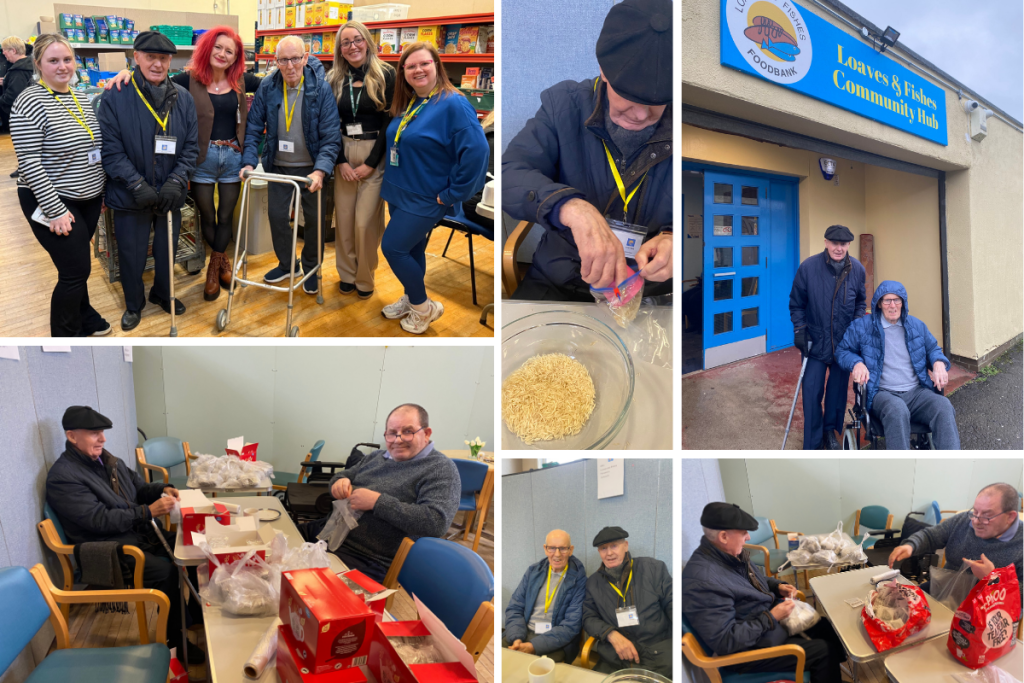
A group of residents have recently begun volunteering at the Loaves and Fishes foodbank in East Kilbride, where they’ve been warmly welcomed by fellow volunteers. The gentlemen involved have particularly enjoyed meeting new people and feeling part of the wider community, helping with practical tasks such as weighing and measuring essential items including sugar, teabags, rice and chocolate.

One resident, Jim, shared how meaningful the experience has been, saying it is “such a worthwhile cause” and that he feels proud to be doing something positive to support the foodbank. The opportunity to give back has brought a real sense of purpose and connection for everyone involved.

Back at Forefaulds, there has been no shortage of fun either. In January, residents enjoyed a lively daytime rave, complete with a DJ, glow sticks, hand stamps and even a few novelty “shots”. The dancefloor was full as music from the 1990s through to today played, including some much‑loved Scottish clubland favourites, creating a fantastic atmosphere and plenty of smiles.

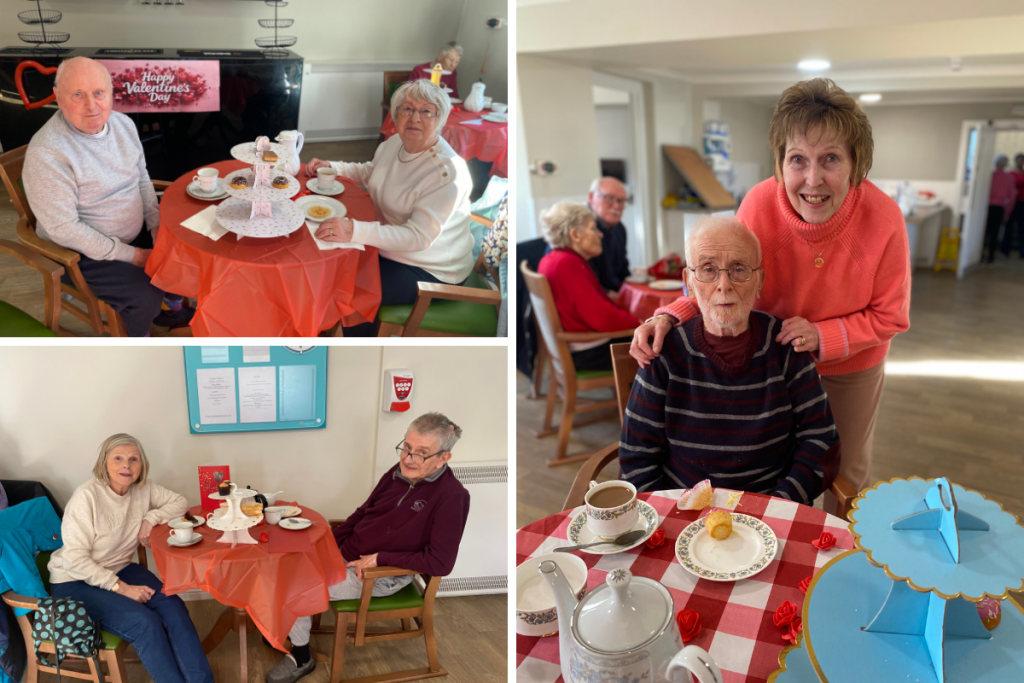
More recently, the home hosted a Valentine’s afternoon tea for residents and their loved ones. Spouses, family members and even a mother and daughter joined residents for a relaxed and romantic afternoon, enjoying delicious food, tea and gentle music. Events like these are always special at Forefaulds, where staff place great importance on creating opportunities for residents to spend meaningful time with family and friends.

Apricity: The warmth that breaks winter: a reflection on social care.

February is a month of thresholds. The earth is still held in winter’s grip, but the light is unmistakably returning. Days stretch by minutes, a shy lengthening, and occasionally, on those rare, crystalline afternoons like the ones we had a couple of weeks ago, the sun breaks through and offers something almost startling: a moment of warmth in the cold.

As regular readers know I’m a sucker for an unusual word, especially old ones which have fallen out of use, and I came across one such just this past week.

Apricity means the warmth of the sun in winter.

It first appeared in the 1620s, likely derived from the Latin verb apricari, meaning “to bask in the sun.” The same Latin root also gives us apricus, meaning “sunny” or “warmed by the sun.” From this root, English formed apricity; a word that flickered into use for a century or two before fading into poetic obscurity.

In essence, apricity describes a gentle, unexpected gift: the way the sun can land on your skin in the cold months and momentarily transform a harsh landscape into something quietly hopeful. It is a word that wraps meteorology in emotion, suggesting not just temperature but soothing relief, renewal, and quiet joy.

It is hard to imagine a better metaphor for the work of social care and the people who deliver it. In a season defined by scarcity, strain, and austerity; in turn a financial winter, emotional winter, political winter – at such a time as we are currently enduring – carers bring warmth that feels improbable, generous, life‑altering.

In the world of social care, apricity appears not as meteorology but as presence.

It is the warmth of the support worker who arrives with humour in their voice despite a long shift.

It is the quiet companionship offered to someone who fears the night.

It is the patience needed to listen, to really listen, when the world moves too quickly for those who can no longer keep pace.

Apricity is found in the everyday: a hand steadying someone’s steps; a cup of tea made just the way they like it; the way a carer remembers their stories, their rhythms, their personhood.

All too sadly these acts do not melt the snows of bureaucracy, nor end the frostbite of underfunding. But they are transformative in their own small, glowing way.

Social care often functions in the coldest parts of society, in places of poverty, loneliness, fragility, and grief. Yet it generates warmth that radiates outward, shaping families, communities, and the national character.

Think of the elderly woman whose world has shrunk to the dimensions of her living room. To her, the home‑care worker is not merely support: they are sunlight breaking through cloud, a reminder that life is still capable of connection.

Or consider the young woman living with complex needs whose support team empower her to take her place in the world: to go to college, nurture friendships, have ambitions. Where once she felt invisible she is now seen.

These are acts of apricity.

They are the winter sun that coaxes life into movement again.

If February’s natural world is shifting toward renewal, perhaps our social care world can do the same. The warmth carers provide is real, but they are themselves often exposed to the cold: low pay, workforce shortages, burnout, and the emotional toll of always giving, always absorbing.

To honour apricity in social care is to ensure the carers themselves are warmed.

That means valuing the emotional labour built into every interaction; it means recognising care as a skilled, relational profession; it is furthered by ensuring fair conditions that allow carers the rest and renewal their work demand, and all of this requires re‑imagining social care not as a cost but as a public, moral, and cultural asset.

Apricity is a gift, but it cannot be taken for granted. Even the winter sun needs a clear sky.

As February slips toward March, the earth prepares for its thaw. The same is needed in Scotland’s approach to social care. The last few weeks following the Scottish Budget which was signed off on Wednesday last, have been bruising and hard and full of moments of a deep lack of awareness and appreciation for the organisations and workers who make up Scotland social care sector. After years of political frostiness; debates frozen between ideologies, reforms stuck in permafrost, perhaps now is the moment to welcome a change of season.

Carers have long been the apricity in our national winter.

It is time we became theirs.

Apricity does not pretend the cold is gone.

It simply reminds us that warmth is still possible.

In the landscape of social care, that is what carers do every day. They offer small, unwavering acts of humanity that break through the bleakness and remind us that even in the hardest months, care is a form of sunlight: steady, life‑giving, and quietly revolutionary.

As February creeps to its ends, let us celebrate the apricity they bring, and work toward building a Scotland where that warmth becomes not a rare winter gift, but the climate we all live in.

Winter Light

Late‑winter light drifts across the quiet ground,

a soft glow settling where the cold once held firm,

the kind of warmth that arrives without announcement,

a reminder that the world still holds gentle surprises.


Shadows loosen their grip as the day unfolds,

and a pale brightness gathers in the stillness;

unhurried, steady, mindful of its own return,

a quiet promise stitched into the turning hours.


In this moment, there is a pulse beneath everything,

a subtle sense of belonging rising from the calm,

teaching that even in the leanest seasons,

light finds a way to begin again.


And as the hours stretch their fingers into evening,

a softer truth becomes visible:

even in the coldest months, renewal begins quietly,

often unnoticed, but always moving forward.

So when the first true warmth settles on your skin,

gentle as a hand placed reassuringly on a shoulder,

may it bring with it the knowledge that nothing stays frozen forever;

that in time, light returns, hearts open, and the deep work of caring

for ourselves, for one another,

is quietly renewed.


Donald Macaskill

Photo by elizabeth on Unsplash

Early Bird Tickets – Care at Home & Housing Support Conference 2026

Early Bird Tickets Now Live for Care at Home & Housing Support Conference 2026

Early Bird tickets are now available for the Care at Home & Housing Support Conference & Exhibition 2026, taking place on Friday 15 May at the Radisson Blu, Glasgow.

With a new conference format and a strong focus on the story of care at home, this year’s event brings the sector together for a day of insight, reflection and connection.

Early Bird rates are available until Friday 3 April:

  • Member: £70 + VAT
  • Non‑Member: £105 + VAT

Standard rates will apply after this date. Places are limited – early booking is recommended.

Find out more and book here

When words come home: Gaelic, memory and the meaning of care

There are moments when language stops being a tool and becomes a refuge.

For me, Gaelic has always been like that. Not simply a language I inherited, but a way of being in the world, one that shaped how my family understood land, kinship, humour, grief and responsibility. It was there in the background of my childhood: half-heard phrases, songs that carried more feeling than explanation, a sense that words could hold people together even when life was hard.

In a previous blog now five years ago I spoke about how I had to be taught English to replace my mixture of twin-speak and Gaelic, of how I missed the cadences and rootedness of my original tongue, and of how my mother’s dementia was shaped by her return to the language of her childhood. I am mindful of all this in the year that the Gaelic language has received official status from the Scottish Government and two days out from the start of Seachdain na Gàidhlig (World Gaelic Week) which runs from 23rd February to the 1st March 2026. It is a Scotland wide and international celebration of Scottish Gaelic language and culture which is funded by Bòrd na Gàidhlig, with events in communities, schools, care settings, arts venues, and online. The theme for 2026 is: “Use It or Lose It / Cleachd i no caill i”

As I have grown older, that sense of language as belonging has deepened in me especially as I watched my own mother live with dementia. The sense of losing language unless it is used is also very pressing as every year without my mother’s Gaelic chats I grow further and further away.

Something remarkable happens as memory frays both with age and especially with dementia. The acquired, professional, socially expected layers of language often fall away first. What remains is older. Deeper. More elemental. For my mother, Gaelic had not disappeared in the way that names, dates or recent events sometimes did. Instead, it returned, even more dominant,  unexpectedly, tenderly, as if the mind, in its own wisdom, retreated to the place where language first felt safe.

This is not nostalgia. It is neurology, identity and care colliding.

During Seachdain na Gàidhlig, we rightly celebrate the living language, its creativity, its resilience, its future. But we also need to speak about its role at the end of life, and in the long, complex middle space of ageing, frailty and cognitive change. Because language is not just about communication. It is about recognition.

To be spoken to in your first language, especially when you are vulnerable, is to be told: you still belong here.

People living with dementia do not lose their personhood. But they do lose the scaffolding that helps them navigate a world built for speed, efficiency and cognitive performance. In those moments, language becomes more than semantics. It becomes emotional geography.

A familiar phrase can calm distress where medication cannot. A song can unlock connection when logic fails. A word spoken with the right rhythm and accent can say you are known in a way no care plan ever could.

This is as true for Gaelic speakers as it is for people whose first language is Urdu, Polish, Cantonese, BSL, Scots, or any other language carried into later life. Scotland is not monolingual in its ageing. Our care systems often behave as if it is.

Cianalas

There is a Gaelic word I keep circling back to as I get older: cianalas.
It is usually translated as homesickness, but the word is larger than that. Cianalas is the ache for what shaped you, the place, the people, the sounds, the blàs (the flavour, the accent) of speech that tells you you belong. It is a longing that is not simply for a geography, but for a known way of being.

In the gentle erosion that dementia brings, I have watched how cianalas moves from the edges of a life to its centre. My mother’s English, the language that carried so many of her adult years slipped away like a tide. But Gaelic did not go far. It returned in the mornings, in the intimacies of care, in the quiet between questions. A phrase. A hymn. The cadence of a blessing half‑remembered. And when a carer answers in kind, even with a few words, even with an approximation of the blàs, recognition sparks. The room settles. The person is seen.

This is not romanticism. It is what so many of us know from lived experience and professional practice: first languages often endure somewhere in the layered self, and when we meet someone in that language, we meet them in a place of safety and identity.

But what happens to language when the system and structures of social care become so pressured and stressed that just as in this past week we read of yet another Health and Care Partnership warning that care will potentially have to be reduced just to those with critical need?

For years, we have spoken about person‑centred care as a moral and professional baseline. But the reality across social care today is stark. Underfunding, workforce shortages and crisis commissioning have narrowed care down to task completion and risk management.

When the system is forced to focus only on what is “critical”, everything relational is framed as optional. A focus on language becomes a “nice to have”. Culture becomes an “extra”. Time becomes the enemy.

And yet, for someone living with dementia, language is not an extra. It is care.

A care plan that captures first language, familiar songs, place‑names; a team who learn basic greetings; signage and small rituals that carry the beul‑aithris (oral tradition) into daily life – these simple acts lowers anxiety, restores dignity, and anchors the self.

I have seen a single line of a psalm do more to soothe than any sedative; a remembered place‑name (An t‑Eilean, An Gleann) restore orientation more quickly than any timetable. These are not luxuries. They are expressions of dignity. But they are precisely the things most at risk when care is reduced to survival mode.

Gaelic carries concepts that modern care policy struggles to articulate. Ideas of belonging, mutual responsibility, and continuity between generations. Words that assume relationship rather than transaction. Care as something done with, not to.

When older people lose access to their language, they are not just losing words. They are losing a moral universe that once made sense of the world.

In a country that is ageing, diverse, and increasingly unequal, this should trouble us deeply.

If we allow the social care crisis to hollow out language, culture and relationship; if we accept a system that only meets “high‑level needs” while neglecting the human ones then we will end up with services that keep people alive but fail to help them live.

Seachdain na Gàidhlig reminds us that languages survive not because they are protected in law, but because they are used in daily life especially in moments of vulnerability.

I leave you with a poem:

Speak to me
not only so I understand,
but so I am recognised.

When my words come slowly,
meet me there.
When they come from another time,
do not correct them,
walk with them.

Care is not the task you finish,
but the person you remain with
when the task is done.

If we forget this,
we will build places
where bodies are kept safe
and selves are quietly lost.

Listen.
The language is still here.
It is asking
to be answered.


Donald Macaskill

Long-Term Care Workforce Webinar – 24 Feb 2026

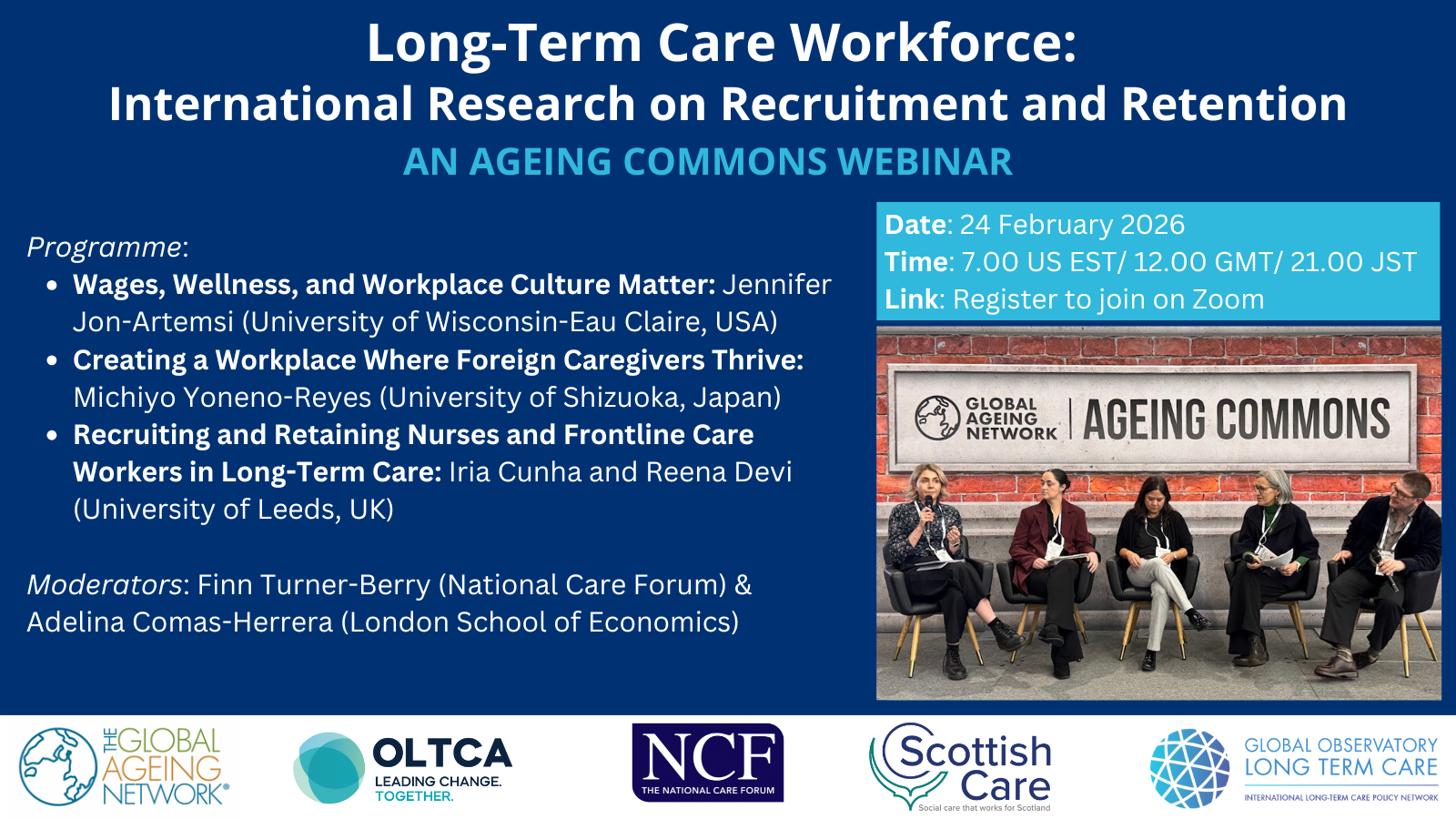
Long-Term Care Workforce: International Research on Recruitment and Retention

An Ageing Commons Webinar

Date: 24 February 2026

Time: 7.00 US EST/ 12.00 GMT/ 21.00 JST, you can check your local time here

Link: Register to join on  Zoom

This webinar is part of a Global Virtual Roundtable series organised in partnership by the Global Ageing Network, National Care Forum, Scottish Care, Ontario Long Term Care Association and the Global Observatory of Long-Term Care, building on the Ageing Commons format. We aim to bring together researchers, providers, workforce leaders, and practitioners from around the world to explore one of the most urgent challenges in long-term care: building and sustaining a strong workforce while maintaining quality of life and quality of care.

The key question we are addressing is: How can long-term care providers retain good workers while supporting quality of life for both staff and those they serve?

In this 60 minute webinar we’ll explore research findings from the USA, Japan and the UK.

Programme:

  • Wages, Wellness, and Workplace Culture Matter, Jennifer Johs-Artisensi (University of Wisconsin-Eau Claire, USA)
  • Creating a Workplace Where Foreign Caregivers Thrive, Michiyo Yoneno-Reyes (University of Shizuoka, Japan)
  • Recruiting and retaining nurses and frontline care workers in Long-Term Care: A REACH Realist Review, Iria Cunha and Reena Revi (University of Leeds, UK)

Moderators: Finn Turner-Berry (National Care Forum) & Adelina Comas-Herrera (London School of Economics and Political Science)

At the rim of the world: Love in the world of care.

Love is not a word you will find in most policy documents. It does not feature in strategic frameworks, regulatory standards, or workforce planning spreadsheets. It is too soft, too subjective, too human. It resists the tidy categorisation of outcomes or indicators.

Yet, walk into any care home, supported living service, or the home of someone receiving daily support, and you will find love everywhere. Not the commercialised romance that dominates 14th February each year, but the quieter, sturdier forms of love: presence, patience, kindness, fidelity, and regard. These are not sentimental extras. They are the hidden architecture on which good care depends.

We speak of care as if it were primarily a task, something to be delivered, commissioned, or purchased. We live in a time when so much of care is framed through metrics: minutes allocated, tasks completed, regulations checked. These things matter because they provide structure and accountability, but they do not reveal the soul of care. They cannot. Because the soul of care is relational. It lives in the space between people. It is the meeting of one human being with another at a point of need or vulnerability. And it is love, in its broadest and most elemental sense, that makes this meeting transformative rather than transactional.

To name love explicitly in this context is not sentimental. It is honest. It is professional. It is human.

Love appears in the way a carer notices the slight change in a resident’s breathing. In the way a support worker sits quietly with someone in the distressing confusion of dementia. In the way a team keeps vigil at the bedside of a person approaching the end of their life. In the way families entrust their mother, father, partner or child to the hands of strangers who, over time, become companions.

None of these fits easily on a procurement form.

In recent years, we have become braver in acknowledging that the emotional labour of social care is real labour; skilled, demanding, draining, and profoundly important. But we still hesitate to name love as part of that skill set. Perhaps we fear sentimentality. Perhaps we worry that invoking love will weaken the professional boundaries we have so carefully crafted. Or perhaps we are uneasy with the idea that a system so chronically underfunded depends on something as immeasurable as the human heart.

But naming love does not diminish professionalism; it deepens it. It reminds us that care is not simply a service but part of the moral fabric of society. Love is what roots dignity. It is what honours the personhood of individuals who may have lost speech, memory, mobility, or independence. Love refuses to reduce people to tasks, conditions, or risks. It insists that each person is deserving of attention, respect, and warmth.

I have long believed that the crisis in social care is not only a funding crisis, workforce crisis, or demographic crisis. It is also a crisis of imagination. We have forgotten that systems exist to serve human beings, and not the other way around. If love were recognised as a central component of care, we might design our structures differently. We might prioritise time over throughput. We might value continuity of relationship rather than the cheapest unit cost. We might reward the emotional intelligence required to soothe, reassure, and accompany.

Love, after all, is not free. It requires time, training, support, reflection, and fair pay. It requires leaders who understand the emotional ecosystems of their services. It requires political leaders courageous enough to speak not only of budgets and efficiencies, but of the ethical duty we owe one another.

Love is costly. It demands presence, patience, resilience, and vulnerability. It asks carers to carry the stories of others as gently as their own. It asks families to trust strangers who will become companions. It asks society to honour those at the margins, not with pity, but with regard.

And perhaps, if we are truly bold, it requires us to rethink what we consider to be success. A life well supported may not be measured in metrics, but in moments of connection: the smile that returns after days of silence; the shared memory that breaks through the fog of dementia; the comfort of being held, known, and not abandoned.

And when love is absent? We see loneliness deepen. We see distress unaddressed. We see people reduced to tasks and time slots. We see a system that may function on paper but fails in humanity.

This Valentine’s Day, while the world trades roses and declarations, it is worth pausing to honour the quieter forms of love that shape the everyday practice of care across Scotland. The love that is expressed in touch, tone, patience, and presence. The love that sustains people at their most fragile. The love that is given freely, but not without cost. The love that sustains social care in Scotland through long nights, under immense pressure, in moments of grief and in moments of joy.

Love may never appear in the formal architecture of our social care system. But without it, nothing holds. Love is not the soft centre of care. It is the structure. Love is the architecture.

As I reflect on the central argument of this piece; that love is the hidden architecture of care, I’m drawn again to the clarity of our poets. Naomi Mitchison, was a woman of fierce humanity and political tenderness, and in her work, she names love as a kind of ballast: a weight that keeps the world from spinning apart. Her steady, grounded lines feel perfectly at home in the landscape of care.

She understood that love and belonging are often expressed not in grand gestures, but in the small acts that hold people in relationship with one another. Her voice reminds us that care is built from these daily, patient continuities.

So it feels right to close with Mitchison’s poem,  a reminder that love does the quiet work of holding things together, in poetry as in care.

“Love Poem”

Naomi Mitchison

Love, like a stone at the rim of the world,
Holds the edge of things together;
It is the weight that keeps the sky from falling,
The stillness that steadies the weather.

Not loud, not sudden, not possessed,
But patient as the turning sea;
Love is the thing we build with daily,
And the thing that builds us, quietly.

Donald Macaskill.

Photo by Mayur Gala on Unsplash

Scottish Care responds to social care Living Wage funding announcement

Today’s announcement by the Scottish Government of £20 million to address the funding gap in paying social care workers the Real Living Wage is a welcome and necessary intervention.

This decision recognises what providers, workers, local government and trade unions have been consistently clear about: the workforce is the heart of social care, and failure to properly fund the Real Living Wage places both staff and the sustainability of services at unacceptable risk.

While this funding will not, on its own, resolve the wider and deep-rooted challenges facing the sector, it is an essential step in the right direction. Ensuring that social care workers are paid fairly for their skilled, compassionate and vital work is fundamental to retaining staff, maintaining safe services, and supporting the wider health and care system.

We are grateful to all those who have stood alongside us in recent days to raise the urgency of this issue, including colleagues in local government, other provider bodies and trade unions. The collective voice of the sector has been instrumental in ensuring the seriousness of the funding gap and its consequences were clearly understood.

However, it is also important to acknowledge that the situation should not have arisen in this way. The lack of consultation and the unilateral approach to funding decisions have caused real anxiety for providers and workers alike, and have placed unnecessary strain on services already under significant pressure. The recent treatment of the workforce has been regrettable, and must not be repeated.

This announcement must now be seen as a foundation, not a conclusion. Much more will be required to address the true cost of care, ensure fair and transparent commissioning, and secure the long-term sustainability of social care services across Scotland. We remain committed to working constructively with the Scottish Government, COSLA and wider partners to achieve a system that properly values social care and those who deliver it every day.

Read the Scottish Government Budget update here: Budget agreement secured – gov.scot

A sense of betrayal: social care and the SNP Government.

There are moments in public life when the gap between rhetoric and reality becomes so wide that it can no longer be bridged by warm words, sympathetic tones, or polished political narratives. The Scottish Government’s 2026–27 Budget is one such moment. It speaks the language of dignity, rights and fairness, yet delivers a settlement that undermines all three. For those who work in social care, and even more critically, those who depend upon it, this Budget is not simply inadequate. It is to put it frankly, a betrayal.

The tenth anniversary of me doing this job as the CEO of Scottish Care comes on the 1st April. I remember it well because on the 1st April 2016 the ground-breaking and at the time dramatically innovative commitment of the then Scottish Government to pay all care workers the Real Living Wage (or as we used to call it the Scottish Living Wage) came into force. Indeed one of my first tasks as CEO, was a radio interview to laud the game-changing nature of this action. But even then, although it valued workers, we all recognised it was a first step on a journey towards the proper reward and renumeration our critical frontline care workforce deserved. Along with many others I had been involved for months in the planning for the day and in ensuring there was sufficient funds in place. We didn’t get it completely right, and there remains huge issues f equity not least at local government level, but it was a great first step. Roll on ten years and we have a very different set of behaviours at play in the current Scottish Government.

The Real Living Wage: a promise broken

The Real Living Wage was meant to be a baseline of decency, a statement that Scotland values the people who provide intimate, skilled and emotionally demanding care. It has been a continual commitment of successive administrations. Yet the latest Budget fails to fund this commitment. COSLA described the Budget a failure “to fully fund… the Real Living Wage to workers in Adult Social Care”, leaving local authorities to absorb the difference.

The consequences are profound.

Social care organisations, particularly independent, charitable and small providers, cannot magic up unfunded wages. They operate on ultra‑thin margins, with fee rates set by local authorities. When government increases wage expectations without increasing funding, providers must either cut services, reduce hours, freeze recruitment, or hand back contracts. This is not hypothetical. It is already happening.

And all this means that staff who are continually told they are valued, are denied the means to live. Frontline workers hear ministers praise them as heroes while watching other sectors achieve pay rises. Without funded differentials, experienced workers earn the same as new entrants. Without stable contracts and predictable hours, workers juggle shifts to pay the rent. Without respect reflected in pay, they leave.

Every unfunded wage rise becomes a cut in disguise: shorter visits, inconsistent staff, unmet need, closed services, exhausted families. The Budget may never state it in writing, but this is how human rights erode, not by decision, but by neglect. And the human rights of those who use social care in Scotland have been run into the ground.

Government cannot meaningfully claim commitment to social care while shifting the financial goalposts year after year.

This is not partnership. It is the slow extraction of responsibility from government onto providers, workers and unpaid carers, cloaked in the language of “efficiency” and “local flexibility”.

The result is that councils will be forced to raise council tax; services are being trimmed to statutory minimum; community supports are being hollowed out and the most vulnerable and valuable of our citizens are being left with fewer options and longer waits.

Scottish Care’s verdict is unambiguous: “This Budget fails the people who rely on social care support – and those who deliver it.”

This failure is not abstract; it is personal. It touches so many lives.

It means older people waiting months for assessments and years for packages of care and support. When providers cannot recruit because pay is uncompetitive, packages do not start. People deteriorate. Families burn out. Hospitals fill.

It means people with disabilities whose independence depends on stable care relationships have their very autonomy undermined because of inconsistent staffing, driven by poor wages and high turnover, all of which puts their lives at risk.

It means unpaid carers are continually being stretched past breaking point. Shared Care Scotland and the National Carer Organisations highlight the absence of clear investment in short breaks, respite and local support organisations. These omissions are not oversights; they are choices.

It means that workers cannot afford to stay and cannot afford to leave. They hold lives in their hands daily, supporting complex care, offering emotional labour, and carrying profound responsibility and yet they are told, through this Budget, that their worth is negotiable.

Now I know that a Government Minister or spokesperson will give the oft quoted statement about ‘record’ investment. Indeed, ministers have presented the Budget as delivering a “record” £22.5 billion for health and social care and a “record settlement” for local government. But this narrative dissolves when placed beside the truth which is no full funding for the Real Living Wage policy for adult social care, children’s social care, or early learning and childcare.

These headline figures create the illusion of investment while disguising the truth: frontline social care does not feel “record” anything. It feels cut, stretched and disregarded.

If the Government truly believed in social care, the Budget would have:

  • Fully funded the Real Living Wage, including progression and differentials.
  • Provided ring‑fenced, multi‑year social care funding aligned to evidence‑based cost‑of‑care models.
  • Invested in ethical digital transformation rather than delaying core infrastructure until 2029.
  • Protected and expanded community‑based supports that keep people well.

These actions would stabilise the system, honour the workforce, and safeguard human rights.

The 2026–27 Budget represents a deliberate political choice: to underfund social care while claiming otherwise. It asks the workforce to bear the burden of government decisions. It asks families to fill the gaps left by inadequate planning. It asks providers to deliver more with less until they collapse. It makes clear that this Government no longer funds the Real Living Wage for frontline carers.

But most of all, it asks the people who need support to wait. To cope. To endure.

That is not dignity. It is not fairness. It is not Scotland at its best.

It is a betrayal—and it must not stand.

Donald Macaskill

Photo by Sarah Agnew on Unsplash

Scottish Care highlights Real Living Wage funding crisis in Care at Home & Housing Support

Scottish Care has today released a new Real Living Wage (RLW) and Sustainability Briefing Pack outlining the growing financial pressures facing Scotland’s Care at Home and Housing Support sector. The publication accompanies a national media statement highlighting the urgent need for government action to protect essential community care services and the workforce who deliver them.

A widening gap between costs and funding

Care providers across Scotland are grappling with significant financial strain following the Scottish Government’s recent unilateral change to how the RLW uplift is calculated.

This change—made without consultation with COSLA, providers or trade unions—has created an estimated £19 million shortfall in funding. The revised approach places the burden of rising wages onto providers while contract rates remain too low to cover the true cost of delivering care.

This funding gap is deepening instability across the sector. Many providers report that they are struggling to maintain financial viability, absorb statutory workforce costs, and protect service quality.

Systemic pressures beyond the RLW uplift

The briefing highlights wider structural challenges that continue to undermine the sustainability of social care services, including:

  • Opaque commissioning and procurement practices by local authorities, leading to inconsistent rates and unpredictable referrals
  • Chronic underfunding of care at home services
  • Delayed payments and uplifts that do not match statutory wage increases
  • Growing financial risks, pushing some providers to withdraw from publicly funded care
  • Unequal access to care arising from inconsistent local decision‑making

These pressures threaten both provider resilience and the continuity of care for individuals and families who rely on community‑based support every day.

Growing evidence of a sector at breaking point

Scottish Care’s own research reinforces a clear and concerning pattern:

  • Wage pressures are rising faster than contract uplifts
  • Many providers now operate at break‑even or at a loss
  • Chronic underinvestment is increasing the risk of service reduction or withdrawal
  • Variability between local authority practices is eroding fairness and stability

Collectively, this evidence strengthens the case for coordinated national action.

Scottish Care’s call to government

In our media statement, Scottish Care emphasises that the current funding model is unsustainable and places providers “in an impossible position”. We are calling for:

  • Restoration of sufficient RLW funding
  • Transparent, consistent commissioning across Scotland
  • Contract uplifts that reflect the real cost of delivering care
  • A sustainability mitigation plan to protect services and the workforce

Without urgent intervention, the sector faces increasing instability, workforce insecurity, and risks to the continuity and quality of care.

Access the full briefing

The full Care at Home & Housing Support RLW/Sustainability Briefing Pack (February 2026) can be accessed here: https://scottishcare.org/wp-content/uploads/2026/02/SRLW-CAH-BRIEFING-PACK-04-02-26.pdf

Scottish Care members can access a comprehensive Advocacy Pack via the Members Section of the website.

For further information, please contact Scottish Care at [email protected] or 01292 270240.