This year’s Summer bulletin has now been published online and is available to view.
We will not be sending out physical copies of the Bulletin due to Covid-19, this edition is in a digital format instead.
Final Summer Bulletin 2021-compressedThis year’s Summer bulletin has now been published online and is available to view.
We will not be sending out physical copies of the Bulletin due to Covid-19, this edition is in a digital format instead.
Final Summer Bulletin 2021-compressedThis week sees the relaunch for the Stay in Scotland campaign, encouraging EU citizens to apply to the UK Government’s EU Settlement Scheme.
EU Citizens living in Scotland, who have not yet applied, are being urged to apply now to avoid missing the deadline of 30 June, so they can carry on living, working and studying in Scotland. Irish citizens and people with indefinite leave to remain do not have to apply.
The Stay in Scotland campaign is being run from this week until 30th June on radio, digital, social, and press.
How You Can Help
Stakeholder Assets
Digital and printable assets providing information and signposting to available support are available via gov.scot, and include:
We note the publication of data relating to care home deaths by both the Care Inspectorate and by National Records Scotland.
This data demonstrates the terrible toll taken by Coronavirus upon those who live, visit loved ones, and work in care homes.
Hundreds of people died during the early stages of the pandemic when a lot less was known about the virus than is known now. We have heard from the Scottish Government, acknowledgment that ‘mistakes’ were made in ensuring that care homes were as ready as they could be to receive the hundreds of people who were discharged from NHS hospitals.
We very much regret that due care and attention was not paid in sufficient depth to the needs of the care sector when compared to the preparation given to and focus upon the NHS. Social care as a whole was let down in the early stages of the pandemic, not least by the failures to introduce testing of staff and residents at an earlier stage.
We are also aware of the extent to which we now know a lot more about the risk of asymptomatic spread of the virus, the risk of airborne infection and the importance of using additional PPE in order to protect staff and residents.
It is testimony to the lessons learned and the improvements in practice that have occurred since the first wave that the second wave resulted in so many fewer deaths.
Nevertheless, as was the case in early March 2020 and is still the case today even with vaccination protection, it is a fact that the most vulnerable, the very frail and old, in other words the population of our care homes, were and are at the greatest risk of Covid-19.
The numbers published today do not describe the sad reality that those living in group and congregated settings such as care homes have been disproportionately affected across the world. They do not describe the reality that those who have suffered the most and who have died across the world are those who are very old and frail, and those living with multiple co-morbidities.
The published data indicates more detail on geographical location and spread, the size of the care home, the home operator and the quality of the care home. What it shows is that there are very few lessons which can be drawn from the data in terms of virus impact other than perhaps the size of the care home increasing the risk of infection, the lack of testing and knowledge of asymptomatic spread. Indeed, size of home is an uncertain determinant because larger homes are almost always ones which support those with advanced needs, greater acuity and frailty, and have as a result a more vulnerable and at-risk population. This virus has hit hard against all types of operators, whether public, private or charitable.
There have been too many lives which have been cut short before their time by a deadly virus. Behind each number is an individual who is loved and greatly missed by family and friends. Their loss is felt also by care home staff who have cared for and supported them for many months and years.
The numbers of deaths tell part of the story but what they certainly do not tell of is the amazing professionalism, sacrifice and dedication of frontline nursing and care staff who daily put themselves at risk and on the line to protect some of our most vulnerable citizens facing the threat of this deadly global virus.
As we consider the numbers and reflect on this data, we remember all the lives lost and the dedication of those who worked to save life. As we consider the numbers, we would ask everyone to reach out to support the care homes, staff, residents and families affected and to do so with compassion and solidarity.
It is our earnest hope that the use of this data by commentators, media and politicians will be sensitive and respectful. Lessons have been and will continue to be learned about the impact of this virus on our care homes, but in so doing we must all of us seek to support the women and men who continue to be residents, their families and those who work in our care homes.
Ends./
Camphill Scotland, the Health and Social Care Alliance Scotland (the ALLIANCE), Scottish Care, Sense Scotland and the Scottish Youth Parliament have today [21 May 2021] written to the First Minister requesting that the Scottish Government hosts, as a matter of urgency, a National Summit to address the impact of Covid-19 upon disabled people, including people with learning disabilities.
Our organisations represent, and work on behalf of, thousands of disabled people, and are aware that Covid-19 is having a significant, and often disproportionate, impact upon disabled people across Scotland. We, therefore, believe there is an urgent need for the Scottish Government to host a National Summit to address how the welfare, wellbeing and rights of disabled people will be prioritised and protected by the new Scottish Government in the face of Covid-19, and its ongoing impact.
A National Summit is vital to address issues such as the impact of Covid-19 and the lockdown restrictions upon disabled people and their families and other carers, on safeguarding, on care and support, including access to day services, on the availability of health services, on access to transport and to other key infrastructure, as well as issues around mental health and wellbeing, and tackling social isolation and loneliness. In addition, the impact of Covid-19 has underlined the need for a Commissioner for Disabled People to ensure that the rights of disabled people are fully understood and protected, an issue which should also be considered by the National Summit.
Emma Walker, Director, Camphill Scotland said:
“COVID-19 has highlighted deeply entrenched discrimination-by-design practices across our society, and it has also created new barriers to equal citizenship. The rights of disabled people should have been at the forefront of the pandemic response. Instead we saw the long-term and immediate cancellations of much-needed (and safe) services, a lack of communication between decision makers and disabled people, and severe impacts on disabled people’s mental health and wellbeing.
A rights-based and inclusive national summit with disabled people at the forefront of decision-making for pandemic recovery is imperative. We must ensure that the rights of disabled people are protected and championed, now more than ever, and we invite the Scottish Government to explore the need for a Commissioner for Disabled People at the earliest opportunity.”
Professor Ian Welsh OBE, Chief Executive, Health and Social Care Alliance Scotland (the ALLIANCE) said:
“COVID-19 has had a profound impact on disabled people and on the Scottish health and social care sector. A range of issues have been highlighted and exacerbated, for example the reduction and removal of a significant proportion of social care packages, despite Scottish Government guidance and resources to continue support.
“It is clear that action is needed to safeguard the rights and interests of disabled people, people living with long term conditions and unpaid carers as a result of the issues presented by the COVID-19 pandemic. A national summit taking a rights-based approach, and co-produced with civic society is an ideal first step in addressing these issues, as well as supporting future improvement.”
Dr Donald Macaskill, Chief Executive of Scottish Care, commented:
“As we continue to live with the challenges of the pandemic it has become ever more important that we spend time to focus on the unique experience of those living with disabilities in our communities. As the representative body for many providers of social care support in care home and in homecare we are very aware at first hand of the urgent need to address the ongoing challenges faced by so many of our fellow citizens. A National Summit will be an important contribution to enabling people to be heard, priorities to be identified and actions to be started.”
Angela Bonomy, Executive Director of Sense Scotland, said:
“Life under lockdown has been really tough for families, with many at breaking point: they had no chance of respite from their caring responsibilities and no opportunity to give their loved ones the comfort of their normal routine, access to the activities they love or even time with friends. All of this has a very real and lasting impact on the whole family.
We have recently elected Scotland’s most diverse Parliament – one that better reflects the society in which we live. Our hope is that our representatives in Parliament not only listen to the voices of disabled people and their families but help amplify those voices in their policy-making and decisions. A National Summit would be a positive first step in understanding what matters to disabled people and their families.”
Aaran McDonald MSYP, Trustee of the Scottish Youth Parliament said:
“The impacts of the COVID-19 pandemic have not been felt equally, and many young disabled people have been disproportionately affected. The beginning of the new Parliamentary term is an opportunity to urgently address the unequal way in which the impacts of the pandemic have been felt. Holding a National Summit will create opportunities for the Scottish Government to hear from those disabled people, their families, and other carers with lived experience and find ways to prioritise their rights in the recovery.”
Scottish Care hosted a webinar to launch ‘Coileanadh’ on Thursday 20th May, 2PM. This session was hosted by Technology & Digital Innovation Lead, Dr Tara French and Policy & Research Officer, Imogen Caird.
‘Coileanadh’ is the output of the ‘Building our collective care future’ programme and articulates a change landscape for social care that embodies the contributions of a diverse range of expertise and experiences from providers, staff, people supported, families and wider partners in care and support in Scotland.
The priorities that have emerged through collectively developing a positive vision reinforce the essential contribution of relationships, partnerships and societal engagement to understand and support the health, social and wellbeing needs and aspirations of our communities and population.
Thank you to everyone who joined us in celebrating this work and helped contribute to taking forward this future change landscape in practice.
Launch materials: https://scottishcare.org/wp-content/uploads/2021/03/Coileanadh-SocialCare-FutureLandscape.pdf
The recording from this webinar session is now available below.
The new report of the Mental Welfare Commission, ‘Authority to Discharge’, which examines the issue of decision-making for people in hospital who lack capacity and their discharge from hospitals to care homes from March to May 2020 makes for disturbing reading.
Its identification of very real knowledge and skills gaps in discharge practice from hospital to care homes and the community should be a matter of very real concern. Of perhaps even greater concern is the analysis that failures were happening even before the start of the pandemic.
Organisations like Scottish Care have long argued that it is critical that we reform our processes around discharge from hospital, especially for those who may have diminished or fluctuating capacity. This means we need to involve families, relatives and staff from care homes and homecare at a much earlier stage in decision-making.
There are simply too many instances where decisions are being made with a limited knowledge of the best interests and needs of the person involved. A professional knows best attitude has no place in modern care and support. That is regrettable at any time but especially so during a pandemic.
It is important that the eight recommendations of the Report are put into practice but we must go even further so that we arrive at a stage where no-one with reduced capacity does not have people in their corner to advocate on their behalf.
After years of training and learning budgets being reduced or even stripped away in social care contracts it is critical that we invest resource in making sure all staff know not just the letter of the law but what good human rights-based practice really looks like.
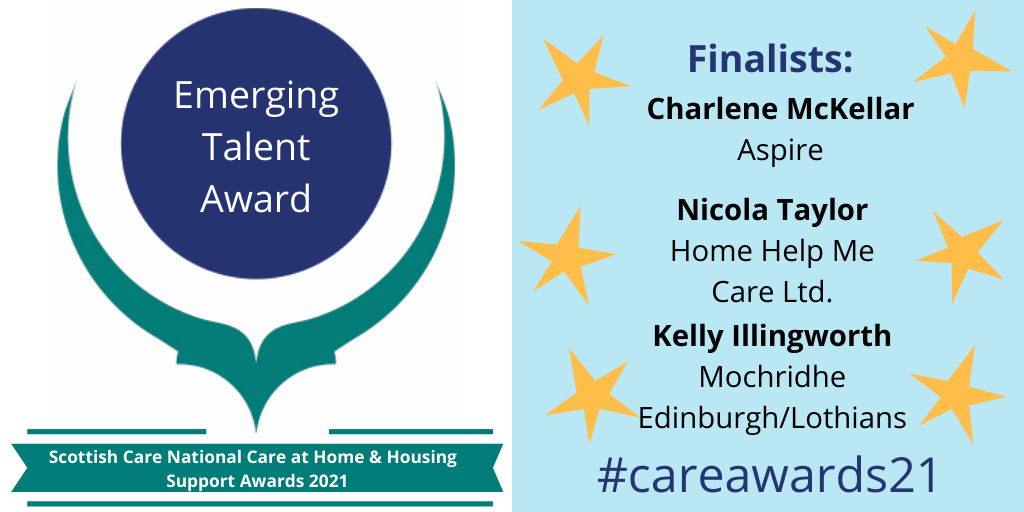
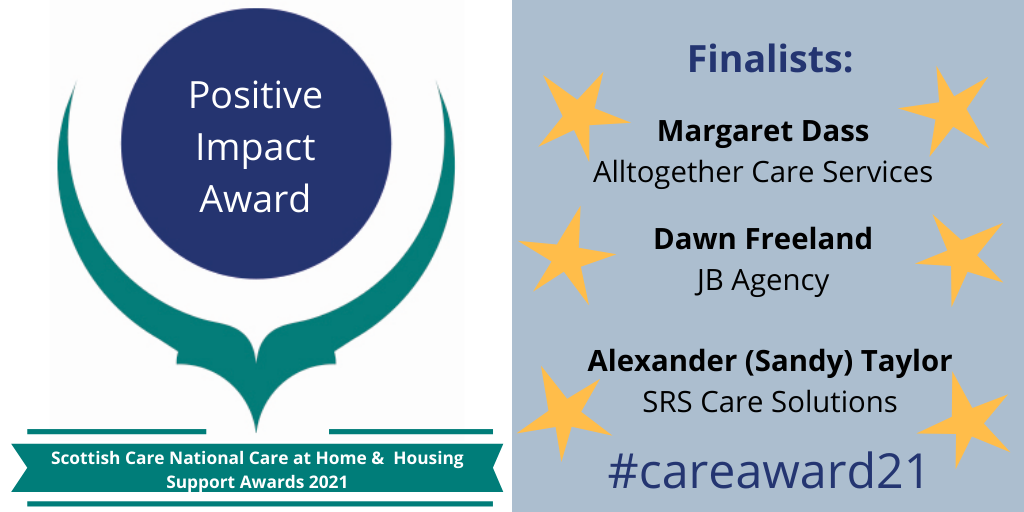
The Scottish Care team has taken the decision to extend the deadline to submit nominations to our Care at Home & Housing Support Awards 2021.
The new deadline is Monday 24 May, 9am.
This is the perfect opportunity to recognise the workforce in this sector who work tirelessly day and night to provide care to individuals throughout the country and celebrate the achievements of clients and service users. So, if you have any individuals or teams in mind, please take your time to put them forward.
The awards ceremony itself will be held on virtually on Friday 25 June 2021.
There are 10 different award categories to enter including:
We urge you to put in your nominations, as it’s very important for us to give recognition to this often undervalued sector.
Additional guidance on residents’ outings away from the care home has been published by the Scottish Government today (17 May 2021).
Following the publication of Open with Care in February 2021, this document provides further guidance around care home residents leaving the care home for meaningful contact or activities.
This guidance is available on: https://www.gov.scot/publications/coronavirus-covid-19-adult-care-homes-visiting-guidance/
Today, Monday May 17, 2021, we are delighted to launch ‘Coileanadh’ – the output of phase two of our ‘Collective Care Future’ programme. We are delighted to launch the findings of this programme, articulated in a future change landscape created in collaboration with Andthen, a design strategy studio. The visual landscape embodies the contributions of a diverse range of expertise and experiences from providers, staff, people supported, families and wider partners in care and support in Scotland. The findings include eight concepts and three priority areas of focus relating to the overarching philosophy and culture, the policy and partnership enablers, and the way in which change can be enacted in social care practice.
We invite you to explore the future change landscape, concepts and the actions for change identified and join us for the webinar launch on Thursday May 20th 2pm where we will share the findings and outline how we plan to continue the conversation around a National Care Framework.
‘Building our collective care future’ is a collaborative programme which commenced in June 2020 with the intention of capturing the experiences of social care during COVID-19 to build on this learning towards developing a positive vision for the future social care.
The insights and expertise shared from our engagements have been translated to inform actions that can allow decision-making and change to materialise, which will be invaluable to key stakeholders at local and national levels. The 39 actions roadmap the ways in which practice-based change can be achieved, implemented and sustained, resulting in a more equal, rights-based and wellbeing focussed society.
We believe the actions identified are both complementary and distinct to the recommendations of the Independent Review of Adult Social Care. ‘Coileanadh’ explores the synergies and areas of opportunity that can help to overcome the implementation gap and articulate the key requirements of a National Care Service, what we refer to as a National Care Framework. In doing so, we aim to offer a more holistic perspective on the creation of a National Care Framework and the resulting implications for how work in this context could be taken forward. The relationship and interdependence of social care and health highlights the need for a broader view that encompasses different ways to how we approach care and support across the life course and we hope that this work is the start of a national conversation on the future of adult social care in Scotland.
If you would like to share any feedback on the findings or ways in which you can contribute to the actions identified, please contact: [email protected]
Sincere thanks to all our participants, Scottish Care members and colleagues who contributed their expertise and experiences across the ‘Care Futures’ programme.
Details to register to attend the ‘Coileanadh’ webinar:
Thursday 20th May, 2:00PM
Registration link: https://us02web.zoom.us/webinar/register/WN_Z-_vQlF1S86q7fyWB-HDVg
Webinar ID: 844 4924 6803
Launch materials
Full document: https://scottishcare.org/wp-content/uploads/2021/03/Coileanadh-SocialCare-FutureLandscape.pdf


Terms & Conditions
Website Design by Creo Design part of the Solutions On Demand Group 2022. All rights reserved