Statement on the responsible use of generative AI in social care published

Artificial Intelligence (‘AI’) offers many opportunities and potential benefits to adult social care. Generative AI, such as Large Language Models (LLMs) that power AI chatbots, can aid with various tasks in social care.  However, many activities in social care directly touch on peoples’ human rights and wellbeing. At this point of time, there are no guidelines for people using social care services, care providers including family carers, tech developers or organisations integrating AI chatbots into their services, commissioners etc. on what responsible use of generative AI in social care entails.

On the 1st of February 2024, representatives of thirty organisations and individuals working in Adult Social Care met at the University of Oxford, Reuben College, to discuss the benefits and risks of using ‘generative AI’ in social care. The event was the first in a series of “AI in adult social care” roundtable events organised by Dr Caroline Green at the University of Oxford Institute for Ethics in AI, Reuben College, the Digital Care Hub and Casson Consulting.

The aim of the event was to articulate a collective understanding of generative AI’s role in social care settings and to discuss its challenges, benefits and viable use cases. There was a core focus on what would constitute responsible and ethical use of this emerging technology.

Following the event, a statement has been published which Scottish Care is delighted to endorse.

The statement outlines the need for robust and rapid work to co-produce actional guidelines for appropriate usage and deployment of generative AI in social care. In addition, it commits the group to engaging in a co-production and consultation process drawing in more people and organisations in social care.

Read the full statement here.

Dr Caroline Green from the Institute for Ethics in AI said:

“Adult social care is about supporting people to live independently and to protect fundamental human rights. Generative AI offers many potential benefits and opportunities to adult social care. However, the rapid development and wide availability of generative AI, such as AI chatbots, is a concern when it comes to use cases in adult social care settings because some fundamental values defining what quality care looks like are at stake if such technology is used inappropriately. We therefore need to address the gap of knowledge and guidance around generative AI quickly, involving all groups of people who are affected and working in social care provision”

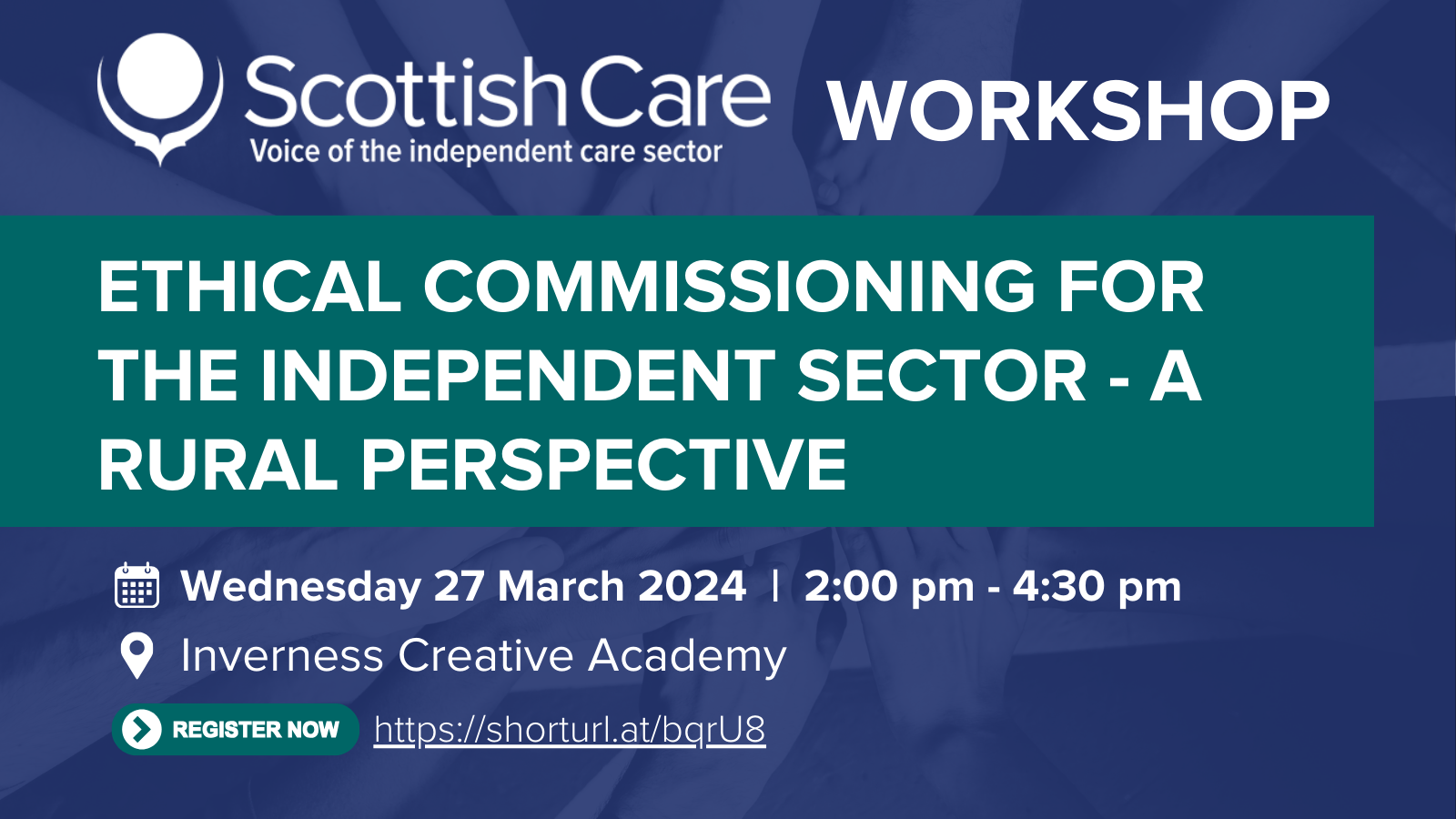
Workshop Invitation: Ethical Commissioning for the Independent Sector – A Rural Perspective

How can ethical commissioning support the unique care needs of rural communities?

Scottish Care members and other interested stakeholders are invited to a bespoke workshop session on 27 March 2024, from 14:00 – 16:30, at the Inverness Creative Academy.

As part of a roundtable and Q & A session, you are invited to learn from and share your experiences with expert local stakeholders from NHS Highland and Scottish Care, on:

  • Barriers and levels to care delivery within rural and island communities
  • Cases of good commissioning practice across the locality
  • Ways to support the ongoing participation of rural/highland communities within the NCS/commissioning discussion

Spaces are available to book, free of charge, through Eventbrite.

The session will come with teas, coffees and snacks, and do let us know us any dietary and/or accessibility requirements.

Ai and social care: towards a human rights approach.

On the 1st of February 2024, representatives of thirty organisations and individuals working in Adult Social Care met at the University of Oxford to discuss the benefits and risks of using ‘generative AI’ in social care. I was pleased to be part of the event organised by the University of Oxford Institute for Ethics in AI, the Digital Care Hub and Casson Consulting. 

I have written a bit over the years about Ai and most recently have reflected upon the potential of chat bots as well as the limitations of their use in social care. What is inescapable is that generative Ai is already being used to a not insignificant extent within the care sector, especially in assessment and care planning.

There are numerous responses to the development and introduction of innovative technologies. Put simplistically one response to all this is to resist and prevent – the expressed concerns around the risks of Ai removing that which is uniquely human, of it supplanting identity, were the same concerns aired in the early stages of human transplant surgery – yet those procedures have become normative today. One position, therefore, is to resist, challenge and remove new technologies. However, resistance and bans rarely work. Another response is to welcome with unbridled evangelical enthusiasm and a lack of critique.

Both positions, I would suggest are erroneous, and therefore my starting premise, is that faced with the inevitably of developments and further ‘progress’ we must develop frameworks and approaches that ensure that technology serves the public good, in an equitable, inclusive, and rights-based manner. It is essential not least in the most human of human industries, for social care, that it is critical to ask questions, raise concerns, balance risks, and adapt or adjust to accommodate cultural and societal technological mores. Concerns around privacy, the use of data, the centrality of individual choice and the advancing of the individual in person-led care and support can only be addressed through dialogue and mutual design development.

For me a critical starting point has to be a human rights-based approach to Ai and yet certainly for its application in social care there is a dearth of both research and writing on what a human rights-based approach to the use of Ai might look like. I offer one or two thoughts in this blog.

Many readers will be familiar with the PANEL principles which are the bread and butter of many human rights dialogues and models. The acronym means Participation, Accountability, Non-discrimination, Empowerment and Legality.

  • Participation – People should be involved in decisions that affect their rights
  • Accountability – There should be monitoring of how people’s rights are being affected, as well as remedies when things go wrong
  • Non-Discrimination – Nobody should be treated unfairly because of their age, gender, ethnicity, disability, religion or belief, sexual orientation or gender identity. People who face the biggest barriers to realising their rights should be prioritised when it comes to taking action
  • Empowerment – Everyone should understand their rights and be fully supported to take part in developing policy and practices which affect their lives, and
  • Legality – Approaches should be grounded in the legal rights that are set out in domestic and/or international law.

So what might PANEL mean for Ai and social care?

Participation – from the moment of design, through application and use, to evaluation and assessment Ai in a social care context must evidence the intrinsic role of the individual as a person, rather than just the individual as part of a collective. This is not without challenge because it means design and development with the end user not just as an optional consideration but rather in the driving seat of investment and priority. It means for instance that the development of time-saving care planning approaches using the machine-learning of Ai must take account of the individuality of the person rather than make generalist assumptions, however well based and broad in the use of harvested data they may be. As I have reflected before the interaction and encounter between two people at the end of which a care plan or an assessment has been completed CAN and will be aided and assisted by Ai (just as much as it has been by pens and iPads) but the moment the technology, the device, the model gets in the way of the particularity and uniqueness of encounter, is the time when false assumptions, stereotypes and prejudices are risked. There must be space for the unpredictable, the surprise, the uniqueness of the person to contradict the norm of others. That is just one example but this process of participation has to be ongoing and continuous in all parts of Ai development and application. The role of individuals as continuing co-designers and evaluators should be primary.

But participation in Ai whether in design or application and review necessitates an increased awareness and knowledge of those who use social care, an enhancing of the digital and technological skills of the workforce at all levels, and a robust engagement of all stakeholders. Participation cannot happen in the vacuum of ignorance and rarely is effective without prioritised resource.

Accountability – Some of the fear and reserve around Ai and its application to social care is rooted as much in a lack of awareness of accountability as in any risk aversion. We all need to know, not least with the rapid speed at which Ai systems and tools are developing, about who is accountable for the use and application of Ai not least in the lives of those who may have clinical or health vulnerabilities and around whom there may be issues of capacity and consent. There have been understandable fears, not least centred upon the human rights to privacy and autonomy, over the use of data. Data without clear codes of behaviour and conduct is dangerous; it is a digital story which can become a nightmare. If public distrust or concern is to be replaced by a positive adoption of new technologies as beneficial then there must be clear oversight on the application of Ai and not least on the collection, storing, access and ownership of all personal data. Personally, I do not believe the use of Ai to better enable consistency within an individual’s care and support pathway between diverse organisations and agencies is antithetical to individual citizen control and access. But the ownership and rights around personal data held by citizens must be much clearer than they currently are. Human rights approaches can massively assist that assurance.

Non-Discrimination – One of the earliest critiques of Ai and especially some of the very early versions of generative Ai was what appeared to be inherent system bias within the data that was being utilised. Human rights law and practice is very clear and consistent around the issues of individual identity and non-discriminatory practice. It would be antithetical to progressive social care for there to be built in bias within any Ai tools which served to limit the rights of individuals based on protected characteristics or other aspects of individual identity. Once again, the way to prevent this risk from occurring is robust evaluation of practice, open access to data utilised, and human rights frameworks which interrogate practice in a non-discriminatory manner.

Empowerment – For a long time those who have used social care supports and services and those who work within provider organisations have recognised that at the heart of all good and effective social care is an empowerment of the individual to take control of their lives, to be the directors of their own actions, and controllers of their own independence. At its best social care enables an individual to discover their unique identity, to flourish and thrive in their humanity. It is not a one-size fits all approach but one that validates the person as who they are and enables them to achieve their potential.

There is an untapped potential in the use of Ai within a social care and support context to further underpin the autonomy, control, choice, and empowerment of the person receiving support. But only if we enable such models and approaches to grow and develop. Critically this will involve a freeing of the regulatory noose that sometimes exists around care services, and which serves to stifle individual action and risk-taking, often in the name of safeguarding and protection, but frequently based on risk aversion and system protectionism. Again, there is a real potential for a human rights-based approach to Ai which enables empowerment to occur rather than consolidates control, power, and resource in the hands of a minority (whoever they might be but certainly including Ai developers and system owners.) The risk is the opposite occurs and the use of Ai results in a further limiting of human autonomy, and a use of models and tools which observe, monitor, control and assess without the direction or voice of the person being supported.

Legality – All human rights models, frameworks and approaches have a distinct and critical vein of legality running through them. The lack of legal protections and frameworks around emerging Ai is a matter of concern. It has always been the case that it takes a few years for legislators to catch up with emerging science and technology, and often by the time that occurs some not insignificant harms and mistakes can be made. In social care the use of Ai must be undertaken utilising existing human rights protections. That is why that ethical approaches to Ai whilst they are hugely valuable and underpin a human rights approach, on their own are less than effective without robust legal and juridical protections. There is a real potential for the social care community to not only self-police the use of Ai but to model its use for others – which is why the work of the Oxford group is so important. We should not be afraid of seeking to develop new legislation and of using existing laws in a robust manner. This may also mean being courageous enough as an international social care and human rights community to re-draw concepts such as privacy for the new technological age of Ai.

I hope some of these thoughts spark and continue a conversation. Ai is here, it is changing every second of every day. We dare not seek to hide our heads in the sand but as a social care community of citizen care and support individuals, frontline workers, and social care thinkers, we need to mould and influence that Ai tomorrow for the betterment of all.

Donald Macaskill

Photo by Michael Dziedzic on Unsplash

Intentional kindness: the task of social care.

A couple of weeks ago I spent time in the company of someone who I only knew fleetingly but who was so passionate about the care and support of older people and who had spent so much of his free time across his life advancing the cause of people who needed care. Within 24 hours that person had died suddenly. I was really shocked that someone who I had shared time with had died within a day of our meeting.

I know I am not the only person who such an event has happened to, and I won’t be the last, but it is something which draws you back on yourself. It makes you begin to realise the fragility of life; it instils in you a sense of just how out of control our living is. It also made me feel how every day, every moment and hour is precious – and it made me reach out to hug and hold my young daughter ever so much tighter that night.

As I have reflected on this sad event and also on the passion the individual had for care, I have come across the notion of ‘intentional kindness.’

In research which was published last year two American scholars evidenced the tremendous benefit which was brought to both giver and recipient by random acts of kindness. They said:

‘Performing random acts of kindness increases happiness in both givers and receivers, but we find that givers systematically undervalue their positive impact on recipients. In both field and laboratory settings (Experiments 1a through 2b), those performing an act of kindness reported how positive they expected recipients would feel and recipients reported how they actually felt. From giving away a cup of hot chocolate in a park to giving away a gift in the lab, those performing a random act of kindness consistently underestimated how positive their recipients would feel, thinking their act was of less value than recipients perceived it to be.’

There are a number of writers who have studied and published on what has become known as ‘intentional kindness’ but none more so than the psychologist Dr Tara Cousineau who wrote ‘The Kindness Cure’. Cousineau has remarked that as humans we are ‘wired for compassion and kindness as Charles Darwin observed many years ago. He suggested that the instinct for compassion is more salient than that of physical strength and fitness.’

I think both she and Darwin are right – kindness and compassion are natural and normative, but she is also right in saying that kindness is not easy and that we have to create the conditions to enable it to flourish and thrive. That we have to be intentionally kind. Kindness is a deliberate not accidental act. It has to be intentional.

I like the concept of intentional kindness and indeed find it chimes with some contemporary psychologies and philosophies. Being intentional means that I have to make conscious and deliberate choices about life and relationships; it instils a degree of positivity and purpose and should force me to edit it out the unnecessary and the distracting. Being intentionally kind allows me to be more present in the moment and its energy should give me more purpose to achieve what is meaningful and important.

In my desire to ‘carpe diem’, to make the most of every day and moment in the light of the sadness of a sudden death, I am today aware that being actively and deliberately, intentionally kind should be my priority. It will not be easy, and I will fail and falter but I suspect it will bring more benefit than loss.

Social care is a discipline and calling which enables the practitioner of the arts of compassion to continually, professionally, and consciously be intentionally kind. Kindness not born out of sympathy or pity, but rather rooted in the appreciation of the dignity and uniqueness of individual humanity; kindness through tough times and hard behaviours, kindness that bridges hurt and sorrow, that shows the best of our being human.

The poet Wes Fessler put it brilliantly:

To Lift Each Other

Is it possible to build a dream by tearing others down?

Is there any way to fly if we refuse to leave the ground?

Not a gain was ever made while shoving someone else aside.

In the course of stopping others, our momentum is denied.

When we find the good in others, praising them for who they are,

we build speed for one another. We’re both able to go far.

It is possible to reach our dreams together if we try.

We must learn to lift each other if we ever hope to fly.

From poems for peace — Phonetic Planet

Donald Macaskill

Photo by Copper and Wild on Unsplash

Human identity and beauty: social care’s affirmation.

I have been away in London for a couple of days of meetings and events. It’s been a week which has seen my head and mind in the space of technology, not least Ai, and its potential benefits and challenges to the social care sector and I hope to write about Ai in social care in a future blog.

But it has also been a week where I have been thinking about identity and what makes us truly human. My week of reflecting about identity started with the news on Tuesday that the Tech billionaire Elon Musk’s Neuralink company had successfully implanted one of their wireless brain chips in a human being.

A BBC article on the event stated that Musk’s company had joined a group of a handful of other companies which had undertaken such implants. It noted that:

‘Among the other companies to make similar advances in the field is the École Polytechnique Fédérale in Lausanne (EPFL), in Switzerland, which has successfully enabled a paralysed man to walk just by thinking. That was achieved by putting electronic implants on his brain and spine which wirelessly communicate thoughts to his legs and feet.

Mr Musk’s company was given permission to test the chip on humans by the FDA in May 2023. That gave the green light for the start of the six-year study during which a robot is being used to surgically place 64 flexible threads, thinner than a human hair, on to a part of the brain that controls “movement intention”, according to Neuralink.

The company says that these threads allow its experimental implant – powered by a battery that can be charged wirelessly – to record and transmit brain signals wirelessly to an app that decodes how the person intends to move.’

Over the next few days, the media was filled with discussion and debate on the risks and benefits of such developments. There are clearly a whole set of ethical issues involved. Is it appropriate that to achieve such ‘progress’ that so many animals are killed during experimentation? Does the technology raise issues of equality given that the majority of those 22,000 people who by 2030 will have had a potential implant fitted will have to pay for it? Are such processes leading to the commoditisation of human beings? What happens to the data that is created by such an implant? Will we be able to ‘download’ the mind? Where is the data to be stored? What happens when the person dies, and the chip is removed? There are as many ethical questions as there are potential answers.

But one question which intrigues me for the purpose of this blog is the extent to which such ‘brain chips’ and the massive resource attached to their development seem to be premised on a particular understanding of the human person and what constitutes a ‘whole’ or ‘purposeful’ person or life. It is a question about human identity. It is this question that has been part of the disability civil rights movement for many decades. The answer from that movement led to the social model of disability which states that it is not the person with a disability who is limited or ‘disabled’ but the way in which society and the environment is structured which serves to limit or restrict a person. We have – or so many might have thought – moved away from a medical or clinical approach to disability which tried to ‘fix the problem’ and which was premised on a notion of human wholeness if not perfection.

So not surprisingly in response to the Musk story and other similar ‘implants’ there has come the assertion that whilst many individuals – perhaps those who have become paralysed as a result of an accident – may indeed find such technologies as potentially liberating and curative, there are thousands of others who define their very identity and self through their disabilities. Is there a danger that these new approaches and technologies will seek to neuter disability? Will they place an even lesser value on those who are not deemed ‘whole’? There are a whole flood of ethical concerns in these new technologies.

Some of those questions came to my mind when in a spare hour I visited one of my favourite exhibition spaces in London, the Wellcome Collection, which is just opposite Euston Station. A great place to stop by before getting the train north. Its current temporary exhibition is entitled ‘The Cult of Beauty’. Displaying over 200 objects, paintings, films, and interactive displays the exhibition explores notions of beauty across time and cultures. It states:

‘Around the world, beauty is constantly seen as an ideal worthy of going to great lengths to achieve. But what are the driving forces that lead us to believe in a myth of universal beauty, despite its evolving nature?’

It questions established norms on beauty, demonstrates the influence of culture and not least gender on changing attitudes, challenges stereotypes and presumptions including some of those that exist around age. One of my favourite installations was Makeupbrutalism’s multimedia installation entitled ‘It makes no sense being beautiful if no one else is ugly’ and which ‘encourages us to question our beliefs, confront our raw selves beneath social pressure and to peel back the layers of the beauty industry.’

It notes:

‘We have created ideals of beauty which very few can live up to. We include and celebrate those we have assigned beauty to and exclude those we think are ugly. These hierarchies are harmful. When beauty becomes privilege, that is harmful.’

In a week where the very concept of identity was uppermost in my mind with reflections of what makes us who we are in Musk’s ‘brain chip’ future the exhibition quite rightly addressed the idealisation of the male and female human body not least in Greek and Roman art which has been so dominant in western culture. But sadly, for me at least, what was noticeably absent (except in a tangential way) was a direct challenge to the body idealisation that has ‘disabled’ so many millions across the ages. Such ‘disablism’, the viewing of disability as something not perfect or needing changed has been present from biblical narratives when those who were physically ‘not whole’ were the object of healing to paintings of medieval perfection which presented unpopular kings as ‘hunchbacks’ to the horrors of the way in which the study of faces ‘physiognomy’ was used by Nazi extremists as the tool of eugenics. All such responses based on an ideal which gave no room or tolerance to individual identity and certainly not to physical or intellectual disability.

Social care and support is perhaps in a unique place in being able to provide the space and affirmation, the authenticity and validation that enables a person to celebrate their unique identity. Social care at its best challenges the ‘wholeistic’ assumptions about disability, capacity and contribution and allows people to be who they are.

That is why social care and support is so important – it is not trying to fix someone in a clinical way, because of an inherited conscious or subconscious assumption that someone is not whole and must be ‘healed’, but it is rather fostering the ability for that person to become fully who they are and to thrive within their identity. It is truly identity affirmation at its best.

So regardless of age or appearance, label or limitation, social care support accepts and affirms the person for who they are. That’s why it matters and why it needs to be valued even more in a world of technological change, ‘brain chips’ and fluctuating ethical values. For me that is the essence of real beauty.

Donald Macaskill

Getting involved – Scottish Care’s Ethical Commissioning and Procurement Project

Scottish Care is delighted to launch its consultation for our ‘Ethical Commissioning and Procurement’ project.

Your insights will assist our reporting to the Scottish Government, as part of the design and implementation of commissioning procedures under a National Care Service. We aim to identify areas for improvement and develop a framework for ethical commissioning that truly meets the needs of the independent sector.

We want to hear of your experiences applying for commissioned services, in particular:

      • The outcomes used by commissioning agencies in your locality, and their relevance to the care delivered by your service.
      • The commissioning process: its duration, ease, and the official mechanisms you have to engage in dialogue with commissioning agencies.
      • The details of the most recent terms of conditions offered to your service to deliver packages of care.
      • The key stakeholders within HSCP’s and other commissioning agencies, that you require strong relationships with to secure the best arrangements for your service.

Throughout the next two months, you can get involved in consultation through these options:

    • Our Workshops

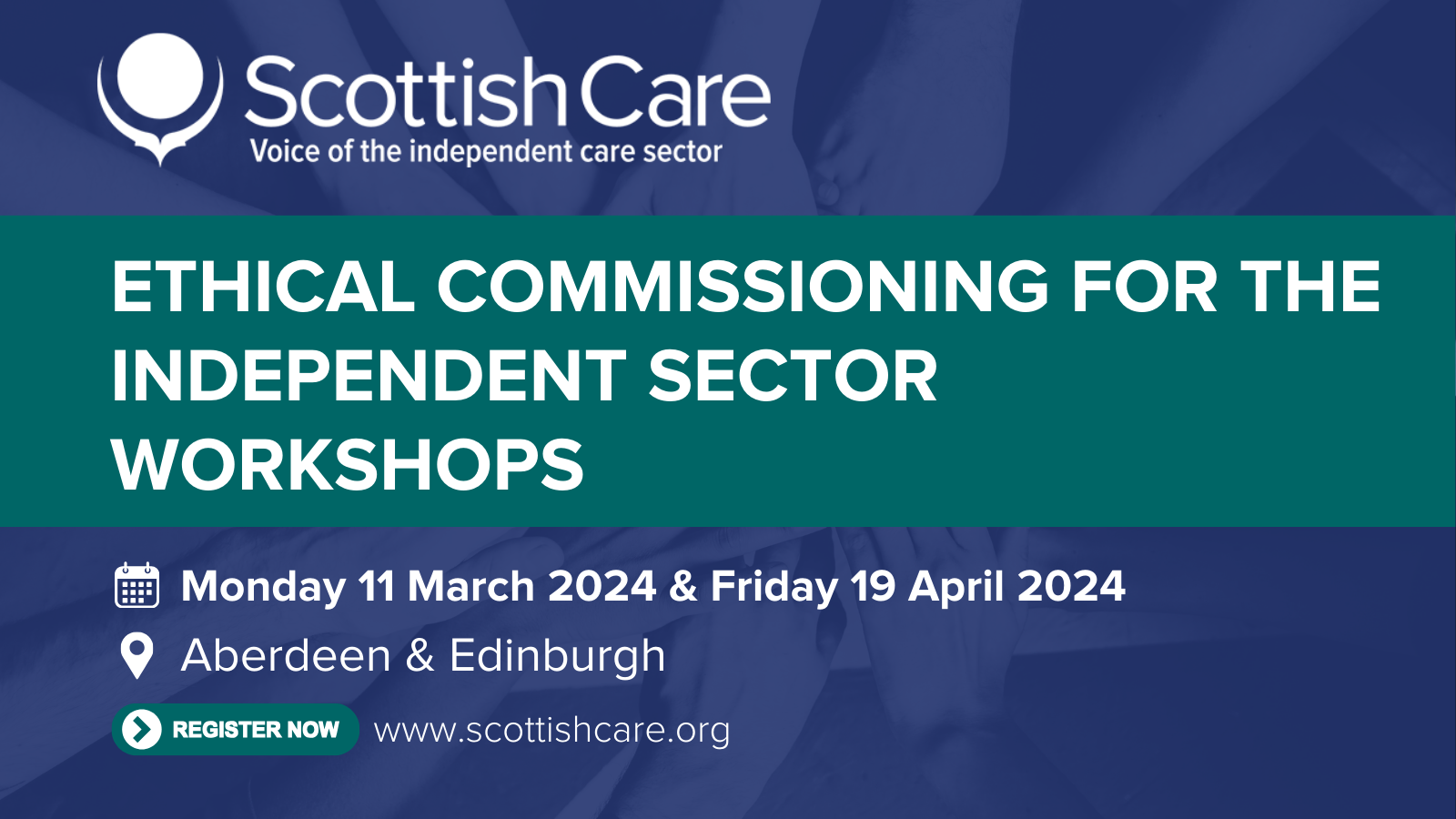
Tickets are now available for the first two workshops of our three-part series entitled ‘Ethical Commissioning for the Independent Sector: Rights, Respect & Redistribution’. Join us to learn from, and share your experiences with, expert stakeholders involved in the commissioning of care services across Scotland.

Our first session in Aberdeen is on the 11th of March, exploring the best practice of commissioning right-based care with a focus on involving people with lived experience and delivering person-led care.

Our second session in Edinburgh is on the 19th of April, exploring the practice of achieving the cultural change required to commission co-produced social care, with a specific focus on fair working practices and innovation.

Complimentary spaces for both events are available through Eventbrite, please follow the link for further details.

    • Our questionnaires

Members can access questionnaires via the following link. There will be further additions to these as our consultation progresses, and we will keep you updated of these changes.

    • Our drop in sessions

I will be live on Teams during the following times, feel free to drop in via the provided links to provide any feedback:

We thank members in advance for their invaluable contributions, as we work to ensure the insights of the independent sector are included with any national commissioning procedures introduced through the NCS.

Should you wish to provide any feedback directly and discuss anything in further detail, please feel free to get in contact to arrange a meeting through [email protected] or 0739 850 3895.

Pass on the story and create a new chapter: social care as storytelling.

This past week I finished telling one story and then started another. I find that one of the joys of being a parent is the time I spend at the end of a day in reading to my daughter. Despite her advancing years we continue the ritual of me reading and her listening, and then she reads on her own or creates a story for herself. There is a lovely rhythm in sitting still and shutting out the world and resting into a book; a peace which comes from words and simply holding the space of imagination between yourself and the listener. I have never read or heard the same story twice without it saying something different to me.

I would not give up those times for the treasure of the world not least in that I am very aware of all those parents who yearn simply to be with their child who is no longer here or parents who ache for their world to be peaceful and safe enough to grant them the space to read and rest.

Being able to tell a story, being safe enough to listen are privileges we too easily forget.

National Storytelling Week starts today. It is a yearly event run by the Society for Storytelling that celebrates the tradition of storytelling and aims to inspire a whole new generation of storytellers.

I have reflected many times in this blog about the power of human story and today I want to briefly highlight the potential of storytelling and listening in the care and support relationship.

I start from the premise that a story does not belong alone to the teller. The power of the oral tradition is that the listener to a story is compelled to pass that story on, to write the next chapter of its transmission in the ears of the listener who makes it their own and who gives it new life. Stories are not possessions to be trapped and locked in our memory they are tales which to which we are charged to give flight and life so that they become meaning and truth for another. That means for some stories that it is the responsibility of the listener to act on what is heard. Not to grasp the story but to pass it on.

There are very few roles in life where we are privileged with hearing the stories of the lives, the experiences, and the memories of those older than ourselves, and those who are coming to the end of their lives. That is one of the very real privileges of social care and healthcare in care home and community. We are honoured to be the listeners of the moment, we are honoured to hear the personal narratives of individuals, we are listeners to truth and anecdote filled with insight and wonder.

I recently read an excellent research article by Prof Lucy Dipper about the power of storytelling in social care. Lucy Dipper is a clinical linguist, and her research has shown the extent to which storytelling can improve older adults’ communication skills and wellbeing. She and her team established a project called Storytelling for older Adults in Residential Settings (STARS), a unique, group intervention for older people to practice telling their personal stories. Its results were remarkable.

I am sure I am not the only person who has witnessed the breathtaking power which story has to enable a person to share their deepest fears and to unlock the pain that lies within them. I have seen and heard people open up and use the trust which deep listening offers to tell the story they have spoken to no other; to share the story that perhaps they are telling themselves for the first time.

Social carers are listeners and tellers of the heart of the human story – it is a story of the essence of humanity … What we need to do is to create the environments of time and space that enable people to tell their story, to pass on the stories of self, community and heritage which are so easily lost in the din and noise of contemporary living.

But as I have often been told the best stories including personal narratives are not tales of the improbable or unlikely, they are not imaginings of the mysterious, but rather they tell of the ordinariness of human community. And in that very ordinariness, in the mess and contradiction, in the fragility and brokenness, is the extraordinariness of humanity. Human community is created when we are all of is enabled to be truly honest and authentic, when our hurts and wholeness, our tears and laughter are able to be shared in equal measure, and who we are is validated for who we are.

The social carer knows the power of human storytelling to enable someone to be truly their authentic self, but they also know the power of a story which is shared, to re-shape and change the world around us.

It is in the community of storytellers and listeners that a different ending is created, and the potential of new direction and changed outcome is realised.

So this storytelling week I hope despite the challenges facing those who care and support others and those who receive that care and support that we can begin to tell a story of a world that is better than ours; of compassion and care resting in reality and rooted in time. I hope we can find energy in the stories of our lives to change the malaise and apathy which suggests things will never get better and that new direction cannot be found. I hope we do not just listen to but tell again the stories we are privileged to hear and start to act their truth out in our living and loving.

I’ve always loved the words of the folk singer Mike Jones who wrote a song inspired by the work of his friend, Taffy Thomas. I hope we can all become storytellers of social care truth.

The Storyteller

 I’m a teller of tales, a spinner of yarns,

A weaver of dreams and a liar.

I’ll teach you some stories to tell to your friends,

While sitting at home by the fire.

You may not believe everything that I say

But there’s one thing I’ll tell you that’s true

For my stories were given as presents to me

And now they are my gifts to you.


My stories are as old as the mountains and rivers

That flow through the land they were born in

They were told in the homes of peasants in rags

And kings with fine clothes adorning.

There’s no need for silver or gold in great store

For a tale becomes richer with telling

And as long as each listener has a pair of good ears

It matters not where they are dwelling.


A story well told can lift up your hearts

And help you forget all your sorrows

It can give you the strength and the courage to stand

And face all your troubles tomorrow.

For there’s wisdom and wit, beauty and charm

There’s laughter and sometimes there’s tears

But when the story is over and the spell it is broken

You’ll find that there’s nothing to fear


My stories were learned in my grandparent’s home

Where their grandparents also had heard them

They were given as payment by travelling folk

For a warm place to lay down their burdens

My stories are ageless, they never grow old

With each telling they are born anew

And when my story is ended, I’ll still be alive

In the tales that I’ve given to you.

The History Press | The Storyteller: A poem about the art and practise of storytelling

Photo by Nong on Unsplash

Donald Macaskill


Business Energy Scotland Briefing Webinar – 15 February

Free energy-saving support and £30k cashback grant

We are delighted to invite you to a special energy-saving briefing with Business Energy Scotland

Business Energy Scotland is funded by the Scottish Government to provide free, impartial support and access to funding to help small and medium-sized enterprises (SMEs) save energy, carbon and money.

Previously known as the Energy Efficiency Business Support Service from Zero Waste Scotland, Business Energy Scotland launched in April 2022 and is managed by Energy Saving Trust.

To help you tackle rising energy costs, Scottish Care has arranged for staff from Business Energy Scotland to provide a special briefing on the energy-saving support and funding that is available right now.

Book your place at this briefing and you will:

  • Learn how you can help your organisation minimise the impact of rising energy costs and reduce its carbon footprint.
  • Find out about the interest-free loans currently available – now with up to £30k cashback grants.
  • Learn about the fully funded, expert consultancy advice and support available to SMEs.
  • Understand how you can grow a greener, more competitive organisation.
  • Hear about care homes that have already acted, what they did and how they have benefited.

Business Energy Scotland’s advisors have already identified over £200 million worth of savings for Scottish businesses, with a massive 24% average energy saving per business. 9 out of 10 businesses that have had support would recommend it to others.

“We have saved on both gas and electricity with the building being more energy efficient.”
Gillian Martin, Clinical Director, Perth Physio

“I can’t recommend Business Energy Scotland enough. Approaching them for support was a game-changer.”
Colin Watt, Managing Director, Carrbridge Hotel

“Because of the interest-free loan and cashback we were able to invest more money back into the business to bring the store up to a 5-star standard.”
Richard Cook, Operations Manager, MC Stores

Who should attend?

This event is a must for managers, directors and owners who are responsible for business improvement, competitiveness and sustainability.

Further information

For further information, please email [email protected] or call 0808 808 2268.

Book your free place here

Care at Home & Housing Support Awards 2024 – Open for Entry!

Submissions are now open for the 2024 National Care at Home and Housing Support Awards! This prestigious event offers a great opportunity to acknowledge the accomplishments of our dedicated homecare workforce and supported individuals.

Scheduled for the 18th consecutive year on Friday 17 May 2024, at Radisson Blu, Glasgow, the awards ceremony will be hosted by Michelle McManus and our CEO, Dr Donald Macaskill. There are 10 award categories, including the new Care Innovation Award.

Nominations close on Monday 11 March 2024, at 5:00 pm. If you know of deserving individuals, teams, or services, please nominate them.

Find out about the awards and enter here.

Being present is an act of care: the value of time.

For a long time, January has been my tidying month. A month where instinctively I feel the need to tidy cupboards and remove the nagging guilt of messy drawers and overfilled space. It’s also a time when I try to get rid of so many of the virtual and physical papers and notes I seem to build up over the year. It’s a cathartic process which is achieved in fits and starts and doesn’t always work as well as it should.

In the middle of going through one of my many notebooks this past week I came across this quote which was relating to a phone call a couple of months ago:

“I worry that in all the pressure to save resources that we are being pushed to cut time spent with people to the barest minimum.” Beside it I had written – ‘stealing time robs presence.’

I’ve often reflected in this blog about the nature of social care and support as being a dynamic which is centred around the forming of real, meaningful, and authentic human relationships. Intrinsic to that is the truth that relationships don’t just happen, but they have to be nurtured and attended to, like plants in a garden they require to be nourished and supported. Fundamental to this is time, that most precious of human commodities which gives space for encounter to occur and exchange to grow. The flourishing of social care is the depth to which a relationship enables real communication and sharing to take place.

Presence is critical to social care. It was one of the bywords of the disability civil rights movement a few decades ago as it campaigned to close long stay asylums and institutions that without people being physically present, without folks being there in the midst of community then they would inevitably be excluded and at risk of harm. Out of sight, out of mind. But on its own presence is not sufficient – being there is pointless unless it results in the person feeling that that presence makes a difference.

Recently the Scottish academic nurse/theologian John Swinton has been undertaking work with the social care sector in Australia. He has published some of the findings in a paper entitled ‘Being Present and Meaningful Engagement for Aged Care Residents Living With Dementia.’ The paper describes the findings of a project which sought to ‘understand care workers’ experiences of providing care to residents, the challenges they face in being present with residents and [the] support that enable them to be more present and provide person-centred care.’

The study of care workers across three care settings showed the critical importance of presence for residents living with dementia, it highlighted the value staff saw in being present whilst at the same time acknowledging the barriers which prevented this from happening at real depth including ‘staff shortages, competing demands of the role, and time-related impediments.’

The research recognises that there is no shared understanding of how we define presence in a care and support relationship but that two commonly held elements seem to be meaningful engagement and person-centred care. The research has two key findings, namely that the establishment of trust is key to the maintaining of relationships and that presence does not just happen but has to be organised, supported and structured as a priority with adequate supporting resources and adequate staffing levels so that individuals and the wider community can be sufficiently cared for. Importantly the research concluded that:

‘Our findings suggest that care worker presence has the potential to contribute to both the physical and emotional health and well-being of residents living with dementia, and to the well-being of the staff that care for them.’

In wider society there is a growing emphasis on the importance of ‘being present’, of recognising the key contribution to relationships which results from time being spent with another. But time has to be rich in focus and attention rather than overfull with distraction and avoidance. We are encouraged to cease or limit the distractions which get in the way of our being with other people. Coincidentally in the United States this day is one which is being celebrated and recognised as #NoPhonesAt HomeDay – a day when people are asked to set aside the distractions of their mobile phone and engage simply in ‘doing things’ or ‘being’ with family. I can sense the tremors out there!

We need presence to enable us to tell our story, to be listened to and to be heard. That is not just important in dementia care and support or in our closest relationships, but rather it is fundamental to all engagement and togetherness. There is a massive difference between listening to someone and enabling them to feel that they are heard, of worth and value through your presence.

I fear just like my note at the start of this blog that stealing time will indeed rob presence, that we will starve our encounters of paid care of the sufficiency of time because we consider that simply being present is unnecessary or not a priority. But as we all know time is an essential ingredient for people to open up and form a relationship with us, and it is also the essential prerequisite for preventative, watchful care and support. If we crowd out our presence by care activism, then we give no space to enable our presence to bring forth real support and compassion.

The beautiful nature poetry of Nan Shepherd reminds us that we are all charged with the responsibility of incarnating presence. Social carers in care home or homecare do that every day – it ill fits our humanity if we seek by contract and cost constraint to limit the encounter of our humanity by reducing the ability of staff simply to ‘be present.’

In her poem ‘Real Presence’ Nan Shepherd writes:

Clear as the endless ecstasy of stars
That mount for ever on an intense air;
Or running pools, of water cold and rare,
In chiselled gorges deep amid the scaurs,
So still, the bright dawn were their best device,
Yet like a thought that has no end they flow;
Or Venus, when her white unearthly glow
Sharpens like awe on skies as green as ice:

To such a clearness love is come at last,
Not disembodied, transubstantiate,
But substance and its essence now are one;
And love informs, yet is the form create.
No false gods now, the images o’ercast,
We are love’s body, or we are undone.

from In the Cairngorms (Edinburgh: The Moray Press, 1934).

https://www.scottishpoetrylibrary.org.uk/poem/real-presence/

Photo by Brett Jordan on Unsplash