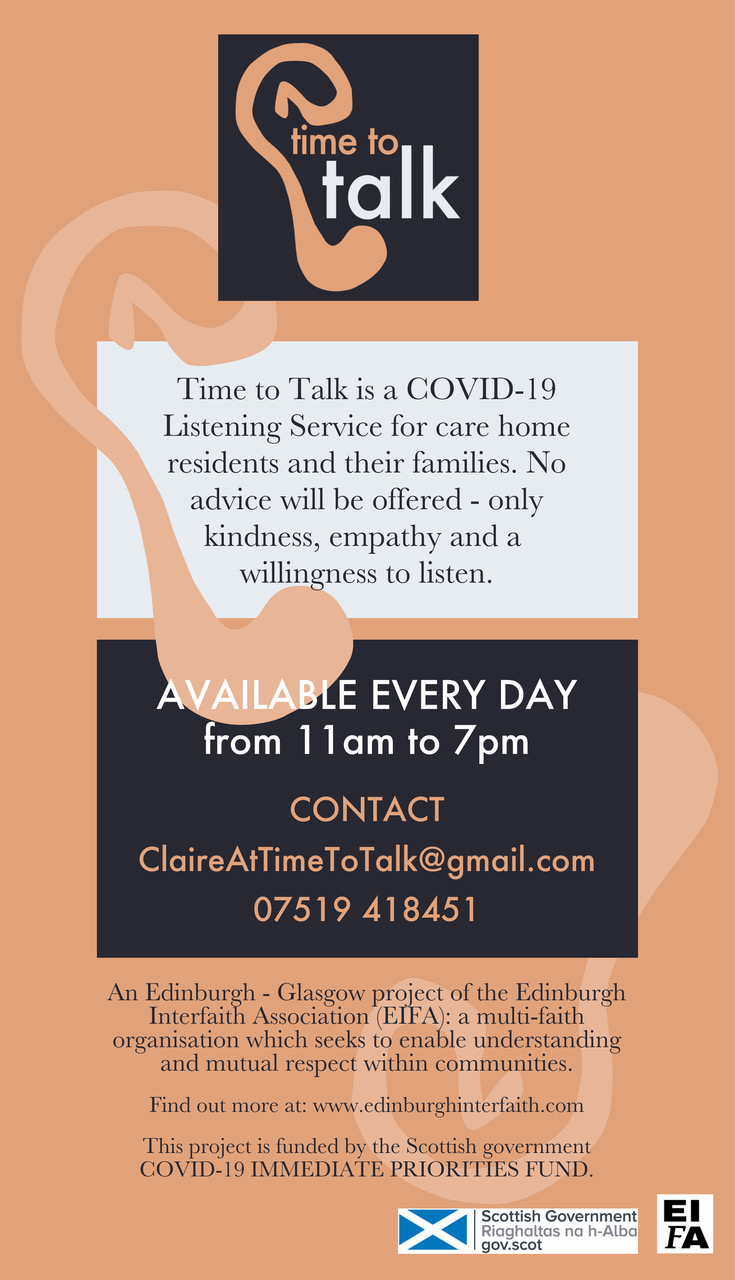
‘Time to Talk’ – Covid-19 Listening Service

‘Time to Talk’

COVID 19 Listening Service available for relatives and residents in care homes

An Edinburgh – Glasgow project of EIFA https://www.edinburghinterfaith.com/

Good day,

I am writing to you on behalf of EIFA – Edinburgh Interfaith Organisation (a multifaith organisation which seeks to enable understanding and mutual respect within communities). The Scottish government has provided seed money to launch a service that will seek to be supportive to care home residents and their families during this time of Covid-19. As we all know, these unprecedented times have hit the care home sector especially hard, with families often unable to visit their loved ones living in care homes.

We will offer a seven day a week (11am – 7pm) opportunity for care home residents and their family members to be listened to by volunteers via the telephone. The volunteers will be vetted for their experience and training as listeners. We hope that care home residents (who are able) and their family members will gain some solace and peace from this and that it will be a support for staff who are under pressure.  Additionally, as this service is being offered through a multi-faith organisation, callers wishing to speak directly to someone of their faith will be connected through our service. It is important to note that although EIFA is a multi-faith-based organisation,all care home residents and their family members are welcomed to make use of this listening service – be they of a particular faith or none.  Also, it is important to stress that this service will offer an understanding and empathic listening service; there will be no advice or counselling offered.

 All calls will be held in the strictest confidence; only very basic background details will be noted as a record of who is making use of this service, to inform future and ongoing offering of this service.

As the manager of this listening service, I am asking if you would be willing to help to get the word out to your residents and their families about this service, so that they may perhaps find a measure of comfort during this most difficult time. I have attached a flyer that can be printed-off and posted/made available to your residents and their families. I am happy to answer any questions or concerns you may have, as well as your suggestions as to additional ways we can let care home residents and families (at present only within Edinburgh and Glasgow) to make use of our service.

Many thanks for reading this letter.  We hope that this service affords a measure of support for all involved. Please feel free to contact me at any time; I will phone you in the few days to follow-up on this.

Thank you and best wishes,

Dr Claire Garabedian

Project Manager – Time to Talk

ClaireA[email protected]

07519 418451

New Covid-19 resource by NES / SSSC

Recognising deterioration and supporting people with acute care needs

A guide for social care workers supporting people in care homes or their own home 

A new partnership resource developed by NHS Education for Scotland (NES) and the Scottish Social Services Council (SSSC) highlights the essential skills to respond to and care for people living in care homes or their own home, who have acute care needs due to COVID-19.

Recognising deterioration and supporting people with acute care needs during COVID-19 will be of value to staff caring for people in a care home or in their own homes, or those supporting staff in their role.

The resource provides guidance on the speedy recognition, assessment and escalation of concerns for a person who may be deteriorating. It also provides guidance on ongoing observation and monitoring of the unwell person, as well as the administration of oxygen. This builds on the many and varied skills staff already have.

They are keen to hear views on this new resource and comments can be shared using the anonymised feedback form in the website. Access the resource at https://learn.sssc.uk.com/coronavirus/acutecare/

The resource is also in the process of being uploaded to the NES Turas COVID-19 site at https://learn.nes.nhs.scot/30824/coronavirus-covid-19/practice-in-the-community-setting/social-care-workforce


Disclosure Scotland email notification service – 1 June

Disclosure Scotland are automating the email notification service for priority applications, please see update from them below. 

As part of our response to coronavirus (COVID-19), we issue email notifications to employers of key workers. This allows employers to make quick and safe recruitment decisions.

From 8 June 2020, most notifications you may receive will come from [email protected]. You may still receive some notifications from [email protected]. Notifications will be issued to the email address held on our system.

We are keen this process is compatible with your business continuity arrangements during coronavirus. Please advise if you would prefer us to issue the notifications to an alternative email address by contacting [email protected].

We will no longer send notification that an application is on hold. Some applications will continue to receive a notification of completion where appropriate. All other notification guidelines remain as set out on 27 March.

Additionally, we have removed the need for organisations to submit a cover sheet with priority applications. From today, you only need to submit the application form(s).

If you are submitting more than 50 applications, please continue to give us advanced notice by emailing [email protected]. Please continue to send completed applications and queries to this address.

Thank you for your patience during this time.

Scottish Care Surgery – 2 May 2020

The next Scottish Care Covid-19 Surgery will take place on Tuesday 2 June at 12:00 pm. In this session our CEO, Dr Donald Macaskill and our National Director, Karen Hedge will be joined by Nancy Burns -Programme Advisor Healthcare Improvement Scotland, NMAHP Directorate – and Derek Barron – Director of Care, Erskine.

Nancy and Derek will be demonstrating the use of the ‘Huddle Dashboard‘ which is a new safety huddle tool which allows audit, reports to everyone and fits with the escalation plans to deploy staff. Nancy will be available to take any questions and feedback on this tool. You can find out more about this resource here: https://scottishcare.org/covid-19-care-home-safety-huddle-staffing-and-escalation-resources/

You will also get the opportunity to ask Donald and Karen any questions you may have on Covid-19 or anything related to social care.

Webinar link: https://us02web.zoom.us/j/83228137088

Webinar ID: 832 2813 7088

Balancing the scales: Covid19 discrimination and future promise

In early March at the beginning of the Covid19 pandemic I wrote an opinion piece for The National which I concluded with the words:

‘Coronavirus will be a test not just of the infrastructures of health and care, of business and commerce, it will be a test which will determine the nature of our nation. Will we be a Scotland that cares for the old or will our compassion be limited by discrimination?’

That piece was written on the back of statements which suggested that we did not need to worry about the disease because it would only kill the old. Both social media and some wider media comment at the time was full of comments which articulated a view that Coronavirus was a ‘boomer harvest’, one of the many sickening references to the baby-boomer generation. The public health message across the United Kingdom at the time was ‘wash your hands and catch your cough.’

Twelve weeks on the truth is that this pernicious virus has indeed taken a devastating toll of the older age population with nearly three quarters of all deaths in Scotland and worldwide amongst those over the age of 75. It is also the sad truth that those who were most vulnerable as a result of age, frailty, dementia and other conditions, and who have been residents in our care homes, have been the hardest hit. This is the story of this pandemic as it has crossed the face of the world, its hurt has taken away from us our memory and soul, its scars have left a mark which will take long to heal.

So has our response been one of inclusiveness, of valuing all, of non-discrimination or has the pervasiveness of age discrimination and bias, subjects I have often written about, been evidenced in our pandemic response as a Scottish society, as a political, health and care system?

I will leave you to make your own mind up on that. But …

In recognising the evidence, we were getting from China in January, South Korea and Singapore, Italy and Spain in February, France and Germany in March, did we sufficiently protect our older citizens? Did we ‘contain’ for too long out of a desire to ‘bring people with us’ and lessen harm to the economy which meant that the entry into lockdown made our older population all the more vulnerable?

In noting the relative success of a strict test, trace and isolate model in some parts of the world with the continual echo of the World Health Organisation stating ‘Test, test, test’ to anyone who would listen,  did we as part of a Four Nation collective response abandon that safeguard too early?

In our desire to prevent our acute NHS system from being over-run did we so encourage the discharge of hundreds of older people from hospitals into the community and care homes where they were to be at greater risk or was staying in hospital an even higher threat?

In our requirement to protect the NHS at all costs did we fail to recognise the importance of ensuring that social care providers and their staff were to be an equal frontline so that requisitioning PPE supplies for the NHS would make their battle all the harder to fight?

In our desire to be prepared for an overflow did the indiscriminate phone-calls and letters about the importance of ‘Do Not Resuscitate’ orders serve to put older and vulnerable citizens into a state of real fear, leaving them with the feeling that they were of lesser worth or value?

In our requirement to support frontline clinicians to make hard treatment decisions if we should face resource constraints and run out of equipment did our ethical framework not give the impression that age would be used as a primary proxy for decision-making?

In our desire to reduce unnecessary admissions into hospitals in order to prevent the anticipated surge did our official Guidance give older people in care homes the impression that they were not to be admitted but were to be cared for and die in situ?

In our withdrawal of packages of care and support from some of the most elderly in our communities did we not place them at even greater harm not just from the virus but from dying alone, without contact, potentially hungry and disconnected?

I have my own views on each of the above but one thing I am clear of is that the attitudes of age discrimination which existed in Scotland before this pandemic have not been wiped away with its pain rather they have been magnified and lit large.

For years I have written about the way in which we have failed to value our older citizens in many disparate ways. But I see very little point in recounting these. Rather as we leave lockdown we have an opportunity to leave behind systems, models and approaches which have not worked and have failed our older citizens. We have the opportunity to cast off attitudes and behaviours which have served only to limit our humanity by dressing ourselves up into a pretence of equality.

Social care is still fighting this virus. It has not gone away and there is much more still to be done. But this is also a time for re-formation and reflection, renewal and re-orientation.

We have the opportunity to finally have honest discussions about how we will value and celebrate the reality that we have one of the fastest ageing populations in Europe. Faced with the gift of longevity and a growing life expectancy, how are we to enable those living longer even with conditions such as dementia to live until the end in the fullest and richest way possible?

We have the chance to change the way in which we value social care and those who work in it. It is not acceptable that we consider that being paid the minimum or living wage should somehow be the summit of our collective aspiration. It is not acceptable that there should be such disparity in what the State funds and what we expect citizens to pay. It is not acceptable that if you are struck down by cancer your care is largely paid for but if you live with dementia you and your family end up being charged.

We have the chance to take some really hard decisions about how as a society we pay for the potential of age which is in our midst. We need to have these grown up national discussions which we have all shied away from especially the closer we get to an election season.

We have the chance to challenge the gender segregation which equates care as being a woman’s work and thus accords it less status where the reality is that care should be the challenge of all, for all and by all. A society that does not care is not a community but a collective assortment of individual egos.

We have the chance to see those who are old as vital contributive individuals. Life does not end until you take your final breath. Let us stop viewing our humanity as if it has a use by date. Let us seriously work at inter-generational levels so that we harvest the knowledge, creativity, skill and ingenuity of all our citizens.

We have the chance to create a system which enables real choice rather than blanket solutions, gives respect and autonomy to our citizens and which takes seriously the human rights and dignity of everyone.

There will be many legacies left by this pandemic. Tragically for many of us there has been raw pain and loss at the heart of the last few weeks. But we owe it to everyone today and tomorrow to make sure that we seize the opportunities we have been given and to really build a social care system and a Scottish society where all are valued and included regardless of chronological age. This will not be achieved by point-scoring, by political fundamentalism, by defensiveness or entrenchment, but by real collaboration, honest humility, and a shared passion that we can and must do better.

Donald Macaskill


A New Taboo – latest nursing blog

Working within the care sector dealing with death, dying and bereavement is intrinsic to the role. However, every episode of care that results in a death will have a different impact on individual staff.

The ability to cope with death in this way is managed by taking comfort in the fact that the person received the best care possible, did not suffer, and that their death was not as a result of neglect or poor delivery of care.

In my early nursing days, I worked in an Oncology ward. I remember the difficulty in trying to care for people newly diagnosed, alongside those receiving chemotherapy and those being nursed at end of life, all within the same unit. I decided to undertake a Death, Dying and Bereavement course to help me cope.

It certainly wasn’t the most upbeat course I ever undertook but it definitely opened my mind and my ability to think beyond what was simply happening. It referred to death as taboo, the subject that no one wanted to talk about and challenged me to ensure that talking about death and dying should be something that needs to happen alongside caring and compassion, to ensure good care.

Everyone who has nursed anyone can always remember someone that had a good death, and sadly someone who did not. Getting the time and the opportunity to go through the grieving process and reach a point of acceptance is what is considered by many as a good death. This allows decisions to be made which enables things to be planned as the person would’ve liked, wishes to be exercised and also lessens the burden on their family by preparing a will, and/or creating an advanced care plan. We all grieve differently and it is important to understand the stages of grief to help ourselves and others. The stages can be interchangeable and in time become less intense. On realising that death is imminent, most people initially experience shock and fleet between denial, fear, anger, bargaining and finally resulting in acceptance, if they can. This process can be typical for both the person dying and those close to them.

Loss due to Covid 19 has however presented different challenges. The rapidness in the deterioration for some people has resulted in the same depth of grief as that felt in a traumatic death.

Traumatic deaths due to accidents, suicide or murder often leave people feeling emotionally detached as they struggle to come to terms with a sudden loss.  Guilt in relation to an untimely death is very common and can result in some people never accepting the loss for many years, if at all, with some holding themselves responsible. Not getting the opportunity to say goodbye, not expecting the death or feeling helpless to change anything or intervene, all play a part in extending grief, loss and acceptance.

Initially in managing Covid 19 there is a move between active treatment and recognition that recovery is a potential, whilst at the same time an acceptance that death may be the likely outcome. The two extremes over a short space of time in itself is difficult to prepare for. Although we saw a number of Covid positive people within the care homes improve and recover, sadly a greater number did not, with care homes accounting for approx. 40+ % of Covid deaths.

For staff it has been difficult. In normal circumstances families would have the option to be present throughout the days leading up to someone dying or when acutely unwell, and it is recognised that families require this support in coming to terms with losing someone, as part of the ongoing bereavement process which allows questions to be asked.

Not witnessing the person receiving care to know they were comfortable, without pain and see first-hand the expert care they received can result in families not being able to process what has happened and why. Not having answers to questions or conflicting responses can negatively affect the behaviours of individual family members after the death. Restricting visits in the last few days of someone’s life or not being allowed to be present within the care homes directly contributes to profound feelings of resentment for not being present at the moment when their loved one passed. This enforced estrangement prevents normal healing. All these scenarios have unfortunately taken place as a result of the necessary lockdown restrictions.

Staff within the care home sector unlike other frontline staff know their residents. They have built up relationships with them and those close to them and therefore the pressures of decision making and communicating bad news is somewhat more poignant and difficult.

The lack of political prioritisation of the care sector and delayed staff guidance at this time has without question heightened the effects of caring for someone who is dying of Covid19 or other causes.

The inability to say goodbye in a way they would normally have been able to, to hold a hand or to simply kiss them goodbye are natural responses that have been taken away, would ordinarily directly impact an individual’s ability to cope with the grieving process. Not to be able to act out someone’s wishes is particularly difficult to accept. Funeral arrangement restrictions, the need for recognition of someone’s life, the adherence to support them through their religious and spiritual beliefs and the bringing together of mourners has been particularly upsetting. Covid19 has taken this away from so many, the individual person, the family and the caregiver.

The increasing volume of deaths experienced by staff working within care homes have been particularly traumatic. The residents have lost their lives due to their susceptibility to the virus as approximately 75% of all deaths have been in the 75 years and above age group.

This has been it extremely difficult for staff to accept and to safeguard residents. The management of the protective factors, access to PPE, lack and delays in testing and frontline response to the care home sector has undoubtably resulted in a significant number of deaths, which may have been preventable.

This has left many staff experiencing feelings of guilt as a result, despite them having no real control. Reflecting and debriefing under such circumstances has been considered as not psychologically beneficial as it may make someone replay a situation that could not have been changed.

Staff followed guidance as it was issued alongside the frontline response which should have supported staff initially as they were aware that care homes had a concentrated population from the most vulnerable group and therefore had the highest risk of spread and transmission.

This accumulation of deaths and the pressures around this, alongside negative press coverage at times has impacted on staff wellbeing and psychological ability to remain resilient, resulting in compassionate fatigue. Many staff left their own homes during lockdown to protect their residents, with approximately 40% of care homes having no Covid cases, which is remarkable and should be recognised.

People are experiencing loss in so many ways out width the work environment, also. Loss of physical contact, psychological, social, emotional and spiritual support. The rituals of everyday life have all been on lockdown.

Very few people have not been touched by the impact of COVID19 as we have all had restricted contact with our families and the constant daily reminder of the devastation and loss of lives.

 Let’s not forget that staff have to also come to work aware of the potential for them to become unwell from this virus and also the need to protect others, as well as their families, in the knowledge that sadly eight social care staff have lost their lives to this virus, alongside a significant number of  other health staff.

The ability to share grief with peers can go a long way to support staff and to find a way to remotely support residents families who are bereaved is also helpful, as it allows the channels of communication to remain open and support people with their loss to heal through this  complicated bereavement.

As we move out of this peak into the uncertainty of when this virus will be controlled the only real certainty is that life will never fully return to what we previously viewed as normal.

The taboo of talking about death and dying has certainly been tested with daily updates on death constantly broadcast into our living rooms over the last 10 weeks. Our ability to feel untouched regardless of age has been taken away from us, we learn more of how this virus turned into a global pandemic and how difficult it may be to eradicate.

With anything in life there is learning which will support us to cope as we move forward in our professional and personal lives. Strength will come from adversity and it’s important that we self- care and support the wellbeing of others.

The use of a safe place to take time out, to recharge and reflect has been highlighted as a useful way to reduce the potential of burnout. Leave needs to be taken and built in to also prevent this. It is important that staff don’t view this as a weakness but a necessary requirement to be kind to yourself, otherwise you will simply not continue to function.

Promis.scot is The National Wellbeing hub which pulls together fantastic resources highlighting the use of different available techniques to ensure staff are supported from the appropriate use of counselling, to the use of mindfulness.

An already challenging job has just reached new heights, but we must remember that whatever we are faced with we can simply only do our best with the resources we have available, nothing more, nothing less.

We are only human.

There is some kind of a sweet innocence in being human- in not having to be just happy or just sad- in the nature of being able to be both broken and whole, at the same time.” ― C. JoyBell C.

Jacqui Neil

Transforming Workforce Lead for Nursing