Manifesto 2025 Session 2: Work Together, Not In Silos (23 Sept)

Scottish Care Members’ Manifesto 2026 – A Call to Action

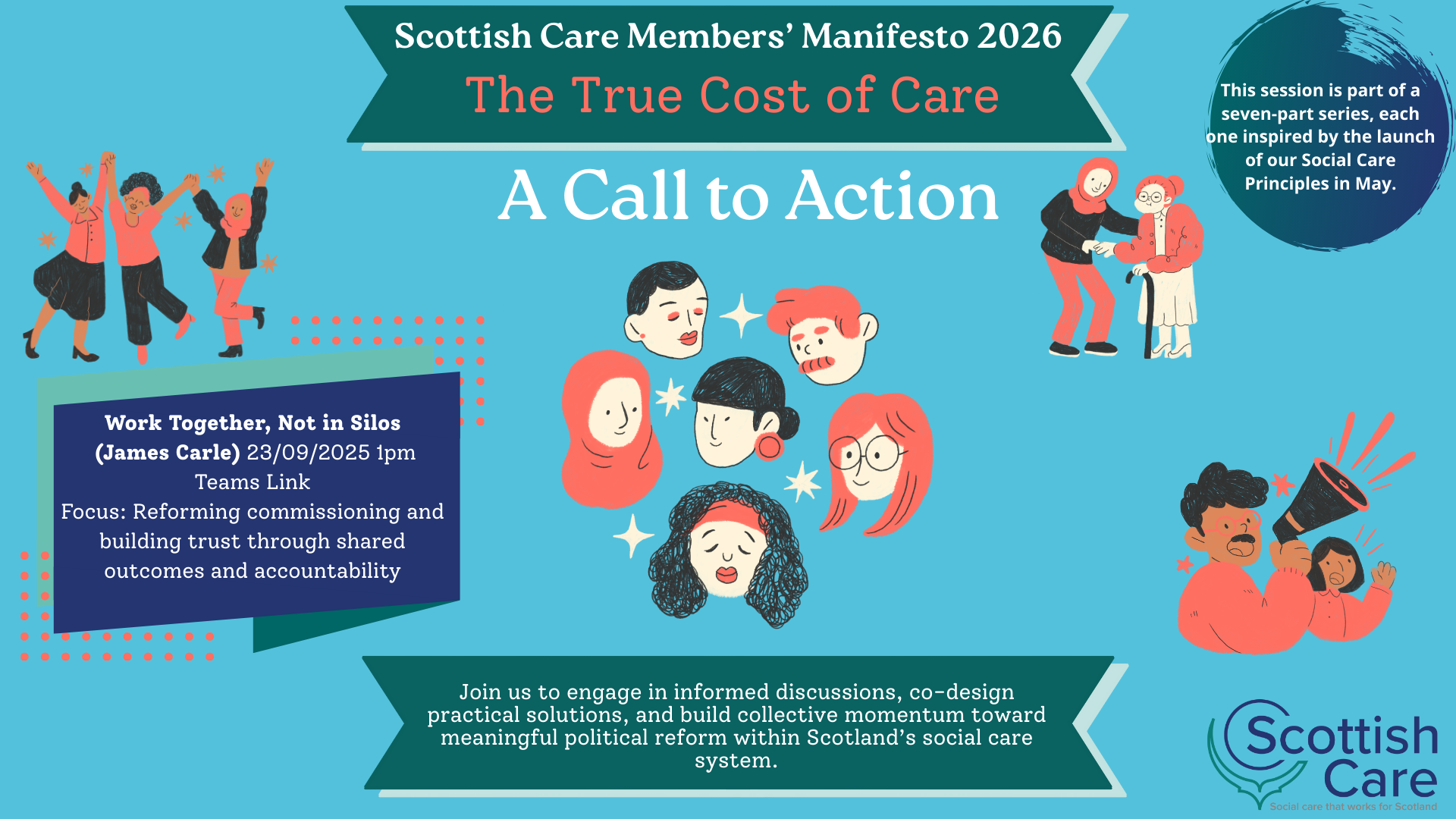
Session 2: Work Together, Not in Silos

Tuesday 23 September 2025, 1:00pm | Online

This session continues our powerful seven-part series spotlighting the Scottish Care Members Manifesto: The True Cost of Care – A Call to Action.

Together, we aim to build collective momentum toward placing social care at the heart of the 2026 Scottish parliamentary elections.

In this second session, we’ll engage in dynamic and collaborative dialogue to co-design two key asks from the social care sector. We will focus on:

  • Reforming commissioning practices
  • Building trust through shared outcomes and accountability

This is a space for shared learning, open discussion, and sector-wide collaboration. All Scottish Care members are welcome.

Members can register now via the Members Area.

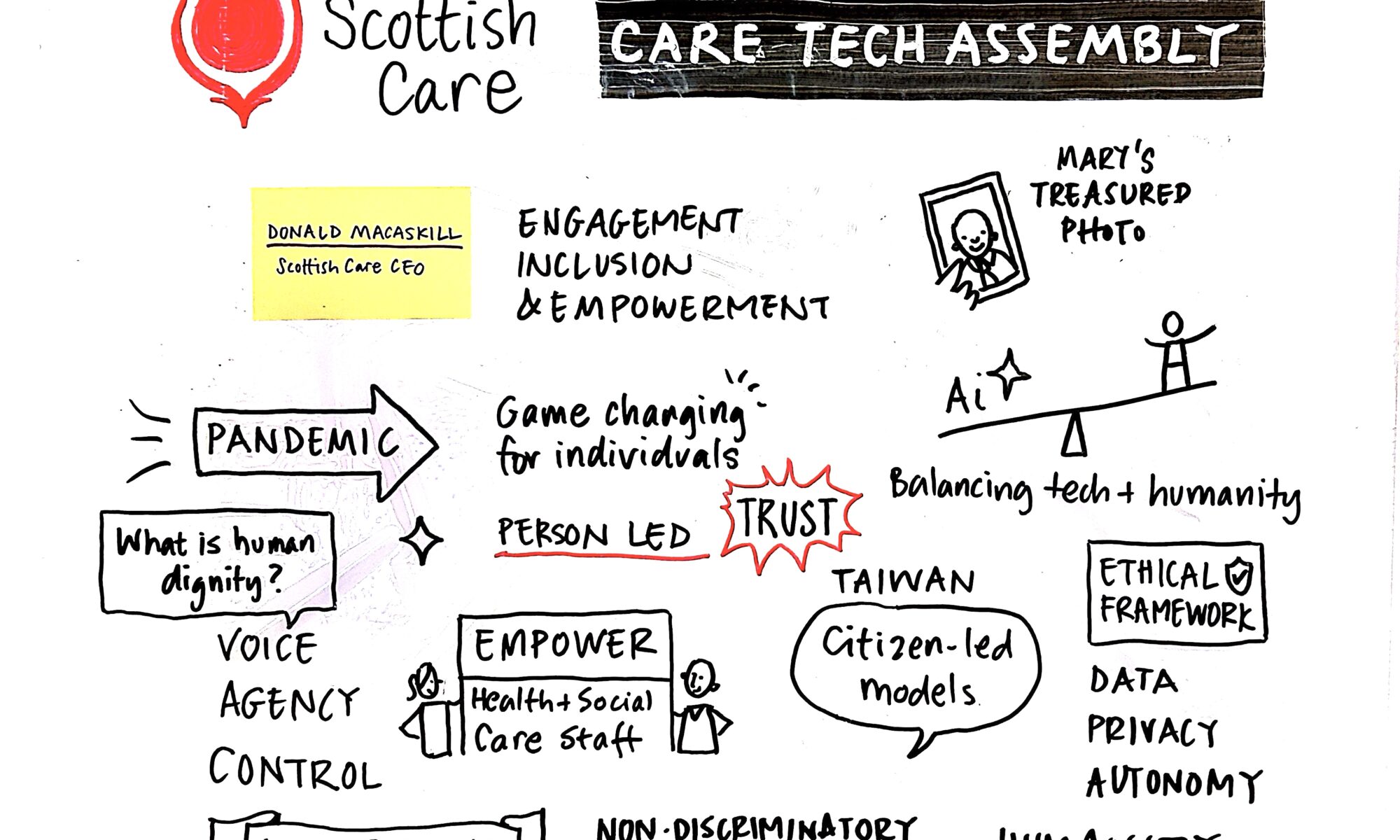
Care Tech Unplugged – 2 October 2025

Care Tech Unplugged – Thursday 2 October, 10:00 – 16:00

The Social Hub, 15 Candleriggs, Glasgow G1 1TQ, UK

A space to step away from business-as-usual and explore the future of care and technology, with wellbeing at the centre.

Following the success of the Care Tech Assembly in June 2025, we’re bringing together a small group of people for a different kind of experience. The day is facilitated by the creativity and regenerative design expertise of the Glasgow School of Art, who bring their internationally recognised strengths in design, wellbeing, and creative practice.

How it works

  • Register your interest
  • We have just 30 places available, and we’re curating the group to make sure we bring together a balance of different perspectives, from across operational, strategic and policy roles in the sector.
  • We’ll confirm places by Wednesday 24 September.

About the day

Together, we’ll explore how different perspectives from across operational, strategic, policy roles fit together in shaping the future of care tech. Expect an approach that is welcoming, immersive, thoughtful, and energising. This is a chance to pause and re-imagine the future of care and technology in ways that feel practical and sustainable.

You’ll come away with:

  • Fresh ideas and inspiration to take back into your team or organisation
  • New connections with others interested in this approach
  • Renewed energy from Glasgow School of Art’s regenerative, wellbeing-led design approach.

You’re also welcome to register with a colleague from your organisation. We’re keen to hear voices from across teams and roles.

A delicious lunch will be provided. Please let us know any dietary requirements when you register.

If you have any barriers to attending, we can cover travel expenses and other reasonable costs. The venue also has quiet spaces if you need to step out for a call on the day. Just let us know how we can support you.

Register here

The need for Fair care – the struggle for equal pay

Thursday 18 September is International Equal Pay Day which is an opportunity to pause not just to measure pay differences, but to reckon with what those differences say about how we value care, and those who give it. In Scotland’s social care sector whose workforce is overwhelmingly female, underpaid, and overworked – the day must surely be more than symbolic. It must after decades of talk set a fire under those who in political leadership have prevaricated for so long.

Recent analysis shows that in health care and social care, the gender pay gap sits at 11.2%, meaning the average woman works 41 days a year effectively unpaid compared to a man.  This isn’t about skill or hours, about professionalism or competence – it’s about value.

In Scotland, over 80% of adult social care workers are women, a figure that should inspire pride – but instead points to persistent undervaluation. Roles demanding emotional labour, flexibility, resilience, and unglamorous hours remain low paid.

That we tolerate this imbalance speaks to gender bias entrenched across public services and policy, within our political leadership and critically within society’s valuing of social care work compared to other sectors.

Scotland fares better than the UK average in headline terms – but it is simply not enough. The full-time pay gap in Scotland is around 5.5%, compared to 11.3% across the UK.  But average figures mask deep disparities within sectors – especially social care.

If we closed the gender pay gap fully, Scotland’s economy could gain an estimated £17 billion.  More than figures, this is about fairness, dignity, and economic justice for women whose work supports us all and in truth is the engine of our economy.

There is a lot more that we can do.

We could finally start to stop talking about the success of paying the Living Wage to workers who allow us all to flourish and thrive and not just to live. A decade ago the Scottish Government was ahead of the curve when it introduced the Living Wage for frontline carers. But the shine has well and truly come off that trophy. Since then we have effectively gone back as more and more, greater and greater pay awards have gone to comparative roles in for instance the NHS. The pay gap is now wider than it was a decade ago. Unless pay is fair across roles – and regularly benchmarked against NHS scales – inequity remains.

The women who do the same or similar roles in social care require parity not promises.

Sectoral bargaining offers the promise of ensuring that pay scales reflect the complex, skilled, and emotional nature of caregiving. But we need government at national and local level to follow through beyond the rhetoric with the reality of real additional resource.

It is time to lift social care out of the poverty trap.

But it goes even further. I was involved in a fascinating discussion with colleagues across the sector this past week on Fair Work and most of our discussion centred around pay, terms and conditions. But I was reminded that there is another dimension to fair work that we often forget, and that is how we value people in the roles they have. I reflected on this in a recent blog but put simply I feel that one of the reasons the system has got away with underpaying women in social care is that we continue to think of the job of care and support as low value and low skilled. We continue to think of care as ‘women’s work’ and to reward it accordingly in a discriminatory manner.

At best social care’s undervaluation stems not from indifference, but from misconceptions: that it is work that is low-skilled, replaceable, optional. We must challenge that. Women chiefly bear the burden of such work – paid and unpaid – and I cannot but detect the hand of misogyny in fiscal and budgetary choices. We urgently need as a whole society to reframe caregiving as respected, essential, and skilled.

Women disproportionately take part-time roles to manage caregiving – for children and relatives – driving pay gaps wider as they age. Indeed, women aged 50–59 can face up to 19.7% pay gaps, along with lifetime earnings losses of £400,000.

Whilst we have increasingly attractive rights in relation to flexible working we need to do a lot more to incentivise secure working, re-entry opportunities, paid family leave, and career break re-entry pathways. We need to invest in schemes that counteract the ‘motherhood penalty’ and support sustained career progression.

And there are particular challenges in social care provision because of the unethical commissioning and contracting practices of public authorities. Ad I have said elsewhere:

‘Fair work is impossible without fair commissioning. For too long, contracts have been let based on cost above all else, driving a race to the bottom where providers struggle to meet the true costs of care. Commissioning must change. It must be relational rather than transactional, valuing continuity, quality and human connection. Contracts must build in the real costs of delivering fair work – not just wages, but pensions, in work benefits, training, supervision and career development. Procurement must become a tool to enable fair work, not undermine it.’

And behind all this we must call out the unequal treatment of frontline carers where they are everyday being stripped of professionalism.

‘Workers must be involved in decisions that affect their practice… We need to start trusting the social care front line with autonomy and the ability to discern and prioritise.’

Scotland’s Gender Equality Duty remains vital. Public bodies must publish equality objectives every three years, including on pay.  This must include social care commissioning and procurement and yet I have rarely seen those critical elements included in such gender impact assessments.

International Equal Pay Day is more than a marker – it’s a call. In care homes and homecare across Scotland, women’s labour sustains lives, communities, and dignity. Yet pay, policy, and perception continue to fall short.

If we truly value care, then it is our actions that matter not decades of aspiration. That means we must fund pay justice, not just pay increases. It means we urgently need as media, leaders and the public to reframe care from an unskilled default to a skilled vocation. It requires us to take active steps to sustain women’s careers, not force invisible caring costs onto them. And to achieve all this we need to embed equality in every funding, commissioning, and oversight mechanism.

Until then, the hope behind International Equal Pay Day risks diminishing every year.

The African poet Adesola Oluwafeyikemi Sarah Amoo wrote these words last year in a poem she entitled:

“Equal Worth, Unequal Pay: The Struggle for Fair Compensation”

She works with vigor, heart, and mind,
Yet finds her paychecks lag behind,
Her worth, her toil, her every day,
Still shadowed by unequal pay.

With every raise, a silent fight,
For justice in the dimmest light,
A climb that’s steep, with every step,
A battle that she won’t forget.

Her voice joins others, loud and clear,
Demanding change, no need to fear,
For equal work deserves its due,
A world where paychecks honor true.

Let fairness reign in every field,
Let parity be our shared yield,
For every woman, bold and bright,
Deserves her worth in dollar’s light.

https://adesolaoamoo.medium.com/equal-worth-unequal-pay-the-struggle-for-fair-compensation-6b3c644a28f2

Donald Macaskill

Photo by Clay Banks on Unsplash

Partners for Integration Event 2025 – 9 October

Shaping the Future of Care—Together

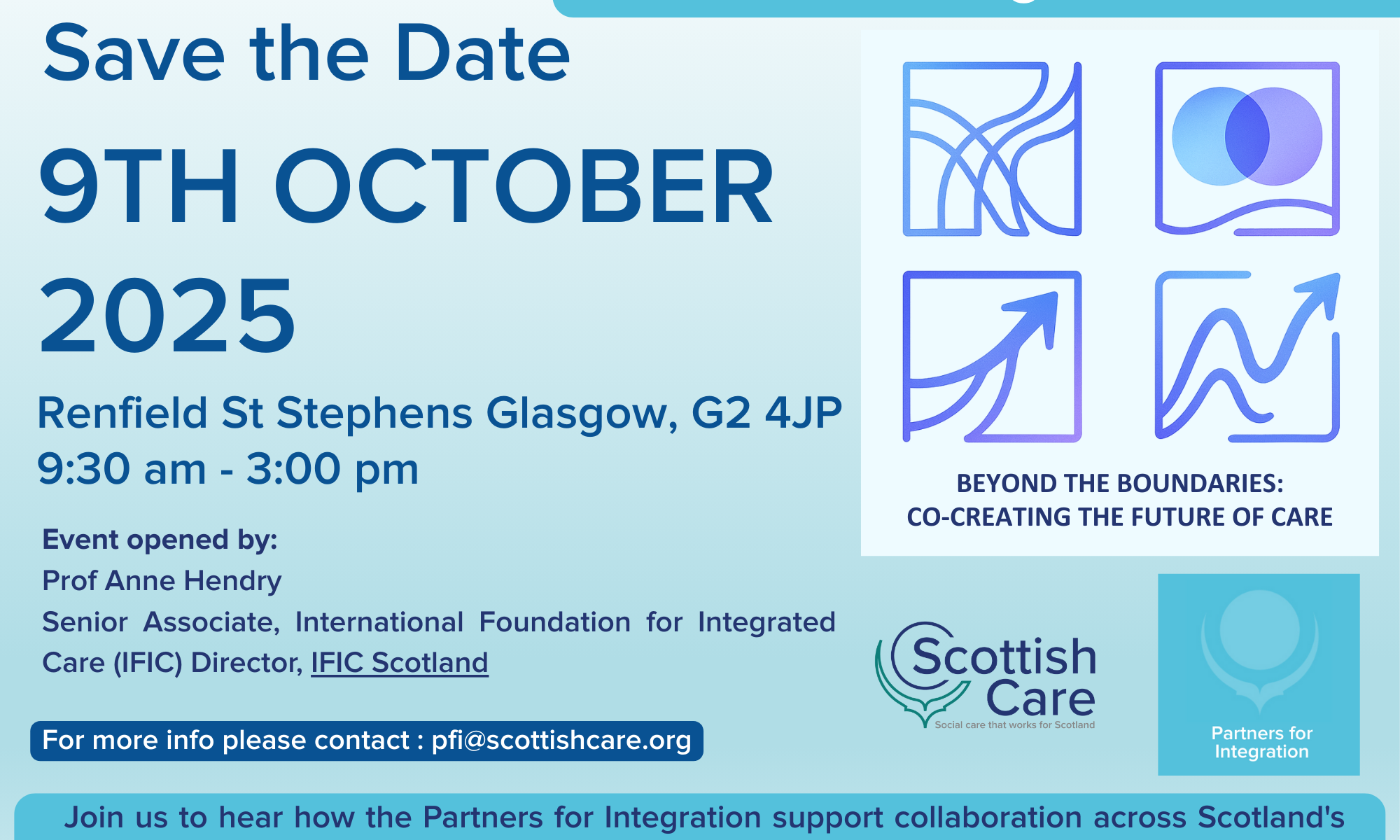
Beyond Boundaries: Co-Creating the Future of Care
📅 9 October 2025 | 🕤 9:30 AM – 3:00 PM
📍 Renfield Centre, Glasgow (G2 4JP)

Join Scottish Care’s Partners for Integration team for a day of insight, inspiration, and connection.

Why attend?

  • 🌟 See real impact: Discover how our team is improving care across Scotland’s HSCPs.
  • 🤝 Strengthen partnerships: Learn how collaboration is driving innovation in care.
  • 📈 Support strategic growth: Explore how we contribute to planning and improvement programmes.
  • 🗣️ Hear from the frontlines: Gain insights from our team and their partners on successful projects.
  • 👥 Network with leaders: Connect with colleagues across HSCPs and independent care providers.

The event programme is available to view down below. Download the programme here.

Feel free to share with other HSCP colleagues who may be interested.

Questions? Just get in touch! Please contact us at: [email protected].

Please note: While this is a free event, cancellations must be made by 2 October. Non-attendance without notice or late cancellations will incur a £25 fee to cover catering costs.

#PFI2025

Tickets are now available to book here.

Partners Event 2025 Programme V1.1

Scottish Care Annual Report 2024-2025

We are excited to share our Annual Report for 2024-2025, which will be presented at today’s AGM in Glasgow.

This Annual Report highlights the work and dedication of the Scottish Care team during what has been a challenging year for the social care sector. It is divided into two sections:

  • Activities and Achievements: This section provides an overview of our organisation’s aims, strategic priorities, and the key accomplishments across our various workstreams over the past year.
  • Finance and Governance: This section outlines our financial performance and governance approach, including the role of our Executive Committee and other representative groups.

You can access both sections of the Annual Report using the buttons below.

Annual Report 2024/25 – Activities & Achievement

Annual Report 2024/25 – Finance & Governance

Manifesto 2025 Session 1: Rights at the Heart of Care (17 Sept 2025)

Scottish Care Members’ Manifesto 2026 – A Call to Action

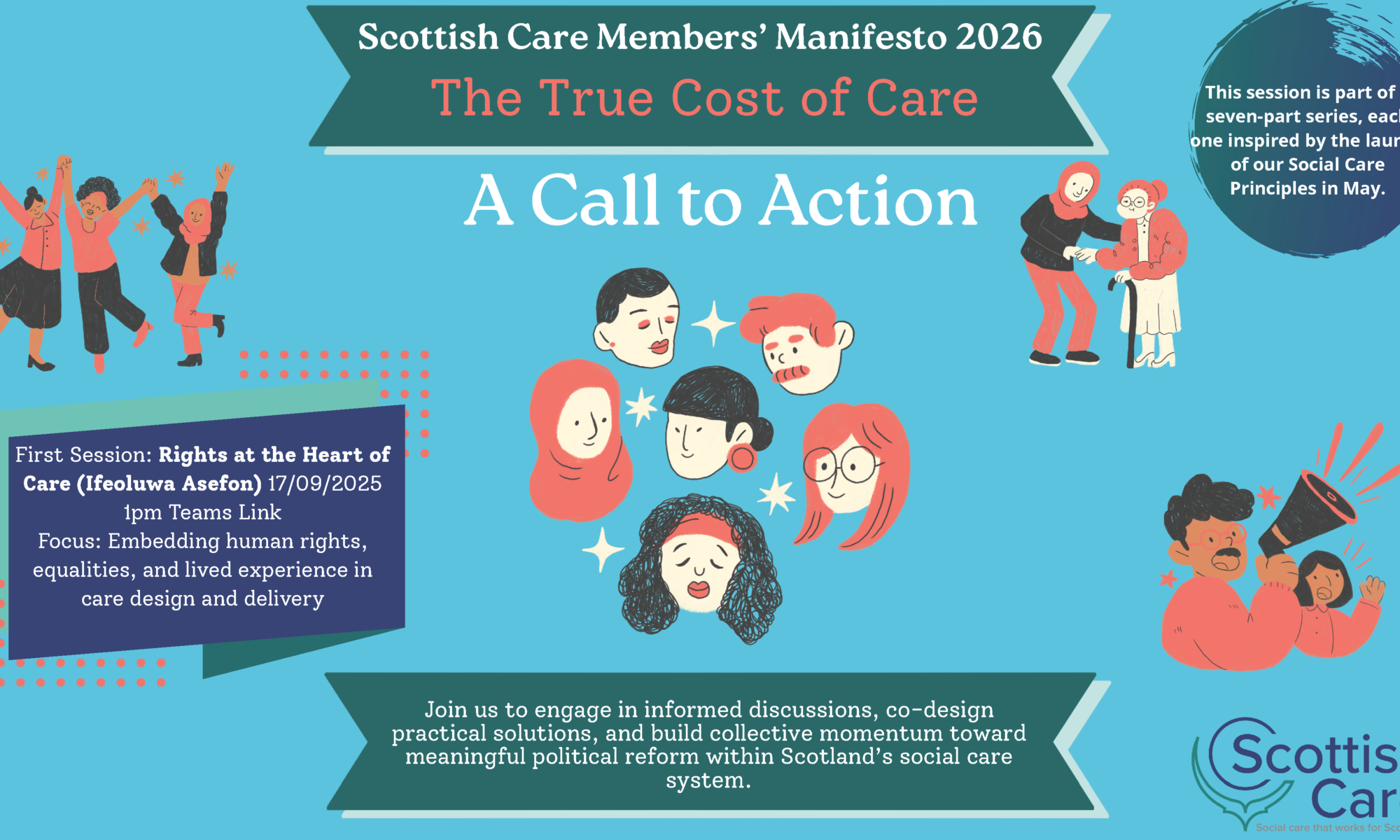
Session 1: Rights at the Heart of Care

Wednesday 17 September 2025, 1:00pm | Online

Scottish Care is delighted to launch the first in a seven-part series inspired by our Social Care Principles, building towards our Members’ Manifesto 2026.

This opening session, Rights at the Heart of Care, will bring members together to co-design practical solutions and build collective momentum for meaningful reform in social care.

Members can register now via the Members Area.

The Distinctiveness of Social Care Nursing – A Call to Discernment

Just occasionally in a conversation or an exchange you hear a word, and it sparks imagination or memory. I was fortunate and have been now for a few weeks to be listening to the Ctrl + Care podcast – which I can thoroughly recommend – and during one of them one of the two main contributors, Michelle Corrigan spoke about how social care is about discernment and how Ai for instance can never replace the activity and the art of discernment.

I have to confess it’s not a word I have used or reflected on for a long period and certainly not outside what might be spiritual or ecclesiastical corridors but Michelle in using it made me think just what is the role of discernment in social care and I reflected further on this at a conference on social care nursing just the other day. So here are some thoughts.

At first the word discernment sounds like an ancient word – something belonging more to the monastery than the modern care home, more to cloistered silence than the daily demands of home care visits. But I want to suggest that discernment is actually at the very heart of what it means to care and support another. And indeed, it is at the very heart of the distinctiveness of social care nursing.

The word comes from the Latin discernere – to separate, to distinguish, to sift. It is more than decision-making, more than problem-solving. It is attentiveness. It is about listening deeply, weighing not just facts but feelings, not just rules but realities.

It is not simply about seeing but about perceiving, about teasing out what is important from what is secondary, what is of value from what is distraction. In the Christian mystical tradition, discernment was spoken of as the ability to sense where love and life were moving, to detect the whisper of the Spirit amidst the noise of daily routine.

In the ancient traditions, discernment was a virtue. In the Celtic world of this land, it was often linked with the idea of anam cara – the soul friend – the one who helps another see the truth of their life. In the secular and philosophical traditions, discernment was seen as a discipline of wisdom: the slow and patient art of sifting, of waiting for clarity before action.

And I think social care nursing, in its essence, is this: not only the application of knowledge and skill, but the cultivation of soul-friendship, the gift of discernment.

In our care homes and in our homecare services, discernment is what distinguishes a task-driven approach from a relationship-centred practice.

It is the difference between hearing a request for a cup of tea – and recognising the deeper thirst for companionship that lies behind it.

It is the knowledge that when someone living with dementia refuses their medication, it may not be stubbornness – but fear, confusion, or a memory of trauma.

It is the sense that when a resident is restless in the night, the issue is not simply sleeplessness – but someone in need of comfort.

Discernment is what guides a carer to pause for a moment longer at a bedside, to ask the question that was nearly left unasked, to offer dignity in the small acts of attention.

Social care nursing has always been about this art: the art of listening beyond the words, the art of noticing the unspoken. And it is so because it is profoundly about nurturing relationship which is always more than simply performing a task.

John O’Donohue, in his luminous book Anam Cara, writes:

“The heart of discernment is to listen for the presence of the other. When you listen generously to people, they can hear the truth in themselves, often for the first time.”

That is, I suspect, the gift of social care nursing. It is not only about providing treatment or attending to tasks, but about creating the kind of space where someone can rediscover themselves, where their own truth can surface.

We are not technicians of the body alone. We are companions of the soul.

Discernment, in this way, is not a luxury. It is not an added extra. It is the very texture of good care and support. It is what makes social care nursing distinctive – grounded in skill, yes, but rooted in presence, in patience, and in the kind of listening that allows another to become more fully themselves.

The art of discernment in social care and social care nursing is one which I think needs to be rediscovered.

And perhaps today, more than ever, discernment is an act of resistance.

It resists the reduction of care to cost.

It resists the temptation to make relationship secondary to efficiency.

It resists the belief that rules and procedures can ever replace the lived moment of encounter.

Discernment insists that every decision is contextual, every encounter is unique, and every person is worthy of time and thought.

We have not lost this need today. Indeed, in a world of information overload, where care is often reduced to metrics and measures, discernment calls us back to something deeper. It asks us to resist rushing, to question the easy answer, to attend to the fragile humanity in front of us.

This is the distinctiveness of social care nursing. It is not simply about doing for another. It is about being with another. It is about the ancient art of wisdom rooted in the everyday acts of attention.

This is not to dismiss the necessity of policy, procedure, or system. But discernment reminds us that no rulebook can ever replace the lived moment of care, the eye contact, the listening ear, the intuitive sense of what is right in this unique situation.

So let me close with a poem, offered as a meditation, echoing the Celtic soul-tone that John O’Donohue so often gifted us:


In the stillness between sea and stone,

where the wind carries whispers of ancient hills,

discernment walks softly,

like a pilgrim listening for the soul of the land.


It is the knowing of tide from wave,

the hearing of truth in the hush of a pause,

the sight of light breaking through cloud,

revealing what lies hidden, tender, and true.


To discern is to sit by the hearth of another’s being,

to hear the music beneath their silence,

to cradle their story as one cradles flame,

protecting it from the gust of indifference.


And in this gentle seeing,

this soul-friendship born of presence,

we remember that care is not duty alone,

but the ancient art of belonging,

the blessing of one heart recognising another.


Donald Macaskill

Photo by Merri J on Unsplash

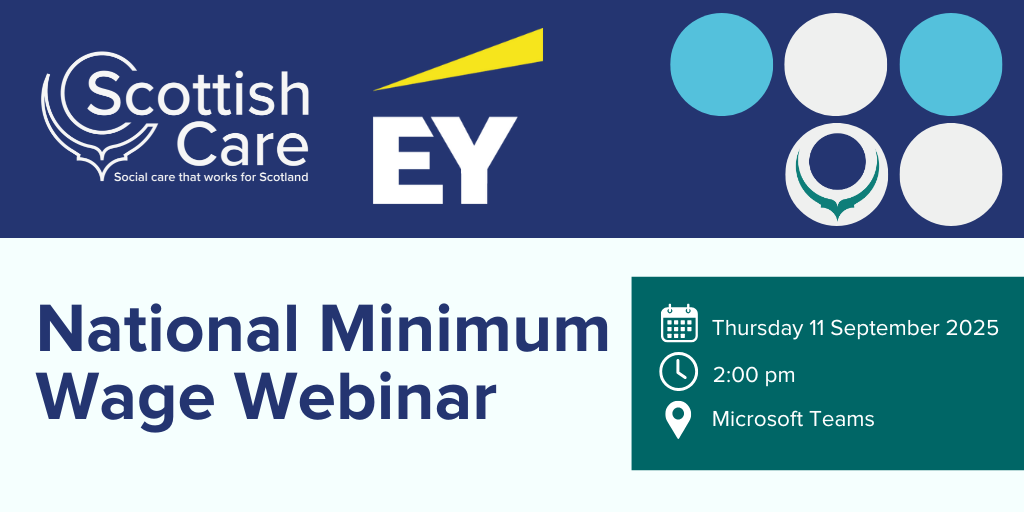
EY Webinar: National Minimum Wage – 11 Sept

Date: Thursday 11 September 2025
Time: 2:00 pm – 3:00pm

Scottish Care will be joined by Gary Henderson, EYs National Minimum Wage lead, to discuss current NMW topics, trends, and challenges.

Gary will be covering HMRCs current enforcement activity in the Care Sector in Scotland – highlighting the risks and issues receiving particular focus.

He will also talk through the timeline of an HMRC NMW enquiry and what your business should expect if an investigation is opened.

Finally, he will share some tips on keeping your business NMW compliant – and outline where you can go for further support and advice.

Gary Henderson has 10+ years experience in the world of NMW, working as an HMRC enforcement officer before joining EYs NMW specialist team in 2022.

This webinar is for members only, please register via the Members Area of our website.

Notwen House Recognised in Scottish Parliament

Notwen House Recognised for Outstanding Care in Scottish Parliament

Scottish Care is delighted to share that Notwen House received formal recognition in the Scottish Parliament on 21 August 2025. A motion lodged by Emma Harper MSP and supported by several other MSPs highlighted the home’s outstanding commitment to residential care.

The motion celebrates the dedication of the Notwen House team, including long-serving staff, for creating a warm, person-centred environment for residents. It also commends the leadership of owner Jim Gatherum and manager Julie Morley, whose compassion and professionalism have earned the home a reputation for excellence.

The Scottish Parliament motion also recognises the unique challenges of delivering care in rural settings and applauds Notwen House for its focus on continuity, experience, and staff training, fostering a truly supportive and caring community for both residents and team members.

Congratulations to the entire Notwen House team on this well-deserved recognition!

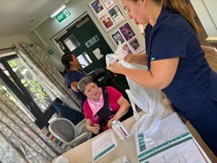
Laura, Resident from Birch House Inspires Through New Role

Scottish Care is delighted to share this inspiring story from one of our member care homes – Birch House.

A resident, Laura, has taken on a new role supporting the staff team by carrying out donning and doffing competencies. She will carry out these checks twice yearly, day and night, helping to ensure safe infection prevention practices across the home.

Laura is thrilled with her new responsibility, which has given her a real sense of purpose and achievement. Next on her development journey will be completing hand hygiene competencies, further supporting the staff and wider care community.

This is a wonderful example of how empowering residents can strengthen both individual confidence and the whole care environment.

laura donnig and doffing_