Home Care Day 19: Defining home care, a blog by our CEO, Dr Donald Macaskill


‘You can change a life in a few minutes…’

In my role I inevitably spend a lot of time with policy makers, commissioners and politicians talking about and not infrequently arguing over the nature and state of the homecare sector in Scotland.  In some of these discussions I get a sense that folks do not really understand the nature of the care and support the sector offers and delivers. For too many there is still an outdated image of homecare as ‘mopping and shopping,’ as a set of practical activities designed to make people feel better but not much more than that. As almost like an added luxury!  This lack of real understanding of what homecare is has become especially evident during this General Election – albeit that these issues are technically reserved matters in Scotland – when it is clear that there is a lack of public and societal awareness about the nature of what homecare is and how critical and vital it is for tens of thousands of people.

But when you strip all the debates – which are critical – around commissioning, funding, workforce and the future away – what you are left with is a consideration of what the essence of care at home and housing support is.

That is why Scottish Care has been articulating our own definition of social care – in part because far too many people (and some of these should know better) keep conflating social care with health care – which it clearly is not! We have stated that:

‘The enabling of those who require support or care to achieve their full citizenship as independent and autonomous individuals. It involves the fostering of contribution, the achievement of potential, the nurturing of belonging to enable the individual person to flourish.’

Homecare is that care and support which enables and empowers an individual to be free, autonomous and independent in their own home. It is the energy which gives purpose to someone wanting to remain in their own space and place, it is the structure of support and care which enables citizens to remain connected to their families and friends, their neighbours, streets and villages. It is not an added extra but the essential care that enables life to be lived to its fullest.

The best of homecare is a care that changes life and gives life.

Some of my readers may know that I am a bit of a Bruce Springsteen obsessive. In an interview which he gave around the time he launched his autobiography in 2016, Springsteen said that:

‘You can change a life in three minutes with the right song.’

He expanded on this by talking about the power of song to change a life and give voice to a story which is not heard or told; the importance of his own challenging upbringing in giving him continuity and boundary, freedom and permission. He spoke insightfully about the way in which words and music can create a possible future for those who feel alone, empty and directionless.

At the time the sense of words and music changing and transforming a life struck me as being a powerful description of the musicality of one of the greats of his genre. But I also think that it is a description of the essential life changing and enabling power which lies at the heart of care. It is this ability to change a life through care and support which we are celebrating in this second Homecare Day.

The women and men who work in homecare are life-changers. The reason that statement is true is that by their acts of personal care, by supporting someone to take their medicines, to get up in the morning; by making sure their space and place is tidy and safe, that hazards are controlled or removed; by taking someone to a club or to their family, to an activity or simply to belong somewhere, these women and men who are the workers of care are the gifters of purpose and meaning to so many. This is not incidental it is essential. It is this work that binds a community together, that truly creates neighbourhood, and moulds togetherness in the midst of our cities, towns and villages.

Most of us are able to be independent – to get around on our own, to have the control that we need not be dependent upon another. As life changes through age or illness the loss of that independence and the forming of bonds which make us reliant upon another can be both challenging and difficult for our sense of identity and self-worth. It is in this territory that the marvellous work of support and care locates itself and comes to the fore.

Good care is not about taking over another person’s autonomy, good support is not about creating dependency – they are both the total reverse. They are the actions and deeds, the words and encouragement that enable others to either re-discover or find for the first time, the abilities to make decisions, to exercise choice, to be in control and to be independent even if support is needed to achieve that goal.

This is why homecare is important – it is because for so many of us being in our own space and place surrounded by familiar furnishings of our memory and the story of who we are,  are critically important to enabling us to be ourselves or to be the person we dream of becoming. The autonomy that homecare gives  a supported person enables them to flourish to their best and continue to grow into the person they want to be.

So, if a good song can change a life in three minutes then good care and support changes a future forever.

So today let us celebrate homecare as the lifeblood of a society which cares.

Dr Donald Macaskill

CEO, Scottish Care

#homecareday19

The Scottish Government’s Adult Social Care Recruitment Campaign – An Overview

Introduction

In early 2020, the Scottish Government will be launching a national recruitment campaign aimed at frontline workers in adult social care (ASC).

Purpose

Recruitment pressures have been increasing in ASC particularly for frontline workers, and some vacancies are becoming harder to fill. This campaign is in response to these pressures, and to the National Health and Social Care Workforce Plan which includes a recommendation to deliver a national recruitment campaign to promote social care as a meaningful, valued and rewarding career choice. This campaign aims to attract new recruits into ASC, in particular in care homes, care at home and housing support.

Timeline

The campaign will launch on 27th January 2020. The campaign will run for eight weeks.

Campaign Development

A review of existing research and bespoke insight research was undertaken to inform the development of the campaign approach and target audience. The campaign’s development and messaging was also informed by:

  • People who use services
  • Focus groups with the campaign’s target audience and the existing workforce
  • A Campaign Advisory Group (CAG)[1]

Target Audience

The campaign is aimed primarily at male and female career changers in the C1C2D socioeconomic groups (SEGs) aged 22-45, with a secondary audience of the same SEG, aged 45-54. A third audience will be key influencers and the sector.

Media Strategy

The media strategy will target commuters on their way to and from work, and is timed to coincide with the ‘new year, new start’ mind-set, when people are considering changing career. It will comprise of press (Metro and Big Issue), digital advertising, radio (local and national) and outdoor advertising (e.g. on buses, trains, phone kiosks and digital sheet panels).  

In addition to the media, there will be:

  • A campaign website, signposting to SSSC’s careers pathway website
  • Partnership and Field activity targeting commuters
  • PR, promoting the campaign and case studies of people who work in ASC

Next Steps

A more detailed overview of the campaign, together with a stakeholder toolkit, will be shared with you once the creative assets have been developed and the website is live.


[1] CAG members are: Scottish Social Services Council (SSSC), CCPS, Scottish Care, COSLA, Care Inspectorate, Health and Social Care Scotland, Colleges Development Network, IRSS, Northern Alliance, the Society of Personnel Directors Scotland, Turning Point, the Scottish Government’s  Marketing and Insight Team and the Office of the Chief Social Work Adviser.  


News Release: Home Care Celebration Day 2019 – Wed 4 Dec

The contribution of home care support is to be celebrated across the UK.

Wednesday 4 December will see an online campaign raising awareness of the crucial role of care at home and housing support services in supporting older and vulnerable citizens across the UK.

Home Care Celebration Day aims to celebrate what home care services do, the people that work in them and the achievements of those supported at home.  The day also seeks to facilitate wider discussions on the future of home care and what services should look like.

The day is supported by two leading care bodies, Scottish Care and United Kingdom Homecare Association (UKHCA), who are calling for organisations and individuals across the UK to join them on social media in raising the profile and value of home care support using the hashtag #homecareday19

Dr Donald Macaskill, CEO of Scottish Care, said:

“This is the third annual Home Care Day and Scottish Care is delighted that it is now a day which is celebrated across the whole of the United Kingdom. It is a day to celebrate and recognise the professional carers who are the lifeblood of Scotland’s care and health system. Through their dedicated skill in support, in palliative and end of life care, in enabling people to remain at home and feel safe, Scotland’s home care workers deserve a debt of huge gratitude.

I hope the day will be one where everyone takes some time to think about those who are cared for and those who care for them. Together they can make us into the nation we want to be, one that cares and enables individuals to live to their fullest potential.”

Jane Townson, CEO of UKHCA, added:

“Home Care Day is a fantastic opportunity to celebrate the difference that the 750,000 people who work in home care services are making in the lives of almost a million people across the UK every year.  From combating loneliness through to supporting people with increasingly complex conditions home care services enable people to live healthier, independent lives at home – the preference for the vast majority of people.

We’re encouraging as many people as possible to get involved in the day and share their stories of the people using and work in care services, as well as their views on the future developments for the sector – please join us at: #homecareday19.” 

Everyone is invited to use this fantastic opportunity to share any good news stories about this sector. We encourage people and organisations to get involved by sharing content through social media with the hashtag #homecareday19. There are a number of themes planned throughout the day including:

  • Defining home care: 8am-10am
    A celebration of what home care is and the crucial role it plays in our communities and health and social care systems
  • Home care heroes: 10am-12pm
    A celebration of the many individuals who work in home care services and the impact they have on people’s lives through their commitment to care
  • Real people, real lives: 12pm-2pm
    A celebration of the achievements and lives of the people who access home care support
  • Changing times : 2pm-4pm
    A celebration of the many ways in which home care services are able to adapt to meet a changing policy and practice landscape
  • The future of home care: 4pm-6pm
    A celebration of the opportunities provided through home care services and support for shaping the future of health and social care

Home Care Day – 4 December 2019

Home Care Day is taking place this year on Wednesday 4 December 2019!

This is a largely online event which looks to celebrate and recognise of the care at home and housing support services across Scotland – including individuals who access these services,  those who work in the sector, and the opportunities that home care services bring to a wide range of people.

Whether you are a provider, worker or partner, we would love to hear your positive good-news stories about the care at home/housing support sector. Please share them with us on social media using the hashtag #homecareday19.

There are several themes planned throughout the day including:

8 am – 10 am: Defining home care 
A celebration of what home care is and the crucial role it plays in our communities and health and social care systems

10 am – 12 pm: Home care heroes
A celebration of the many individuals who work in home care services and the impact they have on people’s lives through their commitment to care

12 pm – 2 pm: Real people, real lives
A celebration of the achievements and lives of the people who access home care support

2 pm – 4 pm: Changing times
A celebration of the many ways in which home care services are able to adapt to meet a changing policy and practice landscape

4 pm – 6 pm: The future of home care
A celebration of the opportunities provided through home care services and support for shaping the future of health and social care

homecare 19 flyer (2)

National Care Home Awards 2019

Scottish Care’s annual National Care Home Awards took place this year on Friday 15 November at the Hilton Hotel in Glasgow.

Huge congratulations to all our winners and finalists, and thank you to all our award sponsors!

#celebratecare #careawards19

Nutrition & Eating Well Award

Winner: Marie Hunter – Thorntoun Estate Nursing Home

Finalists: Iain Young – Murrayside Care Home & Lizzy McNielage – Rumbling Bridge Care Home

Pictured: Winner and Finalists with Michelle McManus and Sakib Rafiq – The Nursing Partnership (Award Sponsor)

Training, Learning & Staff Development Award

Winner: Bandrum Management Team – Bandrum Nursing Home

Finalists: Lynn Hewetson – Erskine Park Home & Margaret Campbell – Blar Buidhe Care Home

Pictured: Winner and Finalists with Michelle McManus and Ann Bain – Vision Care at Home (Award Sponsor)

Outstanding Achievement Award

Winner: Jane Williams – Florence House

Pictured: Winner’s daughter and Florence House staff members with Michelle McManus and Tom Speirs – Addleshaw Goddard (Award Sponsor)

Palliative & End of Life Care Practise Award

Winner: Eric Cordiner – Four Hills Care Home

Finalists: Greencross Care Home & Precious Time Project Team – Antonine House Care Home

Pictured: Winner and Finalists with Michelle McManus and Alan Baird – Scottish Care (Award Sponsor)

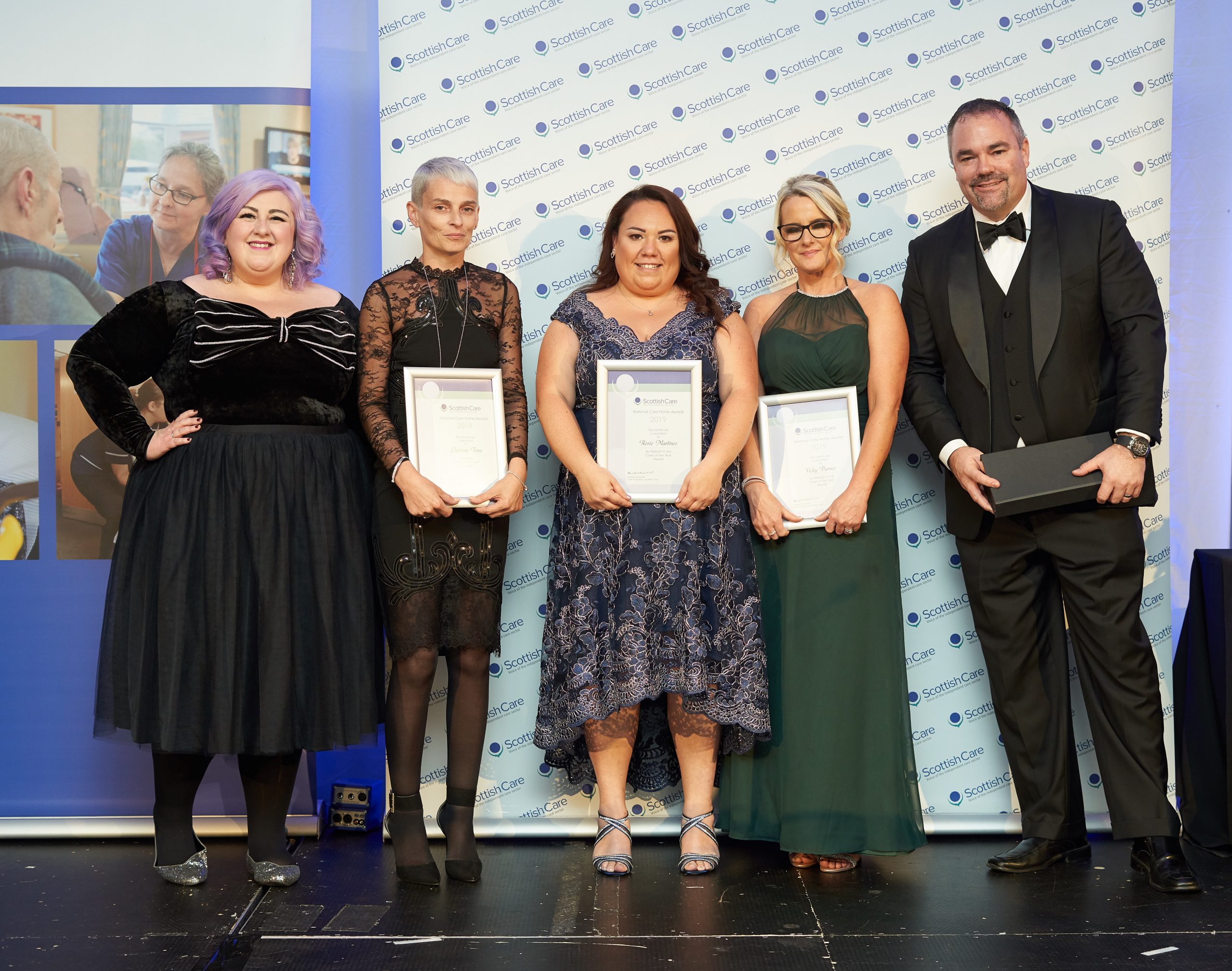
Carer of the Year

Winner: Lavinia Tanu – Balhousie Pitlochry

Finalists: Rosie Martinez – Jenny’s Well Care Home & Vicky Purves – Murray House, Queens House Care Home

Pictured: Winner and Finalists with Michelle McManus and Justin Hutchens – HC-One (Award Sponsor)

Care Home Service of the Year

Winner: Queens House (Kelso) Ltd.

Finalists: Morningside Care Home & Abbeyfield Ballachulish

Pictured: Winner and Finalists with Michelle McManus and Linda Meston – Simply Care Group (UK) Limited (Award Sponsor)

Special Recognition Award

Winner: Robert Kilgour – Renaissance Care

Pictured: Winner with Michelle McManus and Senga Currie – Quality Compliance Systems (Award Sponsor)

Ancillary & Support Staff Award

Winner: Jackie Kennedy – Erskine Park Home

Finalists: Christine Massie – Fordmill Nursing Home & Anne Hughes – Morningside Care Home

Pictured: Winner and Finalists with Michelle McManus and Elaine Rankin – Strategic Thinking (Award Sponsor)

Meaningful Activity Award

Winner: Activity Team – Charnwood Lodge Care Home

Finalists: Sheila Baxter – Beech Manor Care Home & Erskine Care Team – Erskine Park Home/ The Erskine Home

Pictured: Winner and Finalists with Michelle McManus and Andrew Coventry – Lyreco (Award Sponsor)

Emerging Talent Award

Winner: Ben Haddow – Balhousie Luncarty

Finalists: Ross Milne – The Birches & Anthony Mangonon – Berelands House Care Home

Pictured: Winner and Finalists with Michelle McManus and Gerry Hennessey – Meallmore Ltd. (Award Sponsor)

Management & Leadership Award

Winner: Yvonne Manson – Balhousie Care Group

Finalists: Kirsty Faulds – Kyle Court & Teresa Mangonon – Berelands House Care Home

Pictured: Winner and Finalists with Michelle McManus and Alex Wilson – Four Seasons Health Care (Award Sponsor)

Nurse of the Year Award

Winner: Jenny Coutts – Tor-Na-Dee Care Home

Finalists: Linda Mason – Laurels Lodge Care Home & Moira Craig – Hatton Lea

Pictured: Winner and Finalists with Michelle McManus and Salma Iqbal – Boots Care Services (Award Sponsor)

Specialist Service/Unit of the Year Award

Winner: The Oaks Care Home

Finalists: Meadowview Unit – Bandrum Nursing Home & Jenny’s Well Care Home

Pictured: Winner and Finalists with Michelle McManus and Fiona Fagan – Barchester Healthcare (Award Sponsor)

Positive Impact Award

Winner: Pat Gibson – Braeside House

Finalists: McLelland Unit – Douglas View & Diana Moles – Bandrum Nursing Home

Pictured: Winner and Finalists with Michelle McManus and Max Oerton – Compass Associates Ltd. (Award Sponsor)

Care Inspectorate: Consultation events for care at home and housing support services

Since 2018, the Care Inspectorate have been rolling out a revised methodology for inspecting care and support services. The core of the new approach is a quality framework for use in self-evaluation, scrutiny and improvement support which sets out the elements that will help answer key questions about the difference care is making to people and the quality and effectiveness of the things that contribute to those differences. This involves setting out what they expect to see in high-quality care and support provision in order to help allow improvement. Using a framework in this way develops a shared of what constitutes good care and support.

Work is currently underway on a joint framework for support services (care at home) and housing support services (including combined services). The Care Inspectorate wish to consult with the sector to ensure that the framework reflects key issues and areas of practice that will support positive outcomes for the people using this range of services. This will be an approach that will consider how they inspect services across the range of services under these registration categories.

Consultation events are being held at the following locations and we encourage you to participate. A session will be run at each location from 9.30am – 12.30pm. Places will be limited, so please book your place as soon as possible if you are interested.

Please contact Jane McIntosh at [email protected] to request a place at any of the following events:

  • Tuesday 26 November 2019 at the Best Western Queens Hotel Dundee 160 Nethergate, Dundee, DD1 4DU
  • Thursday 28 November 2019 at the Stirling Court Hotel, Airthrey Road, Stirling, Stirlingshire, FK9 4LA

 Please note: A further event will be arranged for Orkney to take place in January 2020.

News Release: Launch of Care Badge Scotland at Scottish Care’s National Care Home Conference 2019

Today, at the National Care Home Conference and Exhibition, CARE badge, the unifying symbol of pride and quality in care, is launched by Duncan Campbell, Director of everyLIFE Technologies Scotland, supported by Dr Donald Macaskill, Chief Executive of Scottish Care.

Under the slogan “It’s the small things that bring people together”, the CARE badge aims to highlight and respect nearly 1 million people delivering care in Scotland every day. This is made up of over 200,000 social care workers, accounting for 7.7% of all employment in Scotland. Unpaid carers are estimated to be 788,000, which is 14.5% of the Scottish population.

Dr Donald Macaskill: I am delighted to be involved in the launch of the Care Badge in Scotland. The work of care is one of the most rewarding, invigorating yet at the same time challenging jobs in Scottish society. We owe an immeasurable debt of gratitude to the thousands of women and men, both paid and unpaid carers, who every day make a difference to the lives of others. They are the soul of our nation and show us our communities at their best.  I hope we will see thousands of these badges being worn in villages, towns and communities across Scotland so that we can celebrate care. This is all about making care visible The valuing of the work of care is a mirror of a nation that cares.”

Duncan Campbell: “It’s time to raise the public profile of this crucial service and the appreciation of those providing care. So we’ve launched the CARE badge campaign in Scotland as a unifying symbol of pride and quality in care.”

In the UK as whole, there are over 2 million social care workers and 7 million more unpaid carers in the UK today. With each carer supporting at least one person, over a quarter of the UK population is either providing or receiving care outside of hospital every day.

The daily impact of care is even greater, given the significant number of family members of those working in or receiving care, as well as the suppliers and employees that assist the sector. Carers deliver this high-quality support each day, no matter if it’s a holiday for others or if the weather is adverse and travel is difficult. Unfortunately, they often do so without the public interest and support that other professionals reasonably enjoy.

The CARE badge CIC is administered and managed for free by everyLIFE Technologies who also donated the first 20,000 badges. To date, over 87,000 badges have been distributed. All profits from the sale of CARE badges are given to care related charities, suggested by care workers and carers and overseen by a CARE badge CIC charity committee.

www.thecarebadge.org

Press Information about everyLIFE Technologies, co-founders of CARE badge

everyLIFE Scotland:

everyLIFE Technologies, a leading provider of care planning and delivery software, is led in Scotland by Director, Duncan Campbell.

everyLIFEprovides the “PASSsystem” suite of care-planning software and apps to the UK’s homecare, reablement and residential care sectors. Provided on a SaaS basis since February 2015 and on a monthly payment structure, the PASSsystem is used by ~700 care businesses throughout the UK.

The PASSsystem digital care planning and management platform provides a single view of care records in real time on both desktop and mobile devices. From initial enquiry and service user assessment through medications (MAR charts), task changes to outcome reviews, PASSsystem automates care management processes while promoting safe medicines administration.

“openPASS” is a sister application that provides consented customers, family members and additional health professionals with inclusive access to real-time care plans and records in the PASSsystem.

Together, everyLIFE’s PASSsystem and openPASS are proven* to:

  • better manage risk
  • realise business efficiencies
  • aid delivery of high-quality care
  • demonstrate accountability to services users, families and regulators

everyLIFE is a Founding Member of the Care Software Providers Association (CASPA).

* Improving care through digital care planning: An evaluation of the PASSsystem by the Social Care Institute for Excellence. SCIE March 2019. Available at https://www.scie.org.uk/

Scottish Care:

Scottish Care is a membership organisation and the representative body for independent sector social care services in Scotland, covering private, charitable and not for profit social care organisations.

We represent over 400 organisations, which totals almost 1000 individual services, delivering residential care, nursing care, day care, care at home and housing support services.

Our membership includes organisations of varying types and sizes, amongst them single providers, small and medium sized groups, national providers and family run services.

Our members deliver a wide range of registered services for older people as well as those with long term conditions, learning disabilities, physical disabilities, dementia or mental health problems.

In Scotland, the independent social care sector contributes to:

  • The employment of over 103,000 people, which is more than half of the total social services workforce, including approximately 5,000 nurses
  • The provision of 88% of care home places for older people
  • The delivery of over 55% of home care hours for older people

About the Care Home Conference:

Over 400 day delegates are expected to attend including care providers, local authority, NHS and Scottish Government colleagues.   This event is the only one of its kind in Scotland specifically for the care home sector and, whilst organised by Scottish Care, is very much a cross-sector event.  The conference is now in its twentieth year.

The conference contains a mixture of key contributions. Through creative, business-focused, practical and policy sessions, the event will focus on the significant role care home services play in ensuring individuals are able to remain connected to their communities and the criticality of their involvement in shaping Scotland’s future health and social care system.

The conference will address current challenges in the sector including workforce shortages, Brexit and the sustainability of the care home sector. There will also be a range of innovative approaches and tech products showcased to help people in their every day care practice.

A number of resources will be launched at the conference:

  • New Scottish Care conference paper – Essential care: the critical role of care homes
  • A hints and tips guide on supporting people with visual impairment from Royal Blind, in partnership with Scottish Care
  • The formal launch of the CARE Badge in Scotland

The conference hashtags are #essentialcare and #carehome19

Genesis of the CARE badge:

The CARE badge was born on the 19th March 2019, while listening to Professor Martin Green, Chief Executive of Care England, highlight the challenges faced providing care and the unfortunate message that the Secretary of State for Health and Social Care inadvertently sends to those involved by only wearing an NHS lapel badge. The Chairman of everyLIFE Technologies, sitting in the audience turned to his colleague and said, “We should work with them to change that”.

How to get CARE badges: 

The CARE badge is sold to companies, charities and other organisations by the CARE badge CIC (community interest company). Badges are not sold to the public directly. Badge purchasers are both from the care community as well as national corporations and organisations, such as supermarkets, manufacturers, service industries etc., interested in supporting care workers and the carers in their own workforce.

Badges are distributed for free to employees and customers i.e. badges are not for resale. Badge purchasers are also given the right to use the CARE badge logo in their marketing materials to highlight how much they CARE.

Organisations with few employees or customer outlets can donate purchased badges to the CARE badge “pool”These will be distributed on their behalf to individual carers for free by the CARE badge CIC at care-related events.

Order details can be found on www.thecarebadge.org. Badges cost £1 including P&P (plus VAT when applicable). There is a minimum order size of £100, with a choice of three fixing styles; butterfly pin, magnetic and brooch to suit both care and non-care settings.

All profits from selling CARE badges go to care-related charities:

The CARE badge CIC is administered and managed for free by everyLIFE Technologies who also donated the first 20,000 badges and 1,000 display trays. Costs incurred are therefore limited to the cost of badges, packaging and postage. All profits from the sale of CARE badges are distributed to care related charities, suggested and voted for online by care workers and carers and overseen by a CARE badge CIC charity committee.

Find out more: 

The website (www.thecarebadge.org) carries background, details of our growing community of partners, and how to order the CARE badge. Twitter, Facebook, Instagram and LinkedIn are live with @theCAREbadge and #badge4CARE. Please post pictures of individuals and teams showing how much they CARE.

Feel free to get in touch by emailing [email protected].

News Release: Care Home Conference 2019 – Essential care: the critical role of care homes

“Essential care: the critical role of care homes”

CARE HOMES ARE ESSENTIAL TO SCOTLAND’S ECONOMY & FUTURE, SAYS SECTOR BODY

Scotland has to get serious about valuing social care or risk losing the vital services, jobs, social and economic contributions it provides.

The message will be delivered at the National Care Home Conference in Glasgow today (FRI NOV 15) by Dr Donald Macaskill, Chief Executive of Scottish Care, the representative body for the country’s independent social care services. The 450 delegate event – the largest event of its kind in the UK - which is sponsored by the Clydesdale & Yorkshire Bank, will include an address by Cabinet Secretary for Health & Sport Jeane Freeman.

Unveiling a new report of the same title as the conference - ‘Essential care: the critical role of care homes” - Dr Macaskill said:

A Scotland that invests in its people invests in care.

“The care sector is a people sector. It is also a sector that contributes massively to the Scottish economy - more than Agriculture, forestry and fishing and many other sectors.

“So why is it that we have so little focus on the need to invest in and grow the care sector? Why does it feel like businesses that care - that employ thousands of people, that are economic engines and care centres at the heart of our villages and towns - continually feel as if they are having to beg new resource, scrimp and save and be apologetic for asking for more? 

“We need to get serious. We either want a world leading care sector with the best possible rights-based care or we want just enough, the sufficient, the it’ll just have to do approach.

“If we are serious about being a country that cares, then let’s grow the sector, let’s invest time, energy and resource in being the best; let’s change the record from it costing too much to contributing so much; let’s invest to ensure survival and sustainability, growth and cutting edge innovation; let’s invest in care by creating a special economic task force to make social care an economic priority .

“Let’s get serious about care or let’s finally stop pretending that we care - and be honest with those who are our most vulnerable and needy.”

The report details the role that care homes play in contributing to Scottish society and citizen wellbeing, in areas such as ethical technology, upholding human rights and tackling social isolation and loneliness.  It highlights that social care is the eighth largest employment sector in Scotland, with nearly 54,000 individuals working in care home services.  With over 1,100 care homes supporting over 33,000 older people in communities across Scotland, the report outlines the ways in which care homes:

  • give people back a sense of community and connectedness where this has often been lost through isolation and ill health
  • prioritise the respect and dignity of all residents in their practice
  • provide companionship as well as complex health and social care support to individuals with a wide range of conditions
  • challenge perceptions of what older people can offer and achieve.

Warning of the dangers of continuing to underfund social care, Dr Macaskill will tell delegates:

“We need to get serious. We either want a world leading care sector with the best possible rights-based care or we want just enough, the sufficient, the ‘it’ll just have to do’ approach.

“If we are serious about being a country that cares, then let’s grow the sector, let’s invest time, energy and resource in being the best; let’s change the record from it costing too much to contributing so much; let’s invest to ensure survival and sustainability, growth and cutting edge innovation; let’s invest in care by creating a special economic task force to make social care an economic priority .

To politicians and health and social care partnerships, he will say:

“Let’s get serious about care or let’s finally stop pretending that we care - and be honest with those who require support in our country’s care homes.”

Derek Breingan, Head of Health & Social Care Sector at Clydesdale & Yorkshire Bank, who sponsor the care home conference added:

“Never has the role of care homes been more crucial for our ageing population with the rise in longevity and increasing ability to live with complex medical and physical conditions.  The diversity of the Scottish demographics and the geography of our country also add an element of challenge. 

“As strong supporters of the sector Clydesdale Bank is delighted to be working with Scottish Care to contribute to ensuring that care homes remain integral to the future of health and wellbeing for our society and also will provide a stable and rewarding workplace for those dedicated to delivering quality care.

Blog: Disrupting stigma means disrupting commissioning and procurement

Every single day I hear people discussing the sustainability of the care sector.

I hear it from providers, I hear it from commissioners, I hear it in the news, I hear it from our Politicians. But the quietest of all in this are those who are most affected. I almost never ever hear it from those who access care and support or indeed their loved ones who are also impacted by social care experience.

This voice is missing for many reasons, but mostly because it comprises of our most vulnerable. Those who may need support to articulate their desires clearly, or perhaps those who do not wish to rock the boat because they may have fought for what they receive, or even those who come to social care at a point of crisis. At best, it may find itself contained within a report presented to an Integrated Joint Board or kept in a silo perhaps because it is considered to pertain only to carers and not the holistic setting that a family is.

There is a stigma in accessing care and support. Those media headline grabbers and others on that bandwagon should put themselves in the shoes of those who may be in the demographic of the ‘ticking time bomb’ they write about. My own loved one describes a pervasive guilt about accessing something in case it prevents another, “perhaps younger person”, from accessing it. The guilt is so deep that I cannot even name them here.

And so we find ourselves (for a variety of reasons) in a place where people are coming to care much later than previously, which means they have more complex needs, are requiring a more intrusive intervention and face potentially life-limiting circumstances as they often first enter ‘the system’ because of an unplanned hospital admission.

This position then creates a ‘double whammy’, in both the here and now, and in the future, as without accurate data, we cannot accurately plan. For instance, how do we know how many care staff or nurses we might need, or need to train, if we do not have a true picture of those who may actually need care and support? And perhaps more importantly, how do we adapt for the future? For instance, by utilising and embedding preventative disruptors such as technology developed and applied with human rights in mind (guided perhaps by Scottish Care’s Human Rights Charter and Guidance for Technology).

Amidst this there remain Health and Social Care Partnerships who continue to dis-invest from social care in order to meet targets, without realising the wider impact upstream. Or worse still, to test out that impact in order to prove a point. And in doing so, completely missing the point. Health and Social care is about people’s lives and lifestyles, not about which funding body holds the pot of money.

The chronic and long-term under-funding of the care sector is undermining the human rights of the citizens of Scotland. It has created the conditions for marketplace competition – a drive for the lowest price rather than the high-quality care and support that the people of Scotland deserve, but which care providers continue to strive for. You don’t come into care if you don’t care.

An Ipsos Mori/Centre for Ageing Better survey conducted earlier this year explored user views on the worst things about getting old: 30% are concerned they won’t have enough money to live on, 26% losing mobility, 24% losing memory; 22% unable to do things they once could, 19% being lonely[1]

Quite frankly, we can do better. If people knew about the opportunities which lie in social care, this could be vastly reduced.

However, I write this blog in the week that the process for application to the National Procurement Framework for Care and Support is due to close. Scottish Care is eager to play our part in ensuring that the current model of commissioning and procurement is changed to ensure that it better reflects a rights-based, trust focused and relational approach to the care and support of older people. I personally have a history in disrupting commissioning practices from when I worked for a Local Authority in England (incidentally, joint funded by the NHS) leading to a model devised by working with families and providers, and resulting in 110% more people having access to care and support than previously at no additional cost.

Collaboration and co-production is where we work together to make the most out of what we have, and the bringing together of minds around a common vision and focus leads to realistic innovation, choice and control. Not incidentally a characteristic required of the market by the Self-Directed Support (Scotland) Act.

Scottish Care saw the initial development of the National Procurement Framework as offering the potential of reducing complexity, fostering relationships and addressing some of the sustainability issues. Yet the process has resulted in a Framework which is far from proportionate, requiring only the accountability of providers, it leads merely to a duplication of regulation and negotiation. An action in opposition of the trust-based relationships being nurtured and in effective community-based planning, and which led to the inherently more cost effective and equitable service provision which I describe above in my previous work.

There are of course other challenges with the framework, but that unwillingness to engage and work with the whole sector as equals is what mostly holds us back. In one recent review of a Health and Social Care partnership, their only comment on the contribution of the independent sector, was to list the number of care home beds and home care hours that they provide. This undermining of resource and opportunity and resistance is clearly articulated in the Audit Scotland report into integration which describes the challenges of culture change and the role of leadership in achieving and embedding best practice. After all, it is best practice which offers opportunity.

Whilst a solution is complicated, it is not unachievable.

In May I launched a paper on ‘Putting Human Rights into the Commissioning Cycle’ at the Scottish Care National Conference for Care at Home and Housing support in an attempt to put the person into planning. All too often Strategic Planning happens behind closed doors and based purely upon a set of statistics, or upon the results of community engagement which is tokenistic or piecemeal and therefore not representative. A shared vision grounded in human rights can support a whole community, including the significant contribution of independent care providers, to come together for good.

Above all however, that shared vision must be a positive one. A vision which recognises the value of our older people and the contribution that they and their families make, a vision which recognises the wider value of social in employing 1 in 10 Scots, and in contributing £3.4 billion to the economy, a vision which values the varied mix of care and support which offers real choice and control to those who may wish to access it.

At the recent Business in Parliament Conference, the First Minister said that “ … any country will only achieve it’s potential if it enables the people within it to achieve their own potential”.

Well, that time has come, who’s with me?

Karen Hedge

National Director, Scottish Care


[1] IpsosMori/Centre for Ageing Better/Feb 2019

Updated guidance to support the real living wage commitment for adult social care workers

Below is a letter from Ms Freeman, Cabinet Secretary for Health and Sport, and Cllr Peter Johnston, COSLA Health and Social Care Spokesperson, with updated guidance on the shared commitment to support payment of the real Living Wage to everyone delivering adult social care in Scotland.  The guidance has been developed by the Living Wage in Care Implementation Group which was established to support. The group comprises representatives from Scottish Government, COSLA, Coalition of Care and Support Providers (CCPS), Scottish Care, the STUC and Integration Authorities.

Guidance to support real living wage commitment - Letter from Scottish Government COSLA October 2019 - final PDF
Guidance to Support Commitment of the Real Living Wage for Adult Social Care Workers October 2019 - final PDF copy