Scottish Care CEO responds to energy plans

Scottish Care CEO, Dr Donald Macaskill, responds to the Prime Minister’s speech on the Government’s plan for energy bills. He said:

“The announcement of a 6-month freeze in energy costs for businesses by the Prime Minister is to be welcomed. The devil in all such statements is in the detail. We note that there will be a requirement to review this support after a 3-month period and that there is a probability that this will target vulnerable businesses. The very nature of the care home and homecare sector is that it is one of the most vulnerable sectors and we will continue to argue strongly to the UK and Scottish Government ministers that emergency priority must be given to the care sector to ensure that those who use social care services, who are amongst our most critical citizens, will be adequately supported over the next years of energy uncertainty.”

Five Nations Care Forum Statement on Social Care Energy Crisis

News Release: Social care energy crisis

Intervention is required to prevent the collapse of social care from rising energy costs.

The Five Nations Care Forum, which comprises of care associations from Scotland, England, Wales, Northern Ireland and the Republic of Ireland, is calling for urgent intervention in the energy crisis in social care.

Rightfully, there have been many stories in the media about the sharp increase in energy costs for domestic consumers. However, the increases in energy costs will lead many vulnerable older people who desperately need a Winter of warmth to place themselves in situations of risk to health and wellbeing. The increases have already placed tens of thousands of citizens into real fuel poverty.

Little attention has been given to the effect of energy price increases on care homes and homecare organisations. The astronomical increases in energy bills have led to many care homes closing. Rising fuel costs have also meant that homecare organisations are closing their doors to new business, and handing back care packages.

Some of our most vulnerable people in care and supported housing are excluded from the various measures in place to support people living in their own homes with their increasing energy costs, such as the £400 energy rebate. There needs to be parity for the individuals living in care and support.

Social care and support providers are facing eye-watering increases in excess of 400% in their energy costs, both gas and electricity costs, which is simply unsustainable. The current energy crisis comes at a time when the sector is experiencing the worst workforce pressures the sector has ever known. Care and support providers are in a position where they must be able to offer better pay and rewards to retain and recruit staff, which is a direct impact of the pandemic.

Without assistance and funding, the rising costs will lead to many more care providers shutting down and ceasing the delivery of care. Staff will lose their jobs and local communities will lose vital care services. For care homes, the loss of home, familiarity and shared company will be devastating for affected residents. And trauma caused by care home closures can have a life-shortening effect. Some of the UK’s and Ireland’s most vulnerable citizens will effectively lose their homes and will have to move to the local hospital or another care facility.

Social care enables people to return home from the hospital and receive adequate care and support, stopping unnecessary admission. A rise in care home and homecare closures will result in real pressure on the NHS. With hospitals already overburdened, they will be unable to cope with delayed discharges, hence having a negative and dramatic impact on those who need NHS treatment and care. If social care collapses because of the energy crisis, then the NHS will follow soon after.

The current energy crisis presents a very real threat to the sustainability of social care delivery. Social care services provide a vital public service to the most vulnerable in our communities but have been largely ignored through the packages of support offered to the nation in dealing with the cost-of-living crisis. There is also a need to treat this care energy crisis with the same degree of emergency financial intervention as was received during the Covid-19 pandemic. Therefore, the Five Nations Care Forum calls on the Governments of the UK and Ireland to attend to this issue as a matter of urgency by:

  1. Issuing emergency funding to the social care sector to deal with the rising energy bills
  2. Introducing an energy price cap for care settings in line with the domestic energy price cap.
  3. Extending that allvulnerable people have access to energy rebates , including those who have made their home in residential homes or supported living.
  4. Ensuring any tax based reform applies to energy bills in a way that incorporates all care settings.

-ends-


This statement has been issued by Scottish Care on behalf of the Five Nations Care Forum, of which Scottish Care is a member.

About the Five Nations Care Forum

The 5 Nations Care Forum is an alliance of professional associations representing the care sector across the UK and Ireland. Through a collective commitment to information sharing, joint lobbying, shared learning and support, the 5 Nations Care Forum aims to add value to members’ activity by promoting the interests of service recipients, staff and service providers. The Forum seeks to encourage the development of a joined-up approach to matters which have a UK-wide or European dimension.

For more information including membership: http://www.fivenationscareforum.com/

 About Scottish Care

Scottish Care is a membership organisation and the representative body for independent social care services in Scotland.  We represent over 400 organisations, which totals almost 1000 individual services, delivering residential care, nursing care, day care, care at home and housing support services. Our membership covers both private and voluntary sector provider organisations.

For more information on Scottish Care’s work: www.scottishcare.org

Media

Media queries, including interview requests should be made via [email protected]


Homecare Day & Light Up for Carers 2022 – 22 September

Homecare Day

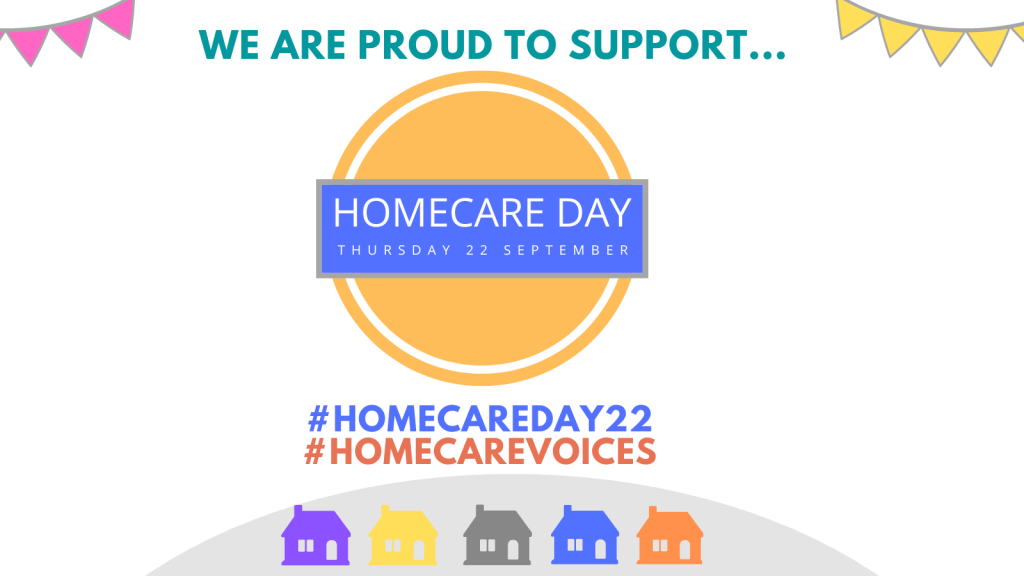
Homecare Day will be held on Thursday 22 September 2022. 

This is a largely online event which looks to celebrate and recognise the homecare services across the UK. Whether you are a provider, worker or partner, we would love to hear your positive good-news stories about the care at home/housing support sector.

The theme of Homecare Day is ‘Homecare Voices’ with the aim to:

  • Listen to the voices of care at home & house supporting staff, providers, managers, service users and relatives.
  • Showcase the expertise of the homecare workforce, and how they should be valued more.
  • Highlight how homecare plays a crucial role in the health and social care system and within their communities.

You can help us commemorate the day by sharing any good news stories, resources, projects, blogs or an example of an innovative practice on social media.

Please use the hashtags below when sharing content, and  will re-share from the Scottish Care account.

#homecareday22
#homecarevoices

If you aren’t on social media, please feel free to share any stories with us at [email protected].

We will be creating some resources for members to use on Homecare Day, these will be sent out in the next weeks.

Light Up for Carers

The Partners for Integration team, along with Scottish Care, will be marking ‘Homecare Day’ by lighting up buildings in Scotland to give thanks to the homecare and social care workforce.

A full list of buildings involved in this initiative will be sent out closer to the time.

The buildings will be lit up in the colour yellow, which was chosen to symbolise the flame of a candle, much like our ‘Candle for Care’ campaign on Twitter.

The homecare sector shows us caring, resilience and compassion at its best. Yet this workforce is often undervalued and not recognised. This workforce deserves recognition for their dedication and professionalism every day of the week, regardless of weather, risk or fear.

This is the perfect opportunity to acknowledge the social care workforce and we encourage care home workers to join the celebration at these buildings on the evening of Thursday 22 September.


More details to follow.

Extended Use of Face Mask Guidance Webinar – 1 September

The Scottish Government will soon be updating the extended use of face mask guidance within social care settings. To discuss the updated guidance, the Scottish Government would like to invite staff, managers and providers within the social care sector to attend a webinar, hosted by Scottish Care, on Thursday 1 September, 2:00 – 3:00 pm. Policy and clinical advisors look forward to answering any questions you may have about the guidance.

This session will also discuss changes to testing as well.

Please note that this webinar is open to the whole of the social care sector and not just Scottish Care members. This webinar will also be recorded and available after broadcast.

The details for joining the webinar are as follows:

Webinar link: https://us02web.zoom.us/j/84344629870?pwd=eE85R3k5VVZ2WXN0M0I3VmQzRDNRUT09

Meeting ID: 843 4462 9870

Passcode: 828169

Global Ageing Conference 2023 – Call for Presentations

The 2023 Global Ageing Network Biennial Conference will be hosted in Glasgow, Scotland on 7 – 8 September 2023. This conference will be in partnership with Scottish Care and the National Care Forum – leading care and support provider associations in Scotland and England.

The event will bring together several hundred international delegates and leaders in ageing services, housing, research, technology and design.

The Global Ageing Network seeks to bring together experts from around the world, lead education initiatives and provide a place for innovative ideas in older person care and support to be born. They seek to improve best practices in aged care so that older people everywhere can live healthier, stronger, more independent lives.

The conference theme is ‘Care about Our Future: Global Symposium for Sustainable Care and Support’. We are currently inviting presentation submissions for this conference. We are seeking presentations that embrace a future perspective and feature thought leadership. Including innovative ideas, research, projects and/or programmes that address specific needs in supported housing, homecare, residential and nursing care and support, backed by professionally documented practical experience and/or research findings.

Find out more on: www.globalageing2023.com

National Care Service Webinar – 24 August

We are hosting a National Care Service Bill engagement session next week on Wednesday 24 August 2022, 2:00 pm.

This session is open to all Scottish Care members and staff. Our Policy & Research Manager, Becca Young, will be presenting on the progress of the National Care Service Bill and the consultation process currently underway. There will also be time for discussion and to ask any questions. This is an opportunity to hear more about Scottish Care’s response to the Bill, and for your comments to help shape Scottish Care’s submission to the Stage 1 Calls for Views. We would greatly appreciate your attendance at this session. A briefing will be shared in advance but attendees are also encouraged where possible to familiarise themselves with the National Care Service Bill:

Please register your interest using the form available on the Members Area of this website.

Please note that this webinar will be in a Teams Meeting rather than the usual Zoom format. After registering, you will be sent the joining link a few days before the webinar.

The straw that breaks the back of care

The last two and a half years have been a period which has been without equivalence for the care home and homecare sectors in Scotland. Regular readers of this blog will know that I have throughout sought to comment and reflect on the whole range of issues and challenges facing the social care of older Scots during this time. I found myself in a reflective mood this past week about the highs and perhaps more persistently the lows that people have been through these last few years. I was doing so because despite the challenges of dealing with an unknown deadly virus, the trauma of tragic deaths in care homes, the acute distress caused by visiting restrictions, the abandonment of those requiring support in their own homes, of disproportionate and inequitable processes such as Operation Koper, of misfiring oversight and scrutiny, of fundamental errors in guidance and clinical response, of an exhausted and burnout workforce, of struggles to recruit and retain amazing staff, of the limitation of fiscal support – despite all this care homes and home care organisations have kept going, kept caring, kept delivering care and compassion with the regularity of committed dedication and professionalism – until now.

Without a shadow of a doubt and with no sense of hyperbole I am now more worried about the survival of social care delivery in Scotland than at any time before or during the Covid pandemic.

We are living in the midst of a perfect storm and already in the last month high quality and excellent performing care homes have either closed or intimated their intention to cease delivery. The same is true of homecare organisations both closing their doors to new business and handing back care packages. The reasons are numerous and manifold from the struggle to recruit staff, inexcusable contractual practices, the critical withdrawal of funding for PPE and infection control at a time of rising Covid cases, astonishing increases in the cost of insurance and so much more. There are many reasons for concern.

But the proverbial straw which has led many to intimate to me they will simply not survive until the year’s end is the spiralling cost of energy combined with the wider cost of living crisis. This week’s dire warnings from the Bank of England of rising inflation and the increase in interest rates will add thousands onto the bills of many care organisations and will push even more of them to the edge of the survival precipice.

In the past week the media has been rightly full of stories about the sharp increase in energy costs for domestic consumers. I have warned previously that the increases in energy costs now and in October will lead many of our most vulnerable older people who desperately need a winter of warmth to place themselves in situations of risk to health and wellbeing. The increases have already placed tens of thousands of our fellow citizens into real fuel poverty.

Little attention has been given to the effect of energy price increases on care homes and homecare organisations. Simply put the cost increases have already been astronomical and have to date in the last few weeks led to some care homes closing their doors. A typical increase was shared with me this week. A small rural Scottish care home which plays a crucial role in its local community in the last year paid around £6,000 for its electricity and gas. Next year the cost will be £36,000. That is a sixfold increase for an organisation which has no private clients and whose residents are all funded by the State at a fixed rate. This is totally unfordable and without assistance that care home will close its doors and its residents will have to transfer to the local hospital or to other care homes should they be available. As I write this another email has landed on my desk stating a care home is being faced with a bill next year of £210,000 compared to £40,000 this year. And all this is because some care homes are renewing now when their fixed rate deals are coming to an end – and I shudder to think what October will bring.

I hardly need to say that the eye-watering increases in energy costs faced by care homes will lead many of them to shut and cease to deliver care. This will first and foremost be devastating for the residents of these care homes because we know that the trauma caused by care home closure has a life-shortening effect. Some of our most vulnerable citizens will become effectively lose their home and will have to either move to the local hospital or to another care facility perhaps miles away. The loss of home, of familiarity and shared company will be devastating on these individuals. Staff will lose their jobs and local communities will lose vital care services. At a national level a rise in care home closures which is presently occurring at an increasing rate will become a flood of closures resulting in very real pressure on the NHS with hospitals already overburdened unable to cope which will lead to unsustainable delays in discharge and will have a dramatic negative impact on all those who wish NHS treatment and care. Our hospitals will fill up and we will not be able to cope with the pressure. Simply put if the care service collapses and implodes because of the energy crisis then the NHS will follow soon after such is the dependency on both in the economy of care support.

In response to all this – what is happening politically? Despite people like me ringing the alarm bell for several months on this critical care energy crisis there strikes me as a degree of political head in the sand behaviour as the buck is continually passed. The former Chancellor Rishi Sunak announced a not insignificant intervention several weeks ago which will result in every citizen receiving £400 to support their energy costs. An equivalent intervention is urgently needed for the care sector, both homecare and care homes.

Today therefore I am calling on the UK Government to intervene and issue emergency funding to the care sector across the United Kingdom. I want both candidates for the Conservative Party leadership and the Prime Ministership to intimate what they are going to do to save the care sector in the United Kingdom and prevent the effective collapse especially of smaller, rural and remote care homes.

In Scotland we have a higher proportion of care homes run by smaller organisations, often family run establishments and charities. We are in a highly vulnerable situation and these organisations have no capacity to pay the mind-boggling fuel increases being demanded of them. As most of the care home and homecare provision in Scotland is paid for by the State then to maintain care the State needs to pay more or risk both personal trauma for residents and whole health and care system collapse.

The challenge facing care homes and care organisations is at a level no one can ever remember. I have had people in tears this last week wondering how they are going to survive and how they will tell families, residents and staff that they cannot continue.

There is a need to treat this care energy crisis with the same degree of emergency financial intervention as was received during Covid. The situation the care sector is in in Scotland today is significantly riskier than Covid and will have just as dramatic an impact on life and the health of our vulnerable citizens. We need urgent action from the United Kingdom and Scottish Governments and need it now. Local authorities who are responsible for paying for social care are penniless as we have seen in the media this week in relation to threatened strike action and even the additional £150 million announced by the Scottish Government yesterday will not suffice. Only Northern Ireland has acted – in their case with a £50m energy fund for care homes. The United Kingdom and Scottish Governments need to act now to save care and stop blaming one another and passing the buck.

If we don’t start to care about care then there will be no care sector left to care about or care for. There is not a lot of time left


Donald Macaskill

Scottish Care Awards Hints & Tips Webinar – 16 August

The Scottish Care Awards are the perfect opportunity to recognise and celebrate the best of the independent social care sector. We typically hold an Awards Ceremony for finalists and winners twice a year – Care at Home & Housing Support in May and Care Homes in November. Awards entries are open a few months before the Awards Ceremony.

If you don’t know where to start or need help filling out a nomination, don’t worry! We are holding a Scottish Care Awards Hints & Tips Webinar on Tuesday 16 August, 2:00 – 3:00 pm for all members to find out more about how to submit a successful awards entry!

Our Deputy CEO, Karen Hedge, will be going through the application and the judging process. We are also hoping to be joined by some successful awards applicants to talk about their experiences and how winning the Scottish Care Awards has impacted them.

This is your chance to come along to ask questions and get all the hints and tips to being successful in the awards. Don’t miss out and join us for this webinar session!

Entries for the Care Home Awards are currently open until 5:00 pm, Monday 5 September, so if you are considering entering, come along to this webinar to get all the information you need! Find out more about the Care Home Awards here.

Details to join the webinar session will be available in the Members Area.

If you have any questions about the Awards, please get in touch with us at [email protected].

2022 Care Home Awards – Open for entries!

We’re delighted to announce that the 2022 Care Home Awards are now open for entries!

Scottish Care would like to invite you to enter your company, staff and residents for this year’s awards. Please help us recognise the work of fantastic staff and providers whilst also giving positive visibility to this often neglected sector.

There are 13 award categories, including:

  • Ancillary & Support Staff Award
  • Nutrition & Eating Well Award
  • Meaningful Activity Award
  • Training, Learning & Staff Development Award
  • Emerging Talent Award
  • Outstanding Achievement Award
  • Leadership Award
  • Palliative & End of Life Care Practise Award
  • Nurse of the Year Award
  • Care Worker of the Year Award
  • Specialist Service/ Unit of the Year Award
  • Care Home Service of the Year Award
  • Positive Impact Award

Find out more about the awards and submit your nomination here.

Award entries close on Monday 5 September 2022, 5:00 pm.

The award ceremony will be held on the evening of Friday 18 November at the Hilton Hotel in Glasgow. More details to follow.

Summer Bulletin 2022

This year’s Summer bulletin has now been published online and is available to view.

We will not be sending out physical copies of the Bulletin due to Covid-19, this edition is in a digital format instead.

We are in the process of redesigning our quarterly Bulletins. If you have any feedback or ideas of what you’d like to see in the Bulletin, please get in touch at [email protected].