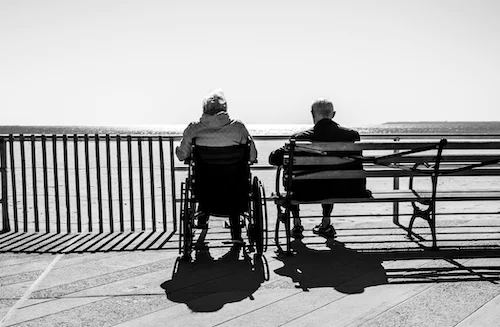
A place to belong: ageing at home. A reflection for the International Day of Older Persons.  

Whenever I am with a group of people who come from outside Scotland one of the commonest questions I get asked – as I am sure we all do – is “Where do you come from?” I have to confess it is a question I have often struggled to answer and have probably given contradictory and different replies over the years.

“Where do you come from?” might simply be a request for geographical birthplace origins but it is so much more.

For me the answer is I was born in Glasgow and lived there in my formative years, then returned again as an adult. But as I walked the streets of Partick, or learnt academic lessons at Gilmorehill, or experienced life’s lessons through the delights of the city’s west end, there were undoubtedly times when I felt ‘at home’ but I’m not sure I ever felt it was the place ‘where I was from.’ That for me is the place where you feel that you truly ‘belong.’

Belonging is an intriguing concept. It can be the space that you call home, the physical bricks and mortar that offers shelter, security and nurture. But it can often be the place that yearns deep within you. For me it has always been closer to the places I sense in my blood – most especially Skye where my parents came from, where I spent every holiday, I had up until my twenties, and where even today after months and months of absence makes me feel different when I arrive there. And lest you think I’ve swallowed a dose of romantic escapism – I don’t think belonging necessarily is always positive or comfortable it can also be a place that unsettles, contradicts and challenges- but it is through all that a place that pulls you into itself and which possesses a magnetic irresistibility. Memory of place can both heal and hurt.

The role of place and the nature of belonging in our character and personality has long been recognised to be of psychological significance. Where we are born and where we live matters on so many counts; where we feel we belong aids our wellbeing and this is perhaps especially true as we age and grow older.

Tomorrow is the annual United Nations International Day of Older Persons. It is a day when we are all encouraged to think about key issues for older age across the globe but most especially in our own communities and nations.

One leading organisation, the Centre for Ageing Better, has chosen this year to focus on the integral role of older people to their place, and the importance of place to ageing well. Like many age-friendly organisations their work is in part grounded in their knowledge and awareness that the place where we live has a huge impact on our wellbeing as we age. So this year they are focussing on the need to celebrate ageing in our community’s past, present and future.

As they state:

‘This year’s IDOP theme encourages people to get curious and be proud about your place; to come together across age-groups to discover your place’s past, to celebrate the diverse range of people and places making yours a great place to age, and to commit to make changes, so more people can enjoy good later lives in your community – now and in the future.’

The ageing-in-place agenda posits that the preferred environment for older adults to age is in the community, where they can remain active, engaged, socially connected, and independent.

So how are we doing? Are we helping people to stay in place? What are we doing to make our streets and communities really inclusive of older age? This is both about the physical and built environment but also about attitudes which include, value and recognise the contribution of older age citizens.

Yesterday I walked through the city centre of my old ‘home city’ Glasgow and by my personal assessment it is not a space that is truly inclusive. Pavements which appear to prioritise cyclists but confuse citizens as to where they should walk or be; on street shop display boards that challenge someone who uses a wheelchair or who has a visual impairment; graded and stepped areas which are an invitation to slips and falls; and pedestrian crossings requiring the speed of a Usain Bolt to get across in time. A frantic, busy commercialism that seems detached from the patience and pace required to support customers living with dementia or simply with the frailty of growing old. Now I don’t want to be banned from entering Glasgow – I could just as easily have mentioned Edinburgh, London or Newcastle. The cities I’ve been in recently simply do not strike me as having prioritised ageing in place.

I think we could and should do so much better. If we are going to take ageing in place seriously we have to recognise as a whole society that we have a long long way to go. And it makes both societal and economic sense not least as the relative disposable income and spending older citizens dwarfs any other age group. But put simply our city centres have excluded themselves through urban planning which has not been age aware or sensitive.

Our population is ageing and in a decade its composition will be very different from what it is today. We need civic leaders to take ageing seriously and not as an afterthought; to create urban communities that foster belonging and equality.

But we also need there to be a wider political recognition that ageing in place with all the benefits that brings to the citizen and to the wider health economy does not just happen by accident but it has to be adequately resourced. It’s not just the physical environment that discriminates against older age.

The stripping out of funding for community based third sector groups; the lack of sustainable support for homecare organisations which foster continued independence, and the hollowing out of support for respite and older persons day resources and services are making it an uphill battle for older people who want to continue to belong to their place to remain where they want.

As the Centre for Ageing Better make clear:

‘ simply changing the built form is not sufficient to create a more inclusive environment for ageing since places are more than physical spaces. Viable environments are articulated through a strong sense of place, defined as the social, psychological and emotional bonds that people have with their environment. A strong sense of place results from having access to supports for active participation, opportunities to build and sustain social networks, and assuming a meaningful role in the community. In contrast a feeling of displacement or ‘placelessness’ is associated with alienation, isolation and loneliness, often resulting in adverse health and well-being outcomes, particularly amongst vulnerable older adults.’

Being able to age where you want should be a fundamental right of citizenship in our communities or we are at risk of creating ghettos of demography.

We all of us need to be given the tools and resources which enable us to belong in the space we choose to be.

This place has grown old with me, its ground has held my feet, its grass has cradled my belonging, its hills have nurtured my hope; its rivers have soothed my dreaming; its streets echo with the laughter of memory, its doors open up to new conversation; it’s where I want to become young in my older age.

Donald Macaskill

Photo by George Hiles on Unsplash

TURAS Update Webinar – 5 October

TURAS Update Webinar – 5 October

Thurs 5 Oct 2023, 2:00 pm – 3:00 pm

Online via Microsoft Teams

This webinar is hosted by our Workforce Policy & Practice Lead, who will be joined by colleagues from the Scottish Government. This session is following on from recent communications on changes to the Safety Huddle Tool. It will give you an overview of what has changed and why. This will be followed by a question and answer session about the tool and the new questions.

This webinar is for Scottish Care members only. The meeting link is available on the Members Area of this website.

Inclusion happens when you use your hands: a reflection.

I have been thinking a lot in the past week about inclusion and what really makes people feel that they belong, are valued, heard and taken seriously.

I am fortunate in that for the last six years I have served as a Director on the Board of a UK non-profit organisation called the National Development Team for Inclusion (NDti). NDTi states in its own self-description that as an organisation and group of people that they ‘want a world where everyone matters.’ And that their ‘work helps create opportunities for independence and choice for everyone…(their) passionate and committed team raises aspirations and outcomes for children and young people at risk of exclusion, people who have a learning disability, autistic people, older people and everyone’s mental health and wellbeing.’

Having witnessed so many of the amazing cutting-edge programmes and pieces of work undertaken at NDTi, I can attest to the truthfulness of the mission statement being worked out in action. At the heart of what they do is the emphasis on inclusion, on ensuring that those ‘on the edge’ do not drop out of our perception or disappear from our notice. It is also the sense that inclusion does not just happen by accident but through determined focus, action and energy. The recognition that we live and work in a diverse world, where difference is celebrated and valued is one thing. But inclusion is more than the recognition of diversity, it is positive action and active steps taken to enable all to be valued, heard and given a place and space so that power can be held and choice exercised.

This coming week across the United Kingdom employers and many organisations will be thinking about what it means to include people who work in their organisation or indeed what it means to deliver services and supports that are fully and truly inclusive. That is because National Inclusion Week 2023 runs from the 25th of September to the 1st of October. It is a week run under the auspices of the organisation Inclusive Employers which is the UK’s first membership organisation for employers looking to build inclusive workplaces. Their work is well worth a look.

They get to the heart of inclusion and indeed talk of inclusion when they state:

‘Inclusion is a broad subject and is a term that trips off the tongue of many. However, people have different understandings of what the word means.

Cambridge Dictionary’s official definition for inclusion is:

“The act of including someone or something as part of a group, list, etc., or a person or thing that is included.”

Simply put, inclusion in the workplace is about ensuring that everyone feels valued and respected as an individual.’

I used to deliver a group exercise when I was a freelance trainer years ago in which I asked people what it meant to them to feel that they were included. They went beyond dictionary definitions to talk about feeling valued, being heard and listened to, being noticed and having a sense of importance; of not being rejected when they made mistakes or were not behaving as well as they might wish; they spoke of people seeing beyond labels, stereotypes and reputations. Most of all they spoke about feeling that they ‘belonged.’ But they time and time again commented upon the truth that inclusion was not easy, it had to be worked for and often that task took many years.

It is maybe a happenstance of timing that today is also the United Nations International Day of Sign Languages. There are few groups or individuals who are more excluded from our communities than those who are deaf or hard of hearing.  In 2018 I wrote a blog  called The Right to be Heard about the experience of so many who were receiving care and support from social care services but whose hearing issues and challenges were not always recognised or prioritised. Indeed, it was then and still is now clear to me that as a whole society we do not work sufficiently hard to include those who are deaf or hard of hearing, and that that lack of priority worsens when people age and get older.

I said then:

‘To be excluded because you cannot communicate, to be shut out because people do not understand, to be ignored because you are not valued and recognised … that must surely be real emptiness and abandonment.

Yet that is precisely what the day-to-day experience of tens of thousands of our fellow Scots feels like every single minute of every day. They are excluded because we have created a distance which separates them from us and us from them. We have failed to hear and allow people to be heard and thus the distance has grown into a divide.

I have, to my shame, only recently become as fully aware of the enormous extent of hearing issues facing the population of Scotland. The fact that in Scotland 40% of the population over the age of forty, 60% over the age 60 and 75% over 75s experience some sort of hearing difficulties I was wholly unaware of.’

The United Nations states that according to the World Federation of the Deaf, there are ‘more than 70 million deaf people worldwide. More than 80% of them live in developing countries. Collectively, they use more than 300 different sign languages. Sign languages are fully fledged natural languages, structurally distinct from the spoken languages.

The Convention on the Rights of Persons with Disabilities recognises and promotes the use of sign languages. It makes clear that sign languages are equal in status to spoken languages and obligates states parties to facilitate the learning of sign language and promote the linguistic identity of the Deaf community.’

More recently I have come across some amazing examples of sign language poetry and deaf poetry which as genres are emerging into mainstream poetic appreciation and are very dynamic in form and style. They are poetic expressions in a language rarely understood which speak to issues of exclusion and discrimination. Whether as employers, as providers of care and support, as citizens and members of communities, as friends or family, we all need to become more aware of the glorious diversity of sign language and the inspiration which is ours to receive from those who are deaf and hard of hearing. Inclusion for all does not just happen it needs to be worked at , it is a task of both hand and heart.  All this is brilliantly expressed in the poem ‘My Hands’, by Stevie Drown:

Then I looked into the mirror and
Saw the good this looking back,
I had to take the positives–
Put them on the right track.

I thought a lot about it
And now i want to shout,
The wondrous gifts God gave me
Outnumber what He left out.

So let me take the challenge
In meeting life’s demands–
I have the power to change things,
And it lives here in my hands

For a wider discussion of poetry and sign language poetry see  American Sign Language (ASL) poetry (lifeprint.com)

Donald Macaskill

Photo by Sharon Waldron on Unsplash

Social Care Emergency: Seeking future designers – 1 November 2023

Social Care Emergency: Seeking future designers

Please join the RSA and Scottish Care for this exciting event in Glasgow

Wed, 1 Nov 2023 09:30 – 12:30 GMT

The Lantern, Hamish Wood Building
Glasgow Caledonian University, Cowcaddens Road,Glasgow G4 0BA

Register for this event here.

The RSA and Scottish Care invite you to collaborate on designing a better tomorrow.

In 2018 Scottish Care worked with the European school of innovation and design at Glasgow School of Art to explore the future of social care. The methodology incorporated Megatrends cards developed by Finish sustainable future organization Sitra and led to the creation of revolutionary new roles in social care such as the Care Technologist. More information on the first phase of this programme in 2018 can be found here.

Taking a future-orientated and ‘pop-up design’ approach (Teal and French 2016) Scottish Care hopes to engage participants in an informal space, enabling creative conversations about the potential of the future based upon the fundamental question “What If?”. This will result in outcomes based upon an understanding of what objects, technologies and ideas will be important and which actors will make up social care and support, shaping the direction for how it will look and feel in 25 years.

People will have grown up in different technological, economic, and social climates, with different family structures, friendships, and relationships. People will hold different opinions on what it means to ’live well’ These differences are very important to consider and may result in multiple futures to map in answer to the question ‘What next?’.

It’s now 2023 and a shifting global landscape has led to a social care emergency, but we are not defeated. Sitra has released an updated set of Megatrends offering us the opportunity to revisit this design methodology in search of a better tomorrow.

We invite you to join us in a human-led design process for all our futures.

We want this work to have legacy in the way that the 2018 version did, to change how and what care and support we access as we age. This time we want to go wider and see tying in with the RSA Design for Life three focus areas as a real opportunity to do this. Building capabilities: we will work from an active citizenship model, bringing together people from beyond the traditional boundaries of the health and social care system because futures thinking that enables us to live healthy lives for longer affects every one of us. Growing hubs: we will build knowledge networks of imagination in the social care space to enable design-led thinking with legacy by enabling space for creative conversations. Developing Infrastructure: we will work in the open, hosting the tools for design and the outputs from the work on our website. We will consider and make recommendations for addressing the implementation gap aiming to create the conditions for lasting and regenerative change. You can find out more about the RSA’s Design for Life mission here.

Register for this event here.

Give me your hand: the season for dementia priority.

I’ve been thinking a lot about dementia this past week in no small part because Thursday (21st) is World Alzheimer Day which is an annual opportunity for the global community to reflect on the extent and impact of Alzheimer’s and all dementias upon our lives and on those around us.

I’ve spent the week at meetings including opening talks on re-shaping the cost model for care homes, as a member of the Alzheimer Scotland Long Term Care Commission, as a member of the Reference Group involved in drawing up Scotland’s next palliative, end of life and bereavement strategy and visiting a Glasgow homecare provider celebrating its 10th anniversary. In each and every one dementia has been in my mind.

On the edge of one such encounter I started to chat to Jane. She spoke to me this week about her husband whose Alzheimer’s is getting progressively worse. He was very unsure about venturing out, had lost a lot of confidence and his moods were increasingly unpredictable. Jane like countless thousands of family carers was knackered. She remarked that her husband when they went out nowadays always said ‘Give me your hand …’

Any parent reading that phrase will doubtless remember, as I do, the changing pattern of hand-holding which is the mark of childhood progressing into age. To begin with in nursery and early primary school there was almost an automatic nature to hand holding. A small hand patterning the need for reassurance and comfort would reach out to take yours. The sense of touch and comfort infused both. Then as the years went by the suggestion that not holding hands when others were about eventually gave way to dropped hands and ‘adult’ non-contact accompaniment which in turn disappeared as independence made parental walk redundant.

I was reminded of all this as Jane spoke to me about how her husband now reached out to hold her hand, to seek comfort and reassurance, to search for safety and the known in the troubling which a disease like Alzheimer’s brings to those who live with it and who love through it.

Give me your hand …might well be the call of those around Scotland living with today with Alzheimer’s disease. An invitation made to national Government who must surely start to right the wrong which has inflicted thousands whereby they have to sell all they own to ensure their loved ones are looked after in a care home. The Alzheimer Scotland campaign for fairness and yet the words of many like me continue to fall on deaf ears and unresponsive political reaction.

And lest my usual critics reply that self-funders are getting ripped off – the reality is by all independent assessment the true cost of nursing home provision in a nursing care home is around £1200 to £1400 which coincidentally is what most local authorities charge self-funders. Yet the rate the State pays is only £888.50 for a week of nursing care and £762.62 a week for residential care. If nothing else only £126 a difference when nursing is 24/7. Those doing the alleged ripping off are our political leadership of all colours and in most contexts.

Give me your hand … might well be the call of those frontline care staff promised £12 an hour by our First Minister in April 2023 and then told 20 weeks later that they would eventually get it from April 2024. Many are trained specialists in dementia care and support and hundreds every month are leaving the world of social care because of the perceived sense of devalue. Comparisons are rarely helpful but as one dementia carer said to me two days after the First Minister said wait till April the Scottish Government announced a pay increase for the police of 7.5% (and well deserved I’d say!) but far from having to wait till next April it’s being backdated to last April! That is economic and budgetary decision-making which prioritises some over another – simples!

Give me your hand …might well be the sentiment of those who are meeting yet another new carer in their home because the provider organisation that delivers the care and support either cannot recruit and so has to use agency staff or is stretched so thin that continuity and continuous care – so important for someone living with dementia – becomes impossible.

Give me your hand …might well be in the minds of those who live in care homes and all their families as yet another care home gives notice that it needs to close because of the inadequate level of public funding – the valued and excellent Erskine charity is having to shut down part of its provision. And yet central Government states it is not its issue but that contractual arrangements are between local government and providers. An ignoring of fiscal truth and public duty if ever there was one.

Give me your hand … might well be in the minds of the wider population as the Census returns this last week highlight the fact that over the last decade that the older age population in Scotland has grown by nearly a quarter. Let’s celebrate that reality of longer living rather than proffer talk of burden and challenge – but at the same time as we value later life living let us make sure that those who live with dementia in later life in Scotland can belong to a society and nation that really walks the talk of equality and human rights rather than pay lips-service to its most valued citizens in their older age.

Give me your hand is one of my favourite poems of Iain Crichton Smith who I often mention here. It describes the changing seasons of love and loss and might well be a descriptor of the autumn of living that many who live with Alzheimer’s go through. I hope as we travel through this autumn that somewhere sometime somehow our leaders in the civic realm will reach out a hand to hold up those who desperately need it and who live with all dementias.

Give me your hand.

Give me your hand.
The autumn has come.
We will walk under the trees in the one light that

is single as steel.

The trees are without crowns.
They have lost their silks.
The queens have left us.
They are without gowns, naked to the weather.

Give me your hand.
The cold has come.
You will feel in your bones that shiver of zero,

that posthumous kingdom.

The trees are like thermometers shining and

visible.
No sap is seen in them.
The sap has descended into the earth.

Give me your hand.
We are like children in an old story written by

Hans Andersen in the autumn.


Taken from ‘Modern Scottish Gaelic Poems’, Canongate Press, 2009.

Donald Macaskill

Scottish Care Modern Slavery Roundtable Event – 26 October

Save the date:
Scottish Care Modern Slavery Roundtable Event

Thursday 26th October 11am – 12pm
Microsoft Teams

Scottish Care are hosting a Modern Slavery Roundtable Event for the social care sector in partnership with Scotland Against Modern Slavery to share best practice standards and experiences around the international recruitment of staff.

This discussion will focus on highlighting the potential risks involved for individuals from overseas who are seeking employment in the Scottish social care sector, give employers an insight into some of the red flags that could indicate illegal trafficking of individuals and to show examples of good practice to follow and reduce those risks involved.

Agenda

Scotland Against Modern Slavery Introduction – Shan Saba (Founder – Scotland Against Modern Slavery (SAMS))
Legal and Strategic overview – Dame Sara Thornton (Ex Anti Slavery Commissioner UK)

Care Sector, risks and investigations/red flags – Phillip Cain (Director of Operations – Gang Master and Labour Abuse Authority)

Scottish overview and How to report in Scotland – DSU Steven Bertram (Police Scotland National Human Trafficking Unit)


Please register below for this roundtable, registrants will be sent details to join nearer the time of the event.

Scottish Care Modern Slavery Roundtable - 26 October 2023

Scottish Care Modern Slavery Roundtable - 26 October 2023

Care Home Awards 2023 – Deadline Extension

Entry deadline extended – 18 September 

We have extended the deadline for making a nomination to our annual Care Home Awards to 9:00 am on Monday 18 September 2023.

Nominations need to be completed by this time and date. If you haven’t already done so, please take a look at the guidelines and categories to help us celebrate and acknowledge the exceptional skills and commitment of those working in the care home sector across Scotland.

There are 13 award categories covering organisations, staff and residents.

Please ensure you read the guidelines before completing your nomination, any submissions that do not follow the guidelines may not be accepted by the judges.

Judging of the awards will be in September and the Awards Ceremony will be held on Friday 17 November at the Hilton Hotel, Glasgow.

Find out more and enter the awards here

The alienation of older age: the time of older age has come.

I am writing this a few hours after the end of the Global Ageing Conference which has been taking place in Glasgow over the last few days. The event was held under the auspices of Scottish Care, the National Care Forum and the Global Ageing Network. It brought together hundreds of individuals from close to 50 countries to explore issues of aged care and support, ageism, technology, sustainability and so much more. The debates and discussions were lively, and challenging.

Yesterday morning there was a particular focus on human rights and participants were privileged to hear a presentation from Dr Claudia Mahler, the United Nations Special Representative on the Enjoyment of all Human Rights by Older Persons. I was shocked to learn that the role of older person’s rights was so marginal in the world of the United Nations. I had known that age was not mentioned in the UN Declaration of Human Rights now 75 years old. I had also known that there was no distinctive Convention (as there is for disabled persons or children) to protect the rights of older people, but what I did not know was the limited extent of current day priority for older person’s rights. Indeed, Dr Mahler noted that only 0.5% of recommendations from the United Nations directly related to older people. To be frank this is both shocking and appalling given the proportion of older persons in the population of most countries across the world.

The previous day attendees were inspired by a presentation on the challenge of age and the potential of older age by the distinguished thinker and strategist, Prof Sir Geoff Mulgan. I have already referred to Geoff Mulgan’s work in this blog. In his opening remarks Geoff Mulgan spoke about the way in which the city of Glasgow had been transformed over the years since his first contact with it in the 1980s. He suggested that this was evidence of the way that change can happen but perhaps not always overnight or in the short term. In doing so he remarked on hearing the inspiring words of the trade unionist, Jimmy Reid and his speeches. Prof Mulgan’s reference made me look again at the work of Jimmy Reid, not least his famous Rector speech.

Jimmy Reid was a shop steward at the Upper Clyde Shipbuilders (UCS), and as such he opposed the proposed withdrawal of subsidies by the then Conservative government. This would have led to the closure of most of the business and the loss of 6,000 of the 8,500 employees. A work-in resulted which was an alternative to the withdrawing of labour during a strike.

Reid was elected as Rector of Glasgow University by the then student body in October 1971 and delivered a famous speech in 1972. It became an overnight success after it was published by the New York Times and is considered one of the greatest of all political speeches. Based as it was on the Marxist idea of alienation. One famous passage lamented the “scrambling for position” in modern society and stated that the “the rat race is for rats. We’re not rats. We’re human beings”.


Reid spoke about the way in which the working people of the yards and city ahd been alienated from the political leadership of the time; how the poor had been alienated from the exercising of their rights and that this was a denial of their humanity and equal dignity.

I hesitate to suggest that had Reid been delivering his speech today he might have used the language and framework of human rights to make broadly the same observations. But in truth I do think that there is at present an alienation of older persons from civic and popular society, not just in Scotland but elsewhere.

A survey carried out by Age Scotland and published in the last few days showed that more than two-thirds of older Scots “do not feel valued” by society, evidencing a sharp increase in the number of older people feeling that life has got worse for them. Two-thirds of people over the age of 50 said they don’t feel valued by society, up from 51% in 2021 to 66%, and more than half (56%) felt life in Scotland was getting worse for older people, up from 34% in 2021. These are depressing and alarming statistics and reflect badly on Scottish society and our political leadership.

I think there is validity in saying that older people are increasingly feeling alienated from the society and communities in which they find themselves. The prevalence of ageism and age discrimination, its societal and cultural acceptance and normalising speak to the heart of our current human rights debate.

Those who framed and shaped the original human rights legislations and frameworks emphasised the inherency of dignity as the starting point for a consideration of being human in relationship with others. But how can you feel a sense of dignity or experience worth and value if you are alienated from all that grants those sentiments and feelings to you? How can you hope to be heard and understood if you are denied voice and action? How can you make your presence felt and your needs known, if you are excluded and granted no presence?

That is why I believe that internationally the time has long since come for there to be a United Nations Convention on the Rights of Older Persons, in order for all governments and public or private bodies to be held to account for actions or inaction. That is why I believe that the time has come in Scotland for us all to support the campaign for an Older Person’s Commissioner.

‘The time for older age has come’ was the comment of one of the delegates from India who spoke this week. Alienation only ends when justice and equality regardless of age, class or circumstance sits at the heart of our being in relationship with one another.


Donald Macaskill


A waiting game of disrespect: a summer of failure.

Next week brings the return of the parliamentary process in both Scotland and Westminster. Our MSPs will come back together after a summer of book festivals, talk shows and podcasts to govern our nation, make decisions, vote on legislation, and develop policy. September 5th may not be the most exciting date in most of our diaries but the relevance and importance of the next few weeks and months for social care in Scotland cannot be underestimated.

We have had an intriguing summer in the world of social care in Scotland. Regular readers of this blog will have been following the failed attempts by Scottish Care and our care home and homecare provider members to influence the Scottish Government to come true on promises made. But just in case the issues have not been front and foremost in your mind here is a quick recap.

On the 18th April in his first major address to the Scottish Parliament the First Minister Humza Yousaf indicated that it was his intention to pay frontline social care workers £12 an hour but that it could not be yet.

He said:

“We are also committed to improving social care services and to reducing delayed discharges. I know well the workforce challenges that the adult social care sector, in particular, faces. That is why I will commit to a timetable that sets out how this Government will get to £10 an hour for adult social care workers. Although we are not able to afford to do that immediately, I want to send a signal to the sector that we are absolutely serious about improving pay and terms and conditions for those who care for our most vulnerable people.” (Scottish Parliament, Official Record)

He later corrected the error to make it £12 an hour.

We then saw a period of delay, dither and disinterest. Scottish Care and others have spent the summer trying to get a timetable out of the administration. We didn’t manage it in relation to the National Care Home Contract. We didn’t manage it in relation to the failing care at home and housing support organisations. All we have been told is that civil servants and ministers are searching for the monies. That it is a lot of money to find in order to value social care staff I am in no doubt, but they seek it here, they seek it there, and no one can seem to find it anywhere.
In the meantime, the Agenda for Change settlement has started from the 1st April which has now created a massive 19% plus gap between new care worker entrants into the NHS and those coming into third and independent sector social care. In the meantime, we have had a new settlement for dentists and additional funding for community pharmacists. In the meantime, we have had a settlement to the dispute with junior doctors. And still the care sector waits – the signal of being ‘absolutely serious about improving pay and terms and conditions for those who care for our most vulnerable people’ has grown so faint it has become invisible to see.

Can you imagine a Health Secretary or First Minister making a statement that we are going to pay junior doctors or nurses £X amount and then say but we will need to find the money first – just you hold on – and then take 19 weeks (and counting) and the promise has not been fulfilled or come to life? I think not.

Now all of this may come to fulfilment with a pronouncement ex cathedra in the Programme for Government when it appears in a few day’s time. But to be honest the damage is done. Women and men have been leaving the care sector to go elsewhere – and who can blame them – the signal of value and respect – has well and truly been lost; and there is not a hope in the proverbial we will get them back. The damage has also been done by this Government’s inaction to the morale of the frontline women and men who have bust a gut over the last few years – who go out in all weathers to care and support, who put others first and foremost rather than last and forgotten and yet 19 weeks after a promise, despite campaigns and messaging, they seem to count for nothing.

This past week as part of our friends at CCPS’s Four Steps to Fair Work campaign we saw over 400 church leaders sign a statement which amongst other things called for the immediate establishment of £12 an hour for frontline carers across all social care services, not just adult social care. This is a remarkable volume of voices committed to ensuring that social care is valued in Scottish society. In the words of the Moderator of the General Assembly, the Rt Revd Sally Foster Fulton,

“As people of faith we have a calling to honour care and service….Dignity and respect for others is at the very heart of the faith message… We have the Gospel imperative to look after each other. This includes paying the workers fairly.”

Media stories on the issue this week had a standard Scottish Government response which firstly said that carers have received increased pay in the last year – undeniably true but in a cost-of-living crisis and when everyone else is receiving a lot more than 3.8% this level of self-congratulation is offensive. The second observation from Government was that carers in Scotland are better paid than in England – come on. Again, true but a comparison with mediocrity is nothing to be proud about and to be frank is again offensive to our frontline carers.

An old Highland headmistress of my knowledge who would have been 140 years old if alive today once wrote:

“Respect as a word is easy because all you use is your mouth, but to put respect into action requires you to use your heart.”

This has been a summer of disrespect to social care frontline staff. Words and rhetoric are easy and empty; meaningful and respectful action has been as missing as a Scottish summer heatwave in these last few weeks.

So, First Minister and Health Secretary. I hope you find the money, but more than that I hope you start to really understand social care and start to respect the amazing women and men who work at the frontline, manage services, provide the resource and ideas to give Scotland its rights-based person-led social care delivery.

In keeping with our ecclesiastical theme, here is a poem about respect which has more than a ring of truth in these days for those of us in the world of social care. It is ‘The Nightingale And The Glow Worm,’ by the 18th century English poet William Cowper.

A Nightingale, that all day long
Had cheer’d the village with his song,
Nor yet at eve his note suspended,
Nor yet when eventide was ended,
Began to feel, as well he might,
The keen demands of appetite;
When, looking eagerly around,
He spied far off, upon the ground,
A something shining in the dark,
And knew the glow-worm by his spark;
So stooping down from hawthorn top,
He thought to put him in his crop.
The worm, aware of his intent,
Harangu’d him thus, right eloquent —
Did you admire my lamp, quoth he,
As much as I your minstrelsy,
You would abhor to do me wrong,
As much as I to spoil your song;
For ’twas the self-same pow’r divine
Taught you to sing, and me to shine;
That you with music, I with light,
Might beautify and cheer the night.
The songster heard his short oration,
And, warbling out his approbation,
Releas’d him, as my story tells,
And found a supper somewhere else.

Hence jarring sectaries may learn
Their real int’rest to discern;
That brother should not war with brother,
And worry and devour each other;
But sing and shine by sweet consent,
Till life’s poor transient night is spent,
Respecting in each other’s case
The gifts of nature and of grace.

Those Christians best deserve the name
Who studiously make peace their aim;
Peace, both the duty and the prize
Of him that creeps and him that flies.

https://pickmeuppoetry.org/the-nightingale-and-the-glow-worm-by-william-cowper/

Donald Macaskill

Photo by Siim Lukka on Unsplash

The ageing of design: beyond functionalist benefit.

I am sure I am not the only person who is fascinated by the worlds of art and design. I have always admired and appreciated the skills of individuals who are able to take their visions and mould them into visible objects and ideas, whether they be visual artist or sculptor, architect, or designer. As is evident by a groaning bookshelf I have changed my own appreciation of what I find interesting and enjoyable in the world of art and design over the years. From a fairly traditionalist stance a couple of decades ago I then discovered myself every few weeks in London for a few days and I decided to get a season ticket to the Tate galleries. Gradually over time I not only began to love the galleries in London but also the exhibitions of modern art and design which they displayed. By deliberately exposing myself to artists, sculptors, and designers who I might previously have dismissed out of hand I fostered a new appreciation and enjoyment.

When it comes to the worlds I now inhabit, those of older age and social care, design plays an exceptionally important part. There has been in Scotland over the last few years remarkable work undertaken not least by the Dementia Services Development  Centre in Stirling University (based in the Iris Murdoch Building) in increasing the awareness and appreciation of the role of design in the provision of high quality care and support for people living with dementia. Many care homes have benefitted from the lessons around layout, colour, tactile awareness, and design which have been developed over the years. There are also numerous architectural practices around the country that are really pushing the boundaries around accessible design for people who might live with disabilities and have mobility restrictions and for the ageing population as a whole. Their work needs to be celebrated and applauded and I am looking forward in a couple of weeks to hearing and seeing exemplars of innovative design at the Global Ageing conference.

This is a critical issue and is intrinsic not only to improving personal wellbeing but also to enhancing real preventative care and support. We spend around 90% of our time indoors, in buildings that are often not supporting our health and wellbeing. A place can heal and re-energise but it can also drain and empty us, and that is not just true of those buildings we describe as ‘sad.’ There is real importance in what has come to be called wellness architecture and design.

But despite the obvious sparks of innovation and real progress there are around Scotland I do bemoan the narratives around ageing which seems to act as brakes and limiters on innovative design for older life.

One such is the ever prevalent if not growing conscious and unconscious discrimination around older age. This last week I heard someone use the hackneyed meme of viewing our ageing population as a tsunami about to hit us. I heard people talk about how we can control the tide of an increasing number of older people and prevent it from overwhelming services. I heard others reflect on what we can do about the ‘problem of there being so many older people in the future.’ Everywhere you look and listen there is a suffocating negativity around older age and that infects the worlds of design as much as anywhere else. Indeed I still remember working a couple of decades ago with an architect’s practice in central London and delivering equality training when the partners proudly informed me that they were not in the least bit ageist. As I looked around the group of around 200 designers and architects sitting before me not one was over the age of 50!

Ageism in the worlds of art and design has to be challenged and addressed. There are lots of laudable efforts around age inclusivity in design, not least the Royal College of Art’s Design Age Institute (www.rca.ac.uk ) but they have to be much more appreciative of the reality that an older age population is developing some of the most radically innovative approaches to design challenges. I think of the amazingly original industrial designer Ayse Birsel who is challenging ageism by presenting real older age innovation. She recently wrote Design the Long Life You Love: A Step-by-Step Guide to Love, Purpose, Well-Being and Friendship.  For Birsel, it is critical that the design world draws on the insights of older age and she argues that longer life is a real opportunity for innovation.

Discrimination and lack of appreciation of the contribution and capacity of older age has to be addressed in part by ensuring the voice of older age influences design but also by addressing the stereotypes of age which many folk, however well intentioned, may still possess.

For instance, if architecture is a manifestation of the most public form of art, then we dare not restrict it to designing environments which are simply more accessible for people as they age. Ageing is not solely about decline and deterioration; it is not just about making sure environments are accessible (though that is critical), there has also to be space for the ideas and inspiration of older designers and artists to contribute to the creation of a new built environment.

Further if product design is to capture the imagination and energy of the person who uses the finished article regardless of their age it must be more than simply usable and functional. So much of what passes as age sensitive design in relation to products is certainly great in its accessibility, its appreciation of visual and aural changes and restrictions, and awareness of the divergences of colour as people age. But in truth so much of it is boring and dull and lacking in any life and vitality. Ageing may restrict visual capacity, but it does not result in the removal of joie de vivre, a loss of the imaginative spirit or simply enjoyment in life.

Designing for an ageing population should not be simply about thinking about the worlds of care and support, about limitation and accessibility, about decline and diminishment. It should be about a continual pushing of the boundaries of spirit to ensure that older age is celebrated. The fact that most of us do not slip off our mortal coil in our fifties as our predecessors did is something to celebrate not to sit and mourn over in dour distress.

Design at its best removes the word old from the vocabulary of the creative. It is truly intergenerational in its appreciation that what works for one age should speak to another. We need inclusive intergenerational design.  And at its heart all design that I have enjoyed over the years sought to go beyond functionalist benefit to demonstrate the value of enjoyment and even adoration.

There is something about the impatience of older age which demands not to be caged and restricted even by accessible and well-intentioned design in this poem by Maya Angelou,

On Aging

When you see me sitting quietly,

Like a sack left on the shelf,

Don’t think I need your chattering.

I’m listening to myself.

Hold! Stop! Don’t pity me!

Hold! Stop your sympathy!

Understanding if you got it,

Otherwise I’ll do without it!

When my bones are stiff and aching,

And my feet won’t climb the stair,

I will only ask one favor:

Don’t bring me no rocking chair.

When you see me walking, stumbling,

Don’t study and get it wrong.

‘Cause tired don’t mean lazy

And every goodbye ain’t gone.

I’m the same person I was back then,

A little less hair, a little less chin,

A lot less lungs and much less wind.

But ain’t I lucky I can still breathe in.

On Aging by Maya Angelou – Famous poems, famous poets. – All Poetry

Donald Macaskill

photo by Med Badr Chemmaoui on Unsplash