
In a couple of days’ time on the 12th May we will mark International Nurses Day 2025, and once again people will be invited on the birthday of that inspirational pioneer Florence Nightingale, to celebrate the skill, the compassion, and the profound contribution of nurses across the globe.
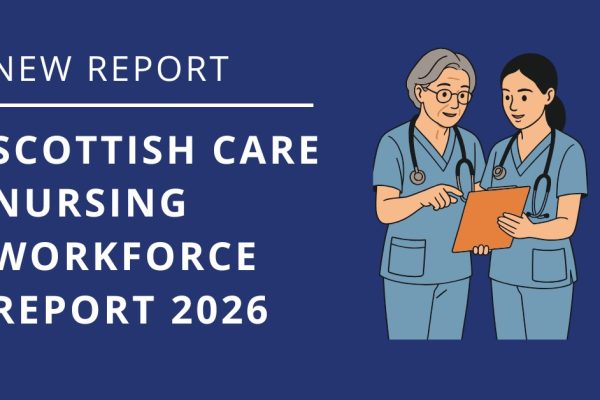
But as we do so I want to invite us to consider a category and field of nursing that is often ignored and forgotten about – at least in Scotland – namely the contribution of the social care nurse.
They are the nurses who work not in the flashing urgency of emergency rooms, but in the quieter spaces of social care – in care homes, in communities, in the places where people live their last, their first, their everyday moments.
This is a nurse whose workplace is not always a ward but a lounge, a kitchen, a bedroom – places filled with the memories and belongings of a life.
The nurse who knows that caring is not an event or a shift but a relationship woven through countless small encounters, each one layered with trust, vulnerability, and human connection.
Social care nursing as I have written and said on many occasions is distinctive. Often, we struggle to identify that distinctiveness but for ease of argument and at risk of simplification – for me social care nursing is distinctive because of the unique emphasis on human relationships at its heart.
Social care nursing is about profound relationships rather than an encounter. It is about relationships – built carefully, patiently, respectfully over time. It is about becoming known to another human being, and knowing them not just in their illness, but in their fullness: their fears and frailties, yes, but also their laughter, their dreams, their stubborn determination.
It is not about quick fixes or hurried interventions.
It is about presence. It is about patience.
It is about bearing witness to the slow dance of ageing, the gradual progression of dementia, the complexity of lives shaped by trauma, disability, or chronic illness.
Social care nurses are not simply providers of treatment; they are companions of the soul.
They are fluent in the languages of silence, of sadness, of stubborn resilience.
They understand that true care is as much about what cannot be measured as about what can – the reassurance in a glance, the comfort of familiarity, the dignity in the smallest choice which is honoured.
The social care nurse does not simply visit a person; they come alongside a life.
They nurse not just the wound that can be seen, but the grief that lingers unspoken, the loneliness that hangs heavily in the air, the hope that flickers still.
Their practice is clinical excellence infused with human intimacy. Their care is scientific, certainly – but it is also relational, ethical, compassionate.
In a world that prizes speed and efficiency, social care nursing reminds us of another way: the way of deep listening, of consistent presence, of stubborn hope in the face of decline.
It is work that demands and achieves clinical excellence, yes – but also emotional courage, ethical clarity, and relational genius.
To be a nurse in social care is to be entrusted with lives at their most fragile and their most fierce.
It is to tread softly into the private worlds of others, carrying not only knowledge and skill but humility and respect.
It is to know that healing often looks like relationship, like recognition, like being truly seen.
So, when Monday comes – on International Nurses Day, let us say loudly and clearly:
Social care nurses are the beating heart of a compassionate society.
They hold the line of humanity when systems creak and strain.
They remind us that care is not about power but about partnership; not about managing lives but about valuing them.
In social care, nursing is a long walk alongside another’s humanity. It demands more than technical skill: it demands courage, patience, emotional intelligence, moral resilience. It demands the willingness to stay, when staying is hard; to listen, when words are few; to hope, when days are short.
To every nurse working in social care – in care homes, in community supports, in supported living, in day services – thank you.
Thank you for your patience when the world rushes.
Thank you for your courage when others turn away.
Thank you for the relationships you nurture, the rights you uphold, the dignity you protect.
Thank you that you continue despite the strain and stress, the under-resourcing and inadequacy of funding.
You show us, every day, what it means to be truly human.
You are more than nurses; you are guardians of relationship, stewards of trust, ambassadors of love.
Today, and every day, we honour you.
Happy International Nurses Day 2025.
Donald Macaskill