Scottish Care responds to Scottish Budget

Scottish Care: “This Budget Fails the People Who Rely on Social Care Support – and Those Who Deliver It”

Scottish Care, the national body representing Scotland’s independent social care support sector has today issued a stark warning that the Scottish Government’s Budget falls dramatically short of what is required to protect essential care and support services, the workforce that delivers them, and most importantly, the individuals, families and communities who rely on them.

Despite warm words about fairness, wellbeing and investment, this Budget fails to deliver on Scottish Care’s Three Key Asks:

  • Increase Core Funding for Social Care Support
  • Invest in Scotland’s Social Care Support Professionals
  • Invest in Ethical Technology, Digital and Data Across Health and Social Care Support

“This is a budget that talks about dignity but does not fund it.” 

Social care support is essential national infrastructure. Yet once again, it is treated as an afterthought, ironically overshadowed by headline NHS commitments when we know that it is investment in social care which will relieve pressure on our health service, and absent the targeted investment required to prevent further collapse across a fragile sector.

The Government has not met our echo for COSLA’s call for an additional £750 million in core funding to stabilise and grow social care support. Instead, providers face another year of delivering more with less, absorbing costs they cannot sustain, and trying to shield the people they support and employ from the consequences of an under‑resourced system.

Every pound invested in social care support returns more than double in socio‑economic value, strengthening local economies, enabling people to live well in their communities, and driving growth in the many women‑led small businesses that form the backbone of our sector. Yet this Budget chooses not to unlock those benefits for Scotland.

1. Core Funding: “A glaring and dangerous omission.” 

The Budget does not provide the robust, long‑term financial commitment required to secure the future of social care support. There is no ring‑fenced protection for social care support, no alignment to the true cost of care, and no meaningful relief from devastating employer cost pressures, which have already forced closures in the sector.

Providers today are operating in crisis conditions. Without urgent core investment, Scotland will see further reductions in care packages, growing unmet need, and avoidable pressure across the entire health and social care support system.

2. The Workforce: “Warm words will not pay the bills.” 

Scotland’s social care support workforce is the heart of community care, yet this Budget does not offer the fair pay, fair work and fair treatment required to recruit and retain staff in a sector with 13,000 vacancies.

A Real Living Wage uplift is welcome but insufficient. Without funded pay differentials, career pathways, wellbeing investment and ethical commissioning, providers cannot deliver the conditions staff deserve. Care workers will continue to leave for roles with better pay, lower responsibility and clearer progression, and supported people will continue to bear the consequences.

3. Technology, Data and Ethical Innovation: “A decade behind before we even begin.” 

While the Government talks of modernisation, the reality for social care support is stark: the sector remains years behind in digital access, infrastructure and investment.

Scottish Care has repeatedly highlighted that the person‑held digital app for health and social care will not be ready ‘social care-ready’ until 2029, an unacceptable delay that entrenches inefficiency, increases costs and holds back innovation.

Every £1 invested in ethical digital care roles returns up to £8 in social value – yet this Budget provides no strategic investment to unlock that future.

Scotland cannot build a modern, rights‑based care system on outdated digital foundations.

“This Budget does not meet the moment.” 

At a time when people are waiting for support, when providers are closing, and when workforce shortages are at crisis levels, this Budget needed to be bold. Instead, it offers incrementalism in the face of escalating need.

This is not simply a missed opportunity; it is a decision which put the system before the people of Scotland. It means fewer people receiving the care they are entitled to. It means greater pressure on unpaid carers, many of whom are already at breaking point. It means continued instability for providers and thousands of dedicated workers.

Scottish Care calls for urgent reconsideration.

We urge the Scottish Government to revisit its spending plans and to recognise that investing in social care support is not a cost, it is a national dividend. Care creates stability. Care creates opportunity. Care creates Scotland’s future.

Until core funding, workforce investment and ethical digital transformation are fully resourced, Scotland will continue to struggle, and those who rely on care support will continue to be failed.

Scottish Care stands ready to work with Ministers, Parliament and partners across the sector to deliver the bold, rights‑based reform Scotland needs and deserves.

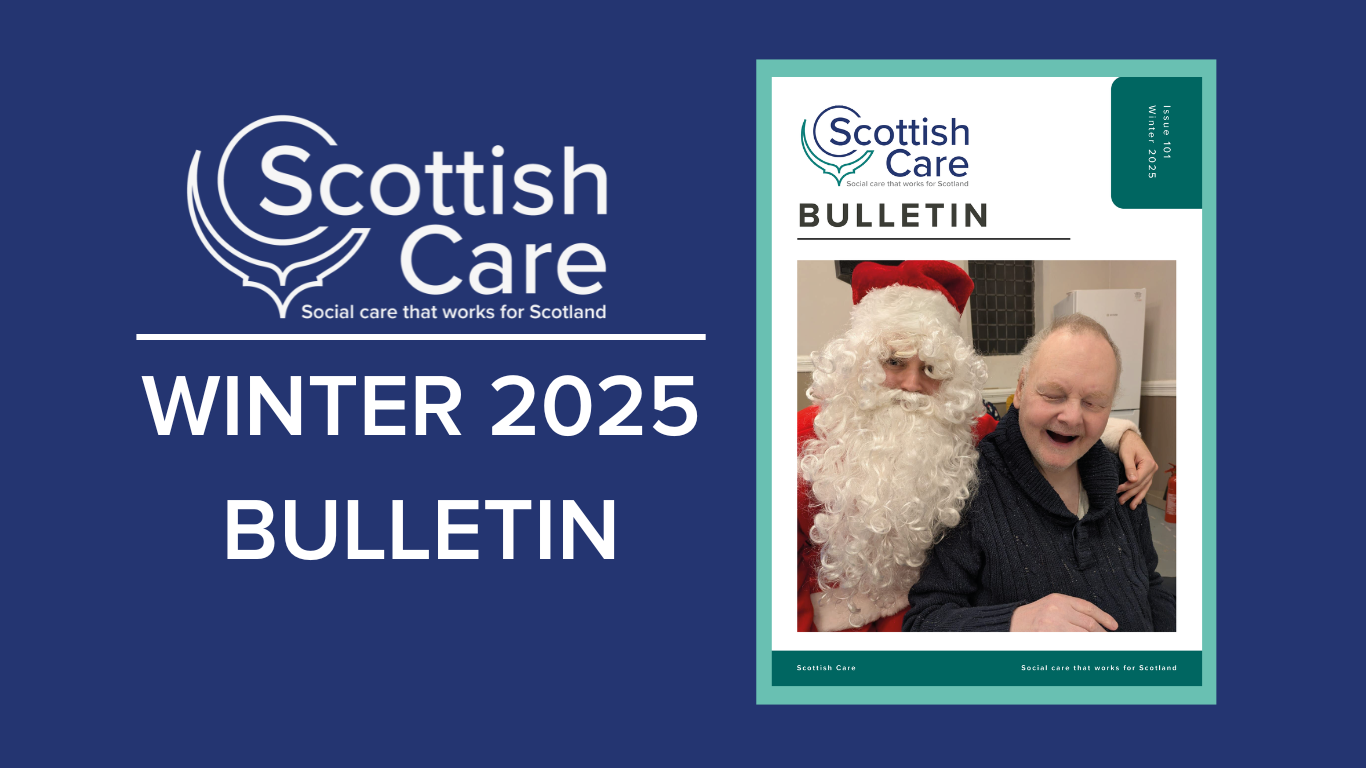
Winter Bulletin 2025

We’re delighted to announce that the 2025 Winter Bulletin is now live!

Packed with valuable updates, inspiring stories and sector highlights, this edition celebrates the creativity and resilience of our care community.

Don’t miss the festive feature on pages 24–29, showcasing heart-warming stories and activities shared by our members. A huge thank you to everyone who contributed to making this bulletin truly special!

We’d love to hear your thoughts. If you have feedback or ideas for future editions, please email us at [email protected].

Read the Winter Bulletin here

Scottish Care’s Key Asks for the Scottish Budget

Investing in Social Care: Three Key Asks for the Scottish Budget

Scotland’s future depends on strong, person-led social care. As the Scottish Budget approaches, we are urging for investment that delivers dignity, choice and control for individuals, while strengthening communities and local economies.

Social care is not a cost, it is critical infrastructure. Every pound invested in care generates more than double in socio-economic value, creating jobs, improving health equity and supporting the many women-led small enterprises that define our sector. With over 13,000 vacancies, investment also means thousands of new opportunities for people to make a real difference every day.

Our Three Key Asks for the Scottish Budget are clear, practical and evidence-led:

1. Increase Core Funding for Social Care Support
2. Invest in Our Social Care Professionals
3. Invest in Ethical Technology, Digital and Data

Why this matters for Scotland

Investing in social care is investing in Scotland’s future:

  • Stronger communities and social justice
  • Local economic growth and job creation
  • Better health outcomes and reduced inequalities
  • A sustainable, person-led care system that leaves no one behind

Read our Scottish Budget Asks here

Scottish Care Manifesto – Care Creates… 

Introducing the Scottish Care Manifesto –  Care Creates…

Care Creates… is our invitation to Scotland to view adult social care support through a lens of opportunity. The Scottish Care Manifesto sets out a practical, hopeful roadmap for a system that places dignity, independence and wellbeing at its heart and recognises social care support as essential public infrastructure that enables people and communities to thrive.

The manifesto is built around six opportunities:

  • Rights at the heart of social care support
  • Fair pay, fair work, fair care
  • Integration
  • Future‑ready care
  • Investing in care like it matters
  • Care that cares for the people and planet

We are calling for decisive action, bold investment and ethical commissioning to make social care support valued, visible, viable and visionary across Scotland.

This agenda aligns with the our wider reframing work to move the public conversation beyond crisis, emphasising interdependence, fairness and wellbeing and showing how social care support creates the foundations of a fairer, healthier Scotland.

Care Creates… opportunity – for people, for communities, for Scotland.
It creates rights upheld, skilled jobs, collaboration and trust, digital empowerment, investment with impact, and climate‑conscious care.

It creates a system that matters, and a future we can build together.

Download the manifesto here

Scottish Care Manifesto 2025

Scottish Care Media Statement on Flu and Winter Restrictions

As we enter the winter months, we are seeing a growing number of health boards across Scotland reintroducing restrictions on visiting and increasing the use of masks in hospitals and healthcare settings. While these measures are intended to protect vulnerable individuals during periods of heightened respiratory illness, it is vital that we do not repeat the mistakes of the Covid-19 pandemic in our care homes.

Care homes are not hospitals. They are the homes of those who live there, and the rights of residents must remain paramount. Anne’s Law, now enshrined in legislation, guarantees that people living in care homes have the right to maintain meaningful contact with those who matter most to them. This is not optional – it is a legal and moral obligation. Any restrictions must be proportionate, time-limited, and based on clear public health evidence.

We also need to remember the lessons of the pandemic about communication and human connection. Masks, while useful in certain clinical contexts, can significantly impair communication, especially for people living with dementia, hearing loss, or cognitive impairment. The ability to see a familiar face, to read lips, and to share a smile is not a luxury; it is central to dignity and wellbeing. Therefore, the use of masks in care homes should be limited to situations of genuine infection risk.

Scottish Care urges all health protection teams, and policymakers to uphold the principles of human rights, person-led care, and proportionality when they are advising care homes. We must protect against infection, but we must also protect against isolation, loneliness, and the erosion of fundamental rights. Our commitment is clear: care homes are places of life and love, not lockdown.

Upcoming Webinars: Care Inspectorate Powers under the Care Reform (Scotland) Act 2025

Following our recent briefing on the implementation of new Care Inspectorate powers, the Scottish Government has scheduled two webinars for CCPS and Scottish Care members.

These sessions will provide:

  • Further detail on the proposed policy and when it may be applied.
  • An opportunity for members to share feedback and ask questions.

Webinar Dates & Links

Tuesday 2 December, 15:00 – 16:00
Join the meeting here

Wednesday 3 December, 11:00 – 12:00
Join the meeting here

We encourage as many members as possible to attend. If you are unable to join, we would still welcome your feedback via email to: : [email protected]

Media Statement: Scottish Care Responds to Covid Inquiry Module 2

Scottish Care welcomes the publication of the latest findings of the Covid Inquiry Module 2 report which covered political decision making during the pandemic.

Prof Donald Macaskill, who gave evidence during this Module commented:

“The publication of the Covid Inquiry’s Module 2 report into political decision making during the pandemic has found that the government did ‘too little, too late’.

We note that it indicated that there was a lack of coordination between the different UK administrations and that this harmed the overall response and risked mistrust amongst the population.

Of considerable concern is its assertion that older people and disabled people were not adequately considered in pandemic planning or decision making.

We note that the Report found that there was a disturbing lack of understanding about the reality of social care provision amongst those who are taking critical decisions.

We further agree with the Report that in the future it is fundamental that those who are delivering social care services at the frontline should be intimately involved in decision-making. Regretfully as far as we can see this has still not become reality in any current planning and preparedness.

Whilst we look forward to the findings of Module Six which are specific to social care, we note that this report highlights the lack of both appreciation of and sensitivity to the particular needs of care home residents and those who were living with conditions such as dementia.

We very much appreciate and recognise the Report’s recommendations that the wider non-physiological impacts of protective measures should be better understood not least as they impact on particular populations such as those living with dementia. We concur with the Report’s assessment that this lack of awareness and sensitivity introduced measures into Guidance which meant that the lives of older people in particular were so negatively impacted.”


Media Statement: Scottish Care Warns Immigration Proposals Threaten Scotland’s Care Sector

Scottish Care is deeply concerned by the Home Secretary’s proposals to extend the qualifying period for settlement for legal migrants, particularly the increase from five to fifteen years for those on health and social care visas. These changes will have a profoundly negative impact on the sustainability and quality of care and support services across Scotland.

Scotland’s care sector is already facing acute workforce shortages, with international colleagues playing a vital role in supporting older and vulnerable citizens. Forcing dedicated care workers to wait up to fifteen years for settlement, and tying their future to restrictive criteria, will deter much-needed talent from staying in Scotland and undermine the sense of security and belonging for all those already here. It is further deeply insulting to the professionalism of care organisations for those who do equivalent jobs as nurses and carers in the NHS to be treated so much better.

Such measures risk destabilising care provision, increasing turnover, and placing additional strain on already stretched services. Their impact especially in Scotland’s remote and rural communities is incalculable.

They also send a damaging message that the invaluable contributions of migrant care workers are not fully recognised or valued. Scottish Care urges the UK Government to reconsider these proposals and to work with devolved administrations to ensure immigration policy supports, rather than hinders, the future of care in Scotland.

We also urgently need Scottish Labour to come to challenge these proposals because they are insensitive to Scotland’s distinct needs and are a fundamental threat to our social care and health systems.


Autumn Bulletin 2025

This Year’s Autumn Bulletin is Here!

Our latest edition is now available online, packed with insightful updates, valuable information, and inspiring stories from across the social care sector.

We’d love to hear your thoughts! Share your feedback or suggest topics for future issues by contacting us at [email protected].

Read the bulletin here

Anne’s Law Consultation Survey

Consultation survey on Anne’s Law (The Care Home Services (Visits to and by Residents) (Scotland) Regulations 2026)

Background

Following the experiences of care home residents during the COVID-19 pandemic, Scottish Ministers committed to making a law to ensure that people living in adult care homes can stay connected with their loved ones. That law is known as Anne’s Law, in memory of Anne Duke, and was enacted in July 2025 as part of the Care Reform (Scotland) Act. This law requires regulations and a code of practice to guide how it will work in practice. The regulations will tell care home providers what their new duties and responsibilities are.

The survey

The Scottish Government would like your feedback on the draft regulations to make sure these are clear and practical. The survey is open to everyone. It will be particularly relevant for care home providers, staff, care home residents and their family and friends, and professionals working in the social care sector. The survey presents the draft regulations and asks you questions about them. Some of the wording of the regulations is based on the Care Reform (Scotland) Act and cannot be changed but where things are unclear further explanations and examples can be included in the code of practice.

Here is the link: Anne’s Law Regulations Survey

On average, the survey will take around 20 minutes to complete and will close on Friday 17 October.

If you have any questions relating to the survey please get in touch via the following e-mail address: [email protected].

Easy Read

An Easy Read explanation document has been produced to accompany the survey. This is to support people who have a learning disability or other condition affecting how they process information, or just need a bit of extra support to access the survey. It can be used by carers or family and friends to help individuals to share their views. Please contact the email above if you would like a copy of the Easy Read explanation document or if you require any additional support in completing the survey.