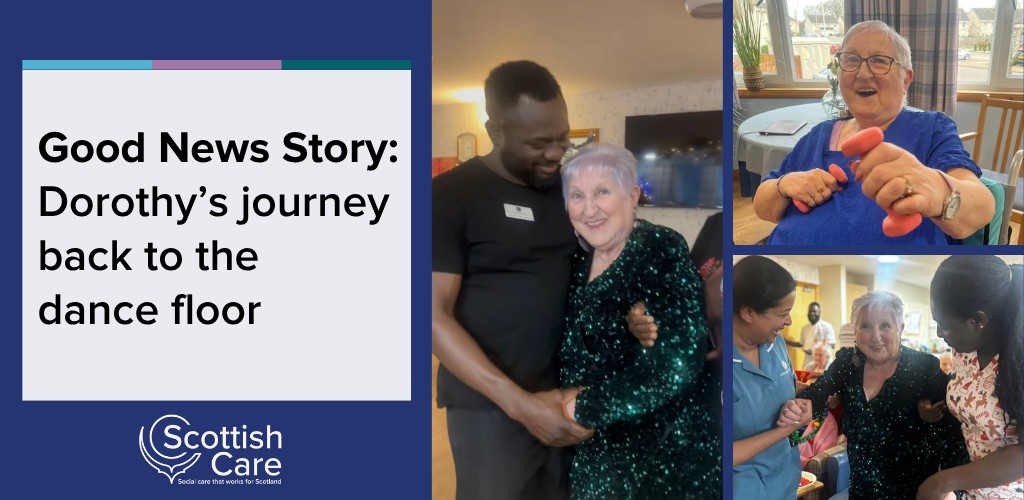
When Dorothy Lord suffered a stroke, it severely weakened her left side and affected her mobility; overnight, she could no longer walk unaided or indulge her lifelong passion for dance.
But the 82-year-old is determined to get back on her feet and back on the dance floor.
Dorothy’s goal is to regain her mobility, with her sights firmly set on dancing with little or no support at the annual Christmas party at Renaissance Care’s Jesmond Home, where she has lived since January 2025.
In addition to conventional physiotherapy, Dorothy believes that danceSing, a unique programme combining dance and music to improve mobility, confidence and independence, is playing a huge role in her road to recovery.
“I enjoy the music, it makes my physio sessions much more enjoyable,” says Dorothy. “It’s helping me to move more, to build strength and I feel good after doing the sessions.”
Dorothy is just one of dozens of residents across Renaissance Care’s portfolio of homes who are using danceSing to move more, connect with others and enjoy the things they love.
The partnership began in 2022 and offers an award-winning, evidence-informed suite of digital wellbeing resources via an online platform, with residents able to access movement, strength and mobility sessions, group sing-alongs, concerts, mindfulness and relaxation activities.
Designed to be inclusive and dementia-friendly, danceSing makes it easy for people of different abilities and levels of mobility to take part.
Sessions can be adapted for those who are chair-based, living with cognitive impairment or simply looking to become more active and engaged.
For group song-alongs, lyrics are displayed in large, easy-to-read formats, and sessions can be streamed via tablet, television or danceSing’s unique On Air radio – a physical radio with its own station focused on music and movement that is relevant to the time of day. Upbeat music can encourage gentle movement and activity in the morning, while softer, familiar tunes help residents relax and wind down in the evening.
Playlists are carefully curated using research from music therapy, neuroscience and gerontology to ensure songs are familiar, uplifting and inclusive.
Renaissance Care’s wellbeing teams are also closely involved in tailoring content that reflects residents’ preferences, from 1940s Jazz and Tea Dances to 1970s Classics.
Natalie Garry, founder and CEO of danceSing, says the power of music goes far beyond entertainment and can be a powerful tool for supporting physical, emotional, cognitive and social wellbeing.
Studies have shown that hearing well-loved music can trigger vivid memories, calm agitation, and reignite moments of recognition and connection that might otherwise seem lost.
For individuals living with dementia, familiar music can provide comfort, stimulate memories and create opportunities for connection and participation, even when other forms of communication become more difficult.
Evidence also suggests that regular engagement with music may have wider cognitive benefits in later life.
A study published last year by researchers at Monash University in Australia suggested that older adults who consistently listened to music reduced their risk of developing dementia by nearly 40 percent.
“Renaissance Care has been on the danceSing journey with us from the very beginning, and it has been wonderful to see the partnership evolve,” said Natalie.
“We know that people are living longer, but what really matters to us is healthspan, helping people to live well, with confidence, independence and a sense of purpose for as long as possible.”
Natalie explains that what makes the partnership particularly powerful is the combination of evidence and real-life impact.
“When danceSing was first implemented across Renaissance Care, there was a 34% reduction in falls, which was a fantastic outcome.
“But alongside the measurable results are the stories of people like Dorothy, who are gaining confidence, achieving personal goals, connecting with others and continuing to do more of the things that matter to them.”
And for Dorothy, that goal is wonderfully simple: to dance again.
Natalie recalls that Robert Kilgour, the CEO and founder of Renaissance Care, once said he initially thought danceSing was a ‘nice to have’, but came to realise it was a ‘must have’.
“I think that really captures what we are trying to achieve,” she added.
“Renaissance Care really embraces the philosophy of danceSing: that through joyful music and movement, strength and mobility, mindfulness, meditation and meaningful connection, we can support the whole person – physically, emotionally, cognitively and socially.
“Ultimately, it’s about helping people like Dorothy to keep doing the things that make life meaningful and, hopefully, getting her back on that dance floor.”