In January 2025, Scottish Care drew attention to the stark impact of ongoing funding pressures for the independent care at home and housing support sector, the untold stress on the sustainability of vital care providers across Scotland, and diminished access to an adequate level of person-led care. We now turn our attention to the #SocialCareCrisis facing the independent care home sector, through the significant decrease in Local Authority or Health Board placements across the country.
Scottish Care received 146 responses from our membership, overseeing the delivery of residential and/or nursing care across 403 homes in Scotland. We found:
- A total of 1,463 placement vacancies.
- 4 vacancies for every home our respondents oversee.
- 68% of these vacancies are accessible through Local Authority or Health Board placement and the subsequent National Care Home Contract (NCHC) funding model, providing an essential public service.
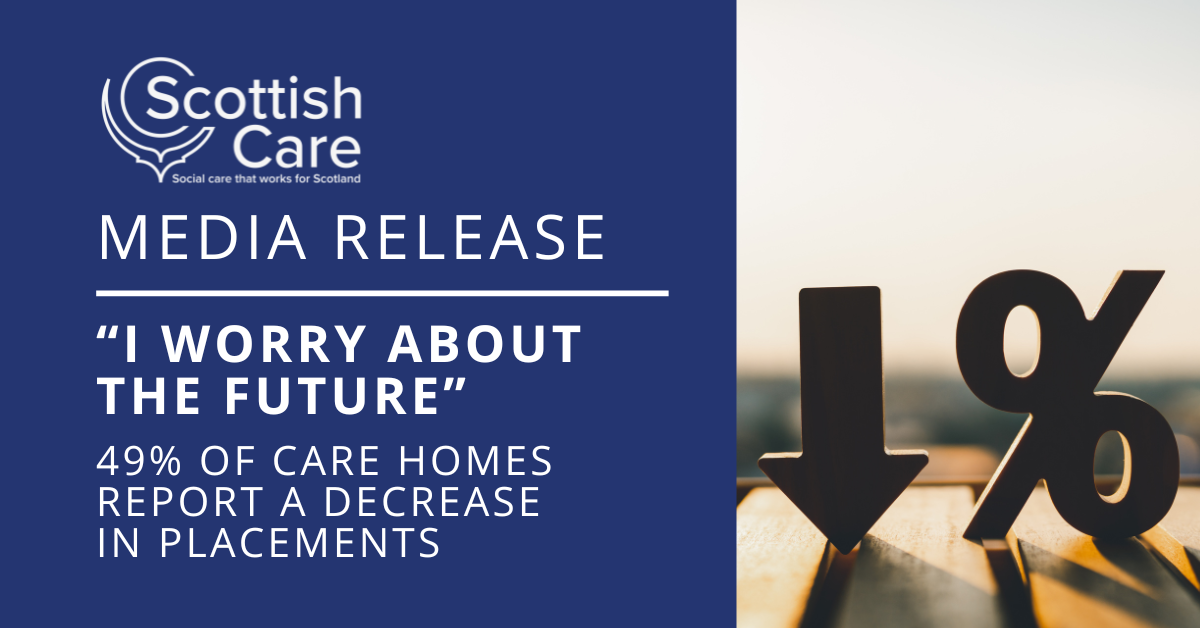
- A significant decrease in the numbers of individuals placed by the Local Authority or Health Board in care homes across Scotland compared to the same period in 2022:
- 20.0% of respondents stated that the number of placements had decreased significantly.
- 29.0% of respondents stated that the number of placements had decreased.
- 45.5% of respondents stated that placements have stayed the same.
- 6.2% of respondents stated that the number of placements had increased.
A practice of particular concern is the increased prevalence of ‘2:1’ placement policies in various localities, that Local Authority or Health Boards must recoup the equivalent money of two placements before funding the place of a new individual. Communities across Scotland should not have to wait for fellow citizens to pass away before being able to receive the care home they desire:
“Since before Christmas, there has been a big reduction in social workers seeking rooms for local authority clients. Sometimes, despite the family feeling care home is more appropriate, only homecare funding is offered”.
Such stark results highlight the unsustainability of the independent care home sector in Scotland. There has been a 18% decrease in the number of care homes for adults in Scotland over the previous decade, and without the sufficient delivery of placements by Local Authorities or Health Boards, this trend will continue. Which each closure, an individual’s choice of and control over their care and support diminishes.
Without a robust and sustainable social care sector, able to promptly place individuals requiring and choosing residential or nursing care, delayed discharge will continue to exert immense pressure on the NHS and other services. More than five million bed days have been lost to delayed discharge since March 2015, at a cost of approximately £1.5 billion.
Never has ring-fenced funding for the social care sector, to meet service demand and support efficiencies across the NHS, been more required. Such funding is notably absent from a Scottish Government budget “that kills”, a very real risk that is summarises by one survey respondent:
“Historically, we had a system aiming to do the right thing but operating poorly, taking too much time to assess and place people appropriately. Now, whether by design or just acceptance, we have a system prepared to let people deteriorate or die without the correct care to save money”.
We must address the #SocialCareCrisis in Scotland. This begins with the urgent delivery of ring-fenced funding for the adult social care sector to sustain the commissioning of placements within care homes. This is critical to safeguarding a care system that prioritises dignity and delivers high-quality, person-led care. One that looks forward to a future where those delivering or receiving care and support no longer worry about the future.
Dr Donald Macaskill, Chief Executive of Scottish Care, said:
“Scottish Care’s research demonstrates the profound social injustice of how our crises-driven care home sector operates. People are desperate to move into care homes across Scotland, not least those stuck in our hospitals, and yet local authorities are choosing or simply do not have the money to pay for their care and support. Because of this underfunding, care homes across Scotland are in crisis, and empty beds will lead to care home closures.
We need a long-term strategy which sustains the care home sector in Scotland rather than what we have at the moment, a reactive, damaging short termism. It is an indignity that we are waiting for two people to die in order for there to be money to pay for one resident.”
-Ends-