There are some losses for which language never seems quite adequate. We reach for words because silence feels impossible, yet almost as soon as we speak we discover that our words are too small for the sorrow they are being asked to carry. Suicide is one such loss.
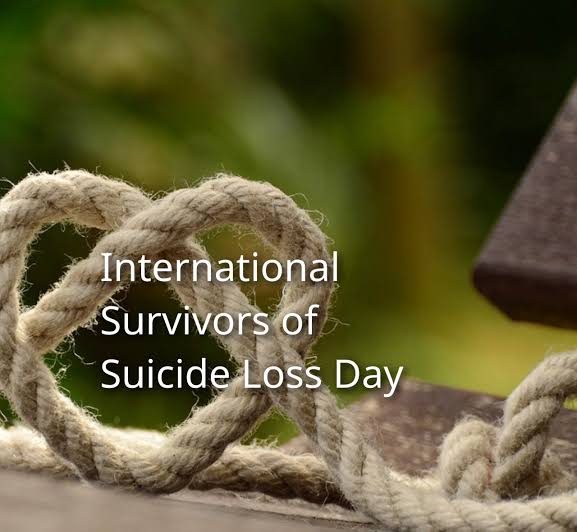
This Saturday is International Survivors of Suicide Loss Day, a day which turns our attention especially towards those who have been left behind after someone they love has died by suicide. It is a day for remembrance, but also for recognising a particular kind of grief, one that can be accompanied by questions, bewilderment, guilt, anger and the endless revisiting of moments which once seemed ordinary but which afterwards can acquire a significance nobody could have recognised at the time.
Perhaps amongst the cruellest words in the vocabulary of grief are if only.
If only I had noticed. If only I had called. If only I had asked another question. If only I had stayed longer. If only I had understood what was happening.
Those words can become cruel companions to the bereaved, returning unexpectedly in the middle of a night or in the midst of an otherwise ordinary day. Yet grief after suicide should never be made heavier by the assumption that those who loved someone should somehow have known what could not readily be seen. Human beings are complicated, and pain is remarkably skilled at disguising itself. Some of the deepest distress is carried behind laughter, competence, work, friendship and the repeated assurance that everything is fine.
Perhaps that is one reason why this day should speak not only to those who have been bereaved by suicide, but to every one of us.
It asks us to become better at noticing.
We live in a world in which we have never possessed so many ways of communicating and yet in which it is still possible for someone to feel profoundly alone. We send messages, respond with emojis, scroll through fragments of the lives of others and move rapidly from one encounter to the next. We can know what somebody ate for dinner or where they went on holiday and yet remain utterly unaware of the darkness through which they may be walking.
There is a difference between being connected and being known. There is also a difference between looking and seeing.
Those differences matter enormously in social care. At its deepest, care has always been about noticing. The good carer notices that the cup of tea has not been drunk today when yesterday it was. They notice the person who normally talks has become quiet, the smile which does not quite reach the eyes, the reluctance to leave a room, the sudden change in appetite or sleep, the apparently throwaway sentence which somehow does not feel throwaway at all.
None of these things necessarily means that somebody is contemplating suicide, and we should resist any temptation to imagine that human distress can be reduced to a checklist of signs. But they remind us of something fundamental: relationships give us the possibility of noticing change.
And noticing sometimes opens the door to conversation.
Perhaps one of the most important questions any of us can learn to ask is also amongst the simplest: Are you really okay?
And then, crucially, to create enough time for the answer. Because there is little value in asking another person how they are if our body language already tells them that we need the answer to be “fine”.
Care requires time. Friendship requires time. And yet so much about contemporary life seems designed to steal precisely that from us. We rush encounters, measure productivity, shorten conversations and turn attention into something constantly interrupted. In social care we know only too well what happens when the human encounter is squeezed by the clock. A task may still be completed, but something essential can be lost.
I have often thought that one of the most radical acts in modern life is simply to give another person our undivided attention. To sit. To listen. To resist immediately trying to solve. To allow another human being to tell us that life is not all right.
There is something else that matters today. We need to become more comfortable speaking about suicide and mental distress. Silence has never been a particularly effective form of protection. For generations we have surrounded mental illness, despair and suicide with stigma, whispering where we should have been talking and sometimes judging where we should have been listening.
Compassion asks something different of us.
It asks us to recognise that despair is not weakness and that asking for help is not failure. It reminds us that the person experiencing mental distress is not a problem to be fixed but a human being whose life possesses immeasurable value, even when they themselves may struggle to believe that.
And for those who have been bereaved through suicide, compassion means allowing grief to take the shape it needs to take rather than the shape others find easiest to accommodate.
There may be anger alongside love. There may be unanswered questions alongside precious memories. There may be laughter one day and devastation the next. There may be anniversaries which hurt and seemingly insignificant moments which suddenly overwhelm. Grief does not ask permission before entering the room.
Perhaps above everything else we need to resist defining a person’s life by the manner of their death. A human life is infinitely larger than its final moment. It is made of childhood and friendship, foolishness and generosity, arguments and reconciliations, favourite songs, unnoticed kindnesses, birthdays, bad jokes, familiar gestures and all the ordinary things through which a person became irreplaceable to those who knew them. Those are the things which deserve remembering.
There is a tendency when confronting something as painful as suicide to search for grand solutions, and of course we need services that are accessible, properly resourced and capable of responding when someone reaches crisis. But prevention also belongs in the smaller geography of human relationships.
It belongs in workplaces where it is safe to say that you are struggling. In schools where emotional wellbeing is taken seriously. In communities where loneliness is recognised rather than dismissed as an inevitable part of ageing. In friendships where silence does not become distance.
It belongs in picking up the telephone, knocking on the door, making another cup of tea, asking twice and staying for the answer.
None of those things gives us control over another person’s life, and we should never burden people with the suggestion that they alone can prevent tragedy. But they help create a society in which fewer people have to carry their pain entirely by themselves.
Perhaps the opposite of loneliness is not simply company. Perhaps it is being noticed.
Being able to say: somebody saw me today. Somebody heard what I was trying to say. Somebody noticed that the answer “I’m fine” was carrying more weight than those two little words should have been asked to bear.
As November moves towards winter and Scotland’s afternoons shorten, there is something almost instinctive about lighting lamps earlier and drawing closer to warmth. Maybe there is a lesson in that seasonal ritual. None of us can remove every darkness another person experiences, but we can leave a light on. We can become people and communities in whose presence another human being does not have to pretend.
And for those who live with the absence of someone who died by suicide, perhaps today we should simply say this: their life was more than their death; your grief deserves tenderness; your questions do not require answers in order for your love to remain real.
You remember because you loved. And love, changed painfully by absence, remains.
I want to finish not with my own words but with Naomi Shihab Nye’s poem “Making a Fist”. There is a line within it which, in its simplicity, seems to hold something of the fragility and stubbornness of being alive: “I who did not die, who am still living”
Sometimes hope need not announce itself loudly.
Sometimes it is simply the discovery that we are still here, still capable of reaching towards one another, still able to notice, still able to listen, and still able to hold another person for a little while against the darkness.
Making a Fist
By Naomi Shihab Nye
For the first time, on the road north of Tampico,
I felt the life sliding out of me,
a drum in the desert, harder and harder to hear.
I was seven, I lay in the car
watching palm trees swirl a sickening pattern past the glass.
My stomach was a melon split wide inside my skin.
“How do you know if you are going to die?”
I begged my mother.
We had been traveling for days.
With strange confidence she answered,
“When you can no longer make a fist.”
Years later I smile to think of that journey,
the borders we must cross separately,
stamped with our unanswerable woes.
I who did not die, who am still living,
still lying in the backseat behind all my questions,
clenching and opening one small hand.
Copyright Credit: Naomi Shihab Nye, “Making a Fist” from Grape Leaves: A Century of Arab American Poetry. Copyright © 1988 by University of Utah Press. Reprinted by permission of Naomi Shihab Nye.