
There is always something slightly strange about the morning after a conference and awards ceremony. The rooms have emptied, the stands have come down and conversations which only hours before seemed urgent have dispersed into journeys home, overflowing inboxes and the familiar pressures of another working day. Yet when a conference has done what it should, something remains. Not simply the presentations we have heard or the notes we have scribbled down, but the questions which have unsettled us, the encounters which have encouraged us and, occasionally, an idea which follows us out of the room and refuses to disappear.
That is certainly how I feel after our Scottish Care Care Home Conference, The Home that Care Creates. We chose that title because we wanted to do more than talk about care homes as services, organisations or parts of a system. We wanted to explore what it means to create a place that someone can genuinely call home, especially at a time when the pressures upon those who provide and work in care homes are immense.
The conference was structured around four interconnected themes: Visible, Viable, Valued and Visionary. They were about how care homes are perceived and trusted, what enables them to remain sustainable, how we recognise the expertise and relationships at the heart of good care, and what we want care homes to become in the years ahead.
Those four words seem even more important the morning after because beneath all our necessary conversations about funding, workforce, regulation, commissioning, technology, leadership and politics lies a more fundamental question: what do we actually want care to create?
For many years we have spoken about social care through the language of crisis, and that crisis is very real. Providers understand the fragility created by inadequate funding, workforce pressures, unsustainable commissioning and rising costs. Workers experience the contradiction of being told that their contribution is invaluable whilst too often working within systems which do not adequately recognise, reward or listen to them. Families struggle to navigate complexity, and those who access support too often encounter systems shaped around organisational boundaries rather than the ordinary realities of their lives.
But one of the dangers of living with crisis for such a long time is that crisis can eventually define the boundaries of our imagination. We become so occupied with stopping the present system from falling over that we lose the time and confidence to ask whether it is actually the system we would choose to create for the future.
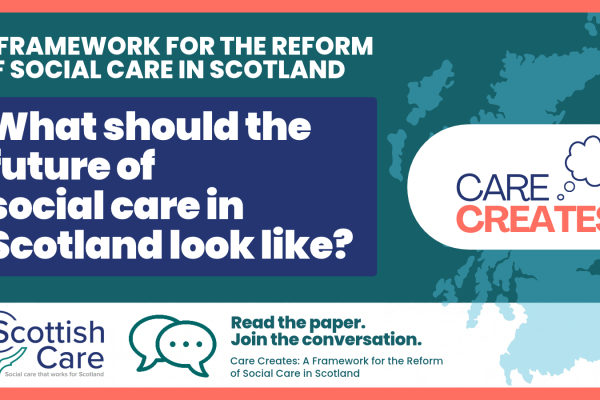
That, for me, is where the conference connects directly with the wider conversation Scottish Care has begun through Care Creates: A Framework for the Reform of Social Care in Scotland. Social care is not simply a collection of services delivered when someone becomes ill, frail, disabled or dependent upon support. At its best, it enables people to exercise choice, sustain relationships, participate in community and continue to live lives of meaning and purpose.
There is a danger that we talk about social care principally through the language of deficit: the unmet need, the vacancy, the delayed discharge, the budget gap. All of these matter, but they can obscure what care actually contributes to the life of a person and to the life of a community. Care creates time, confidence, relationship, belonging and the possibility of continuing to be oneself even when circumstances change.
So perhaps the starting question should not simply be how we repair a social care system under immense strain, but something broader and more ambitious: what sort of Scotland do we want social care to help create?
The home that care creates
Care homes make that question wonderfully concrete because a care home occupies several identities at the same time. It is a workplace, a regulated service and part of Scotland’s health and social care infrastructure. Yet for the person who lives there it is, before all those other things, their home.
And that word changes everything.
Home is not primarily a building or a service specification. It is found in the ordinary details which shape identity: the objects we keep beside us, the food we enjoy, the people whose company we seek, the music we listen to, the memories we carry and the rhythms and rituals which make a day recognisably our own. A care home is therefore not simply somewhere in which care is delivered. At its best it is where friendships are formed, birthdays celebrated, disagreements happen, families gather, grief is shared and laughter unexpectedly breaks through. It is a place in which the ordinary messiness of human life should be allowed to continue.
The language we use matters because it shapes the systems we create. Beds, capacity, dependency, acuity and flow may matter to organisations, but they are not the language of home. When we begin instead with the person who lives there, the measure of success becomes whether they are still able to be themselves, make choices, retain relationships, experience privacy and intimacy, take reasonable risks, contribute as well as receive, and remain connected to the communities and identities which have shaped their life.
A care home should never become simply the place a system sends someone when other options are exhausted. It should be capable of being a place of continuing life, new relationships and fresh experience, as well as safety and skilled support.
Reform has to be bigger than structures
Scotland is once more debating the organisation and future of social care, and structures undoubtedly matter. Governance, accountability, responsibility and where money and decisions sit can profoundly influence people’s lives.
But we should surely have learned by now that drawing a different organisational chart will not, on its own, transform the experience of the person waiting for support, the worker trying to offer compassionate care, or the provider struggling to plan beyond the next financial year.
That is why Care Creates deliberately asks two questions. First, what must improve regardless of the organisational model Scotland ultimately chooses? And second, where should responsibility sit if those improvements are to become sustainable rather than another collection of promises vulnerable to political and organisational change?
The models we have explored are not finished Scottish Care recommendations. They are intended to encourage a more honest discussion about the choices available and the principles against which any future model should be judged.
That distinction is important. Reform too easily becomes preoccupied with where social care sits when the much more important question is what social care enables.
There is little point creating a new architecture for social care if the foundations remain the same: short-term funding, transactional commissioning, unequal partnership and a workforce whose skill is praised publicly but too often undervalued in practice. Reform must ultimately be experienced at the level of the person receiving support and the person providing it. Otherwise, we risk changing the machinery whilst leaving the reality untouched.
Seen through that lens, the four themes of the conference offer a test for the wider social care system we want to create. Social care must be visible as a foundation of everyday life and community; viable, so organisations can sustain, invest and innovate; valued, through the pay, conditions, autonomy and respect afforded to the workforce; and visionary, because maintaining an increasingly fragile version of the present cannot be Scotland’s ambition for the future.
These themes are inseparable. We cannot create visionary care without a viable sector, sustain a workforce unless people feel valued, or secure the priority social care deserves while so much of its contribution remains invisible.
Yet care is ultimately created in relationships: in the worker arriving at someone’s door on a dark winter morning; the nurse who notices an almost imperceptible change; the cook who remembers how someone likes their breakfast; the manager sitting beside a frightened or grieving family; and the colleague who stays a few minutes longer because another person simply needs them.
The challenge for reform is to create the conditions in which such humanitybecomes the norm, rather than something achieved despite the system.
I hope the next stage of Care Creates becomes a genuinely national conversation rather than another policy debate amongst familiar organisations. I understand those who want Scottish Care to choose one model now, but Scotland has too often rushed towards answers before agreeing the questions by which those answers should be judged.
We need a conversation involving people who draw upon care and support, families, frontline workers, providers, communities, commissioners, health and local government, academics and politicians. Whatever emerges should strengthen human rights and voice, sustain providers, properly recognise the workforce, reflect Scotland’s diverse communities and ensure technology enhances rather than diminishes human relationship.
But reform must also leave room for imagination. Social care is not simply there to support another part of the system. Its purpose is rooted in citizenship, belonging and our ability to exercise choice and control over our lives.
Ultimately, Care Creates asks whether reform can create greater possibility, independence, connection and participation. Care does not represent the failure of independence. It helps make independence possible, sustaining family, community, identity and belonging when circumstances change.
Yesterday we thought about the home that care creates. The morning after, I find myself wondering whether our challenge is larger still:
What might the Scotland that care creates look like?
That feels to me like a conversation worth having. And perhaps, rather than beginning yet another chapter in the long story of how we rescue social care from crisis, it might be a much more hopeful place from which to begin imagining its deeper, richer future.